

After several years without irrigation when it was needed, water is reaching the Ganges-Kobadak (GK) irrigation project right at the start of the season this time. In Kushtia district alone 11,000 hectares will get irrigation, and farmers in neighbouring Chuadanga will benefit too. Farmers' Boro costs will fall by at least Tk 3,000 to 4,000 a bigha, and they are delighted.
Farmers and government offices say Boro will be grown on at least 11,000 hectares of Kushtia with GK water this time. If they get canal water for about a month, they will save Tk 3,000-4,000 a bigha; if the water lasts the whole season, their costs will fall much further. Onions and several other crops in the fields will also benefit.
Because of the water shortage in the Padma and broken GK pumps, farmers had not been getting water properly for the past two or three seasons. Last year water came at the tail end of the season and did them no good. Getting it early this year has brought relief.
Akkas Ali, a farmer of Shimulia village in Kushtia Sadar upazila, said: "We had assumed we would not get GK water and planted our seedlings on that basis. Now GK water has become an extra bonus for us."
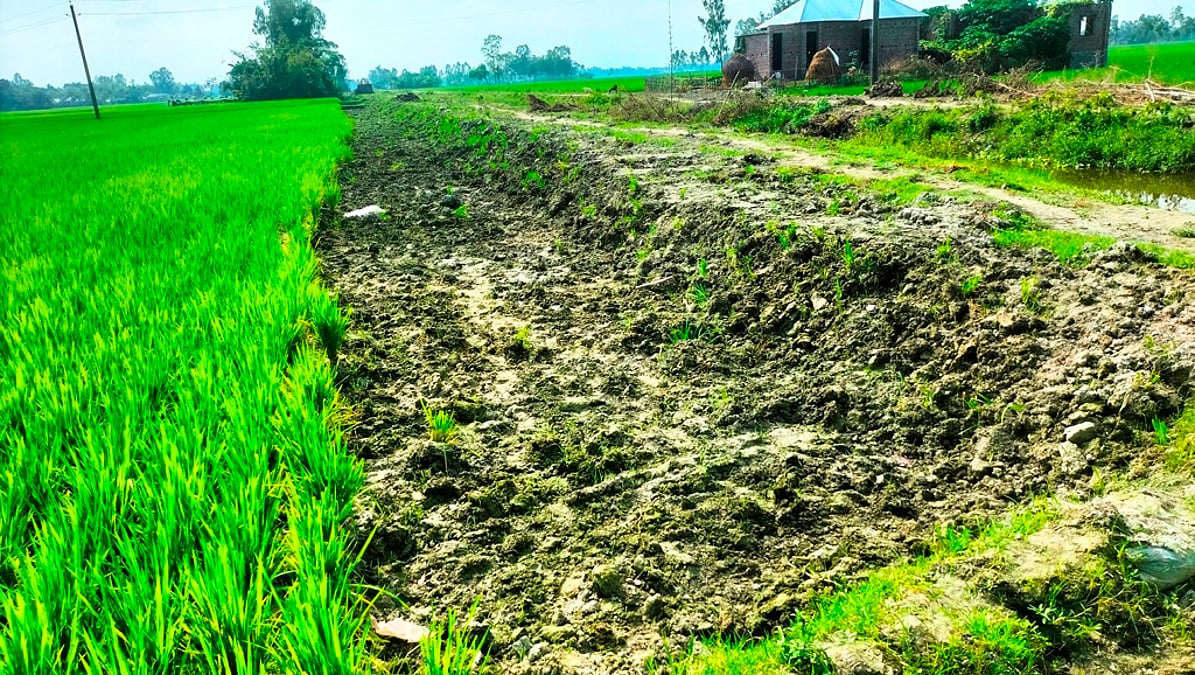
Other farmers said that even land the canal water will not reach will benefit indirectly. The water table in their area has dropped sharply over the past two or three seasons, so shallow engines do not draw water properly. With water in the canals, they will not face that problem this time.
Officials on the season
Sufi Md Rafiquzzaman, deputy director of the Department of Agricultural Extension (DAE) in Kushtia, said farmers would make a good profit growing rice with this water, since irrigation is their biggest cost in the Boro season. Other crops would benefit too, but those who plant Aus rice would gain the most. Farmers will start Aus seedbeds after the 15th of this month, and transplanting will begin 20-25 days later.
He said the district's Boro target this year was 36,464 hectares, while the crop was planted on 35,996 hectares.
Safayet Hossain Poltu, president of the GK Irrigation Management Federation, said that because no water was supplied to the canals last year there were many problems and much land lay fallow. If irrigation is kept running, crop output will rise and the environment will be protected.
The state of the pumps
Mizanur Rahman, pump in-charge of the GK project at Bheramara in Kushtia, said water supply to the GK canal began on 6 March with one working pump. Work is under way to get another pump running, which is expected to supply the canal within this month. The third pump, however, is completely out of order and cannot be repaired.
He said three large pumps were brought from a Japanese company and installed in 2009. Two of them broke down last year, and the other had to be shut during last year's Boro season for lack of water. Japanese engineers inspected them after being contacted. Some parts have already arrived and the rest have reached the port.
The water level of the Padma at the Bheramara point is 4.40 metres, he said, and water can be supplied down to 4.20 metres; below that there will be no choice but to stop. With all three pumps running, 3,900 cusecs can be delivered to farmland; one pump gives about 1,300 cusecs. Although the project covers four districts, the authorities are mainly able to supply water to Kushtia and Chuadanga in the Boro season.
Rashidur Rahman, executive engineer of the Bangladesh Water Development Board in Kushtia, said the GK canals stretch across four districts. A Tk 1,400 crore project has been taken up to modernise the GK pump house and repair the canals, and the present government has advised trimming it to Tk 1,300 crore. Under the project two large and five small pumps will be installed, the canals repaired and trees planted. Once the new pumps are installed, supply will continue even if the Padma falls below three centimetres.
According to sources, the main pump house began operating in 1959. The GK irrigation project was launched in 1962-63 with an initial aim of irrigating 197,500 hectares, when the cultivable cropland was 116,600 hectares. As pump capacity fell, the area shrank to 95,616 hectares. At first the three pumps could lift water 24 hours a day for 10 months a year (15 January to 15 October), with the other two months set aside for maintenance. With all three pumps running, water can be supplied to 193 km of main canals, 467 km of branch canals and 995 km of secondary canals in the four districts.
Source: Jagonews24. First published in Bengali on The Agro News.

Comments
(0)