
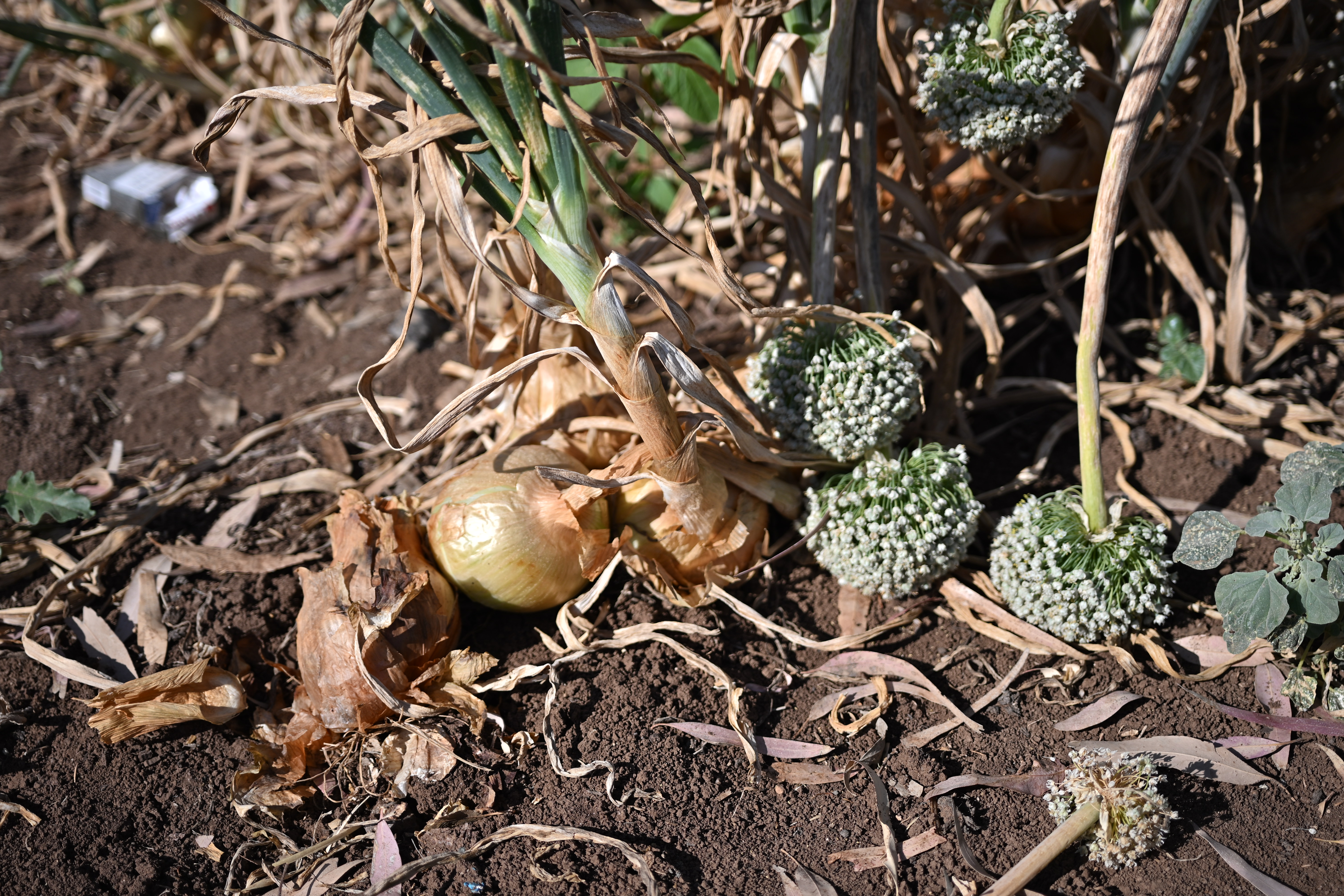
Onion seed was being grown in Kurigram for the first time in the 2025-26 season, a step that farmers in the northern district hoped would open a new source of income, Jagonews24 reported on 10 April 2026. Kurigram has long depended on rice and potatoes. The first seed plot belonged to Rasel Ahmed, a farmer of Chhatmadhai village in Sadar union of Rajarhat upazila, who had planted the crop in December 2025 and hoped to collect the seed in April 2026 if the weather stayed favourable.
According to the report, Rasel Ahmed had grown conventional crops for a long time without making the profit he wanted, and had started looking for another way to earn. That search led him to try seed production for the first time that season, using an onion variety the report calls polycross. He planted it on about 60 decimals of land in December, and by early April the plants in his field were healthy and strong.
The district's agriculture department told the newspaper that this was the first initiative to produce onion seed in Kurigram. Until then, farmers in the district had to bring in seed from outside, mainly from the Faridpur region in central Bangladesh. If seed were produced locally, the department said, production costs would fall and farmers' profits would rise.
Work for local labourers and a farmer's hopes
The seed plot created work in the village. Local men and women worked there every day, according to the report, and were paid daily wages of Tk 300 to Tk 500.
Rasel Ahmed told Jagonews24: "I started onion seed production from a different way of thinking. If the yield is good, I plan to do it on a larger scale in future. Looking at the plants now, I am hopeful. Unless there is a major natural disaster, I expect a good profit." The profit was his expectation at the time; the report gave no figure for his costs or for the seed he expected to harvest.
The risks he mentioned are familiar to seed growers elsewhere in the country. In Faridpur, the main onion seed district, a labourer told The Business Standard in March 2026 that low rainfall that season had actually benefited seed quality, a reminder that weather at flowering and harvest decides much of a seed crop's value. Growers there also spend heavily on hired hands, because many flowers now have to be pollinated by hand.
What Kurigram's agriculture office said
Abdullah Al Mamun, deputy director of the Department of Agricultural Extension (DAE) in Kurigram, told the newspaper: "Onion is an important cash crop in the country. The soil and weather of Kurigram are suitable for this crop. The agriculture department is giving interested farmers the technical support and advice they need."
The DAE is the government's farm advisory service under the Ministry of Agriculture, with offices in every district and upazila. Its Kurigram office did not give a figure for how much seed the district's onion growers used each year or how much they spent on it. For farmers thinking of following Rasel Ahmed, the practical point in the deputy director's words is that technical advice was on offer: the choice of variety, the timing of planting and the control of pests and diseases in a seed crop are questions for the upazila agriculture officer.
Kurigram and Rajarhat: farming country on big rivers
Kurigram, in Rangpur division, covers 2,245.04 square kilometres in the far north of Bangladesh, according to Banglapedia, the national encyclopedia. It borders the Indian state of West Bengal on the north and part of the west, Assam on the east, Gaibandha and Jamalpur districts on the south, and Rangpur and Lalmonirhat districts on the west. Its main rivers are the Brahmaputra, the Jamuna, the Dharla, the Dudhkumar, the Tista and the Zinzira. The Kurigram subdivision was formed in 1874 and became a district in 1984, and it has nine upazilas, of which Ulipur is the largest and Char Rajibpur the smallest.
The 2011 census, as Banglapedia reports it, counted 2,069,273 people in the district. Farming was the main source of income for 70.41 per cent of households, far ahead of commerce at 9.45 per cent. The average literacy rate was 42.5 per cent.
Rajarhat upazila, where the seed plot stands, covers 166.64 square kilometres. It lies between Phulbari and Lalmonirhat Sadar upazilas to the north, Ulipur and Pirgachha to the south, Kurigram Sadar to the east, and Lalmonirhat Sadar and Kaunia to the west. Its rivers are the Dharla and the Tista, and Sarala Beel, Chakirpashar Beel and Gharialdanga Beel are its notable wetlands. Rajarhat thana was formed in 1981 and became an upazila on 14 September 1983. The 2011 census counted 182,981 people there.
Banglapedia's profile of the upazila shows how much it depends on the land and how little many of its people own. Agriculture was the main source of income for 70.32 per cent of households, while 46.36 per cent of households were landless. The main crops were paddy, jute, maize, wheat, lentil, potato, vegetables, peanut and bamboo, and the main goods sent out of the upazila were paddy, jute, potato, betel nut and vegetables. Onion does not appear on either list, which is why the agriculture office described Rasel Ahmed's seed crop as a first for the district.
How an onion plant makes seed
The onion, Allium cepa, is a bulbous herb whose edible bulb is made of food-storage leaves, Banglapedia explains; its sharp taste comes from a volatile oil, allyl-propyl disulphide. The same encyclopedia notes that onions grow on all types of soil in Bangladesh, that the usual time for transplanting is December or the first week of January, and that Tahirpur and Faridpuri are two important local varieties, alongside BARI Piaj-1 from the Bangladesh Agricultural Research Institute.
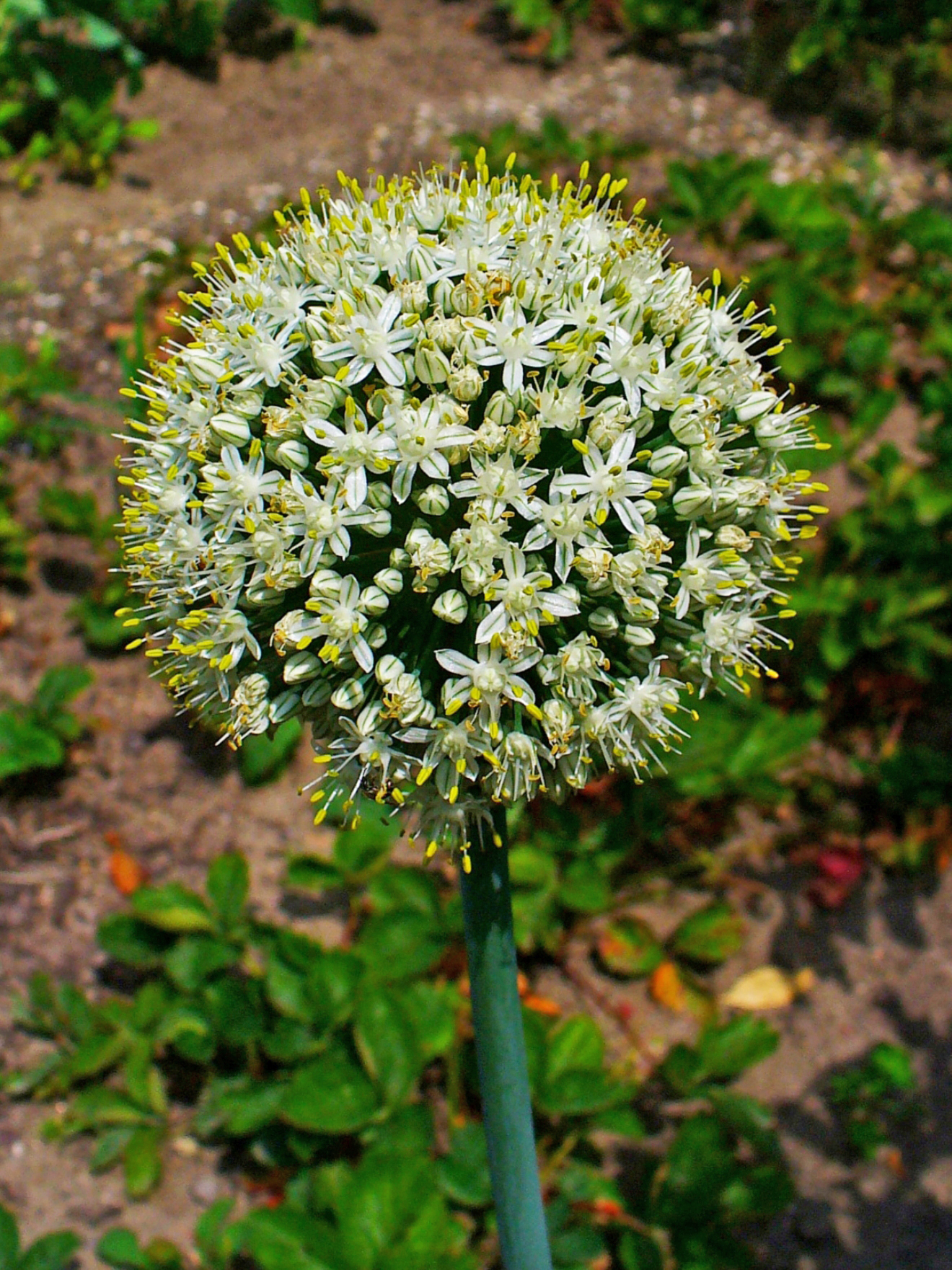
A bulb crop and a seed crop are two stages of the same plant. The onion is a biennial that farmers usually grow as an annual and harvest in its first season, Wikipedia's botanical description says. If a bulb is kept and replanted, the growing point in its centre produces new leaves and a long, stout, hollow stalk topped by a rounded umbel of white flowers. The seeds that form in the umbel are glossy black and triangular in cross-section. Onion seeds are short-lived, so fresh seed germinates better than old seed.
Seed growers therefore start from selected bulbs rather than from seed. Tamil Nadu Agricultural University in India, in its guidance on quality seed production of the large Bellary onion, describes the method step by step for Indian conditions:
- Bulbs are first grown and harvested in the usual way, and medium bulbs of about 40 to 50 grams, or of a set diameter, are selected as seed bulbs.
- The top third of each selected bulb is cut off and the bulb is treated against fungal disease before planting.
- The seed bulbs are planted on ridges in October and November, at a spacing of 50 by 20 centimetres.
- The seed heads are harvested in March, when about half of the seeds in the umbels have turned black, so that seed is not lost by shattering.
- The heads are dried in the sun and the seed is threshed out by beating with pliable sticks, then graded through a sieve.
- The university puts the seed yield at 500 to 600 kilograms per hectare, and recommends drying the seed to 6 to 8 per cent moisture before it is stored in polythene bags.
Those figures are for southern India; in Bangladesh the season and the varieties differ. In Faridpur, Prothom Alo reported in March 2025, seed onion is planted in November and December and harvested in April and May, and the fields turn white with round flower heads that the paper likened to kadam flowers. Rasel Ahmed's calendar in Kurigram, planting in December and hoping to harvest in April, followed the same pattern. Fertiliser and fungicide doses for a seed crop under Bangladeshi conditions should be taken from the upazila agriculture office.
Faridpur's "black gold"
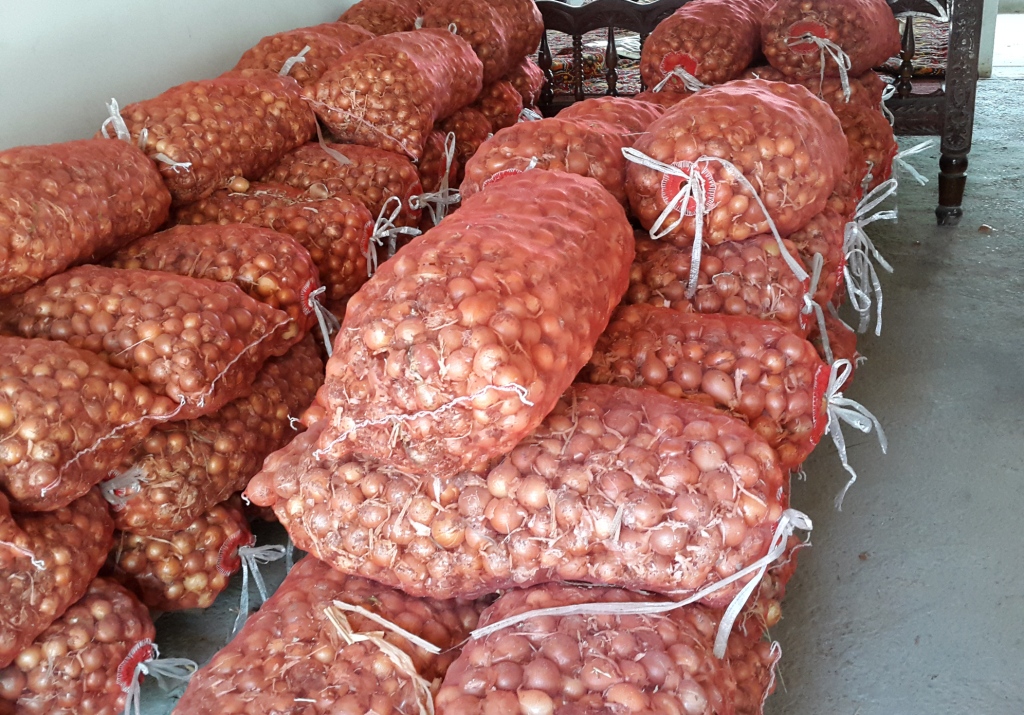
The seed that Kurigram's farmers had been buying came mostly from Faridpur, where onion seed is so valuable that it is known as "black gold". On 28 March 2026, less than two weeks before the Kurigram report, The Business Standard said the district was heading for a record harvest. Farmers and the local agriculture department estimated that production could reach nearly 1,100 tonnes of seed, worth around Tk 550 crore. Faridpur accounts for roughly 70 per cent of the country's onion seed output, the paper said.
According to that report, the area under onion seed in Faridpur in the 2025-26 season slightly exceeded its target: the agriculture department had planned for 1,850 hectares, and nearly 1,865 hectares were planted, with the largest concentration in Gobindapur village of Ambikapur union. The average market price of onion seed in the previous year had been around Tk 5,000 per kilogram, and farmers expected a similar rate. About 30 per cent of the harvest was expected to meet demand within Faridpur and the remaining 70 per cent to go to markets across the country.
Sahida Begum, a farmer with more than a decade of experience in onion seed, told the paper she had grown nearly 100 acres that season and expected around 40 tonnes of seed, which she estimated could fetch Tk 5 crore. She said seed cultivation was risky and costly, but that the returns stayed lucrative because demand for quality seed was high. Another grower, Md Hossain, said seed from Faridpur was known for its quality and urged the government to stop imports of low-quality seed from abroad, particularly from India; that was his view, and the report carried no response from the authorities on it. Md Shahaduzzaman, deputy director of the Faridpur district agriculture extension office, said: "We are providing full support to the farmers from the outset, from technical guidance to seed quality checks."
Faridpur's seed business had been growing for several years. In March 2024 The Business Standard reported that the district agriculture office had set aside 1,890 hectares across nine upazilas for onion seed that season, and that farmers were aiming for a crop worth Tk 300 crore. The report said the district could then meet 50 per cent of the country's onion seed demand. It profiled a couple in Gobindapur, Lovely Akter and Imtiaz Mollah, who had started on two bighas and expanded to 40; they put their cultivation costs at more than Tk 1 lakh per bigha and expected two to two and a half maunds of seed from their land. A year later, in March 2025, Prothom Alo reported that the agriculture department expected seed trade worth at least Tk 500 crore from Faridpur that season.
Bees, hand pollination and the cost of labour
Onion seed growers rely on bees to pollinate the flowers, and in Faridpur that help has been fading. In March 2024 The Business Standard reported that reduced pollination due to a lack of bees had pushed farmers to adopt manual pollination, which may not be as fruitful as the natural process. Prothom Alo's photo report of March 2025 described farm workers, men and women, pollinating the flowers by hand because there were few bees that season.
By March 2026 the problem had become a fixed cost. The Business Standard reported that the decline in bee populations had forced many growers to pollinate by hand, increasing labour costs significantly. At a farm in Gobindapur, workers moved pollen from flower to flower by hand, a job that demands patience and precision. One labourer, Rafiqul, told the paper that workers earned between Tk 25,000 and Tk 30,000 a month, which helped their families, but that the work was exhausting.
The wages paid on Rasel Ahmed's plot, Tk 300 to Tk 500 a day, show that the same kind of work had reached Rajarhat. For a district where, by Banglapedia's figures, nearly half the households in the upazila owned no land, a crop that needs many hands from winter planting to spring harvest can matter beyond the farmer who grows it.
When seed fails: the germination problems of 2021 and 2024
The value of reliable local seed is clearest when bought seed fails. In February 2021 The Business Standard reported that onion seed given by the government to flood-affected farmers in Bogura had not germinated on the land of about 150 farmers in Sariakandi upazila. The farmers alleged that they had been given low-quality seed and said they had lost more than Tk 1 crore. The upazila agriculture officers maintained that the seed was of good quality, and blamed low winter temperatures and late sowing. A deputy assistant agriculture officer in Sariakandi said scientists of the Bangladesh Agricultural Research Institute had told them the soil should be at 15 to 20 degrees Celsius after sowing, while that season it had fluctuated between 6 and 10 degrees.
A larger case followed in late 2024. On 9 December 2024 the Ministry of Agriculture suspended two officials of the state-owned Bangladesh Agricultural Development Corporation (BADC) over the distribution of onion seed with a low germination rate. The ministry said that its evaluation committee's report of 7 November 2024 had put the germination rate of the Tahirpur onion seed bought by BADC at 80 and 81 per cent, but that germination in farmers' fields, especially in Faridpur and Rajbari districts, was found to be 10 to 20 per cent. The ministry found "negligence, misconduct and inefficiency" on the part of the two officials and said it would investigate further and take action against those involved and the supplying company.
Neither case concerned Kurigram, but both explain why the district agriculture office spoke of lower costs and higher profits from home-grown seed. A farmer who produces seed close to home can see how it was grown and stored, rather than relying on seed carried in from another region or from abroad.
Onion production and the market before the 2026 harvest
Seed is the start of one of Bangladesh's most closely watched crops. In August 2025 The Business Standard reported that the country had produced 42.45 lakh tonnes of onions on 2.80 lakh hectares in the 2024-25 season, 4.24 lakh tonnes more than the target of 38.21 lakh tonnes and the highest production in the country's history. The figures it cited for earlier years were 39.11 lakh tonnes in 2023-24, 34.56 lakh tonnes in 2022-23, 36.40 lakh tonnes in 2021-22 and 33.62 lakh tonnes in 2020-21. The same report said that 20 to 25 per cent of onions are lost during production, collection, marketing and storage.
Not everyone accepted the official numbers. Dr Md Nur Alam Chowdhury, principal scientific officer at the Spice Research Centre in Bogura, told the paper that production that year was around 36 lakh tonnes while the country's demand was at least 40 lakh tonnes, and that about a quarter of onions were wasted in storage. Professor Abu Noman Faruq Ahmmed of Sher-e-Bangla Agricultural University said accurate production data was essential to stabilise the market.
Prices swung sharply in the months before Rasel Ahmed's seed crop flowered. On 26 November 2025 Agriculture Adviser Lt Gen (retd) Md Jahangir Alam Chowdhury said the government had not allowed onion imports in order to protect local farmers, and that prices had come down to around Tk 95 to 100 a kilogram after rising to Tk 120 to 130. Ten days later, on 6 December 2025, the agriculture ministry announced that limited imports would be allowed from 7 December, with 50 import permits issued each day and each capped at 30 tonnes, as retail prices reached Tk 150 a kilogram.
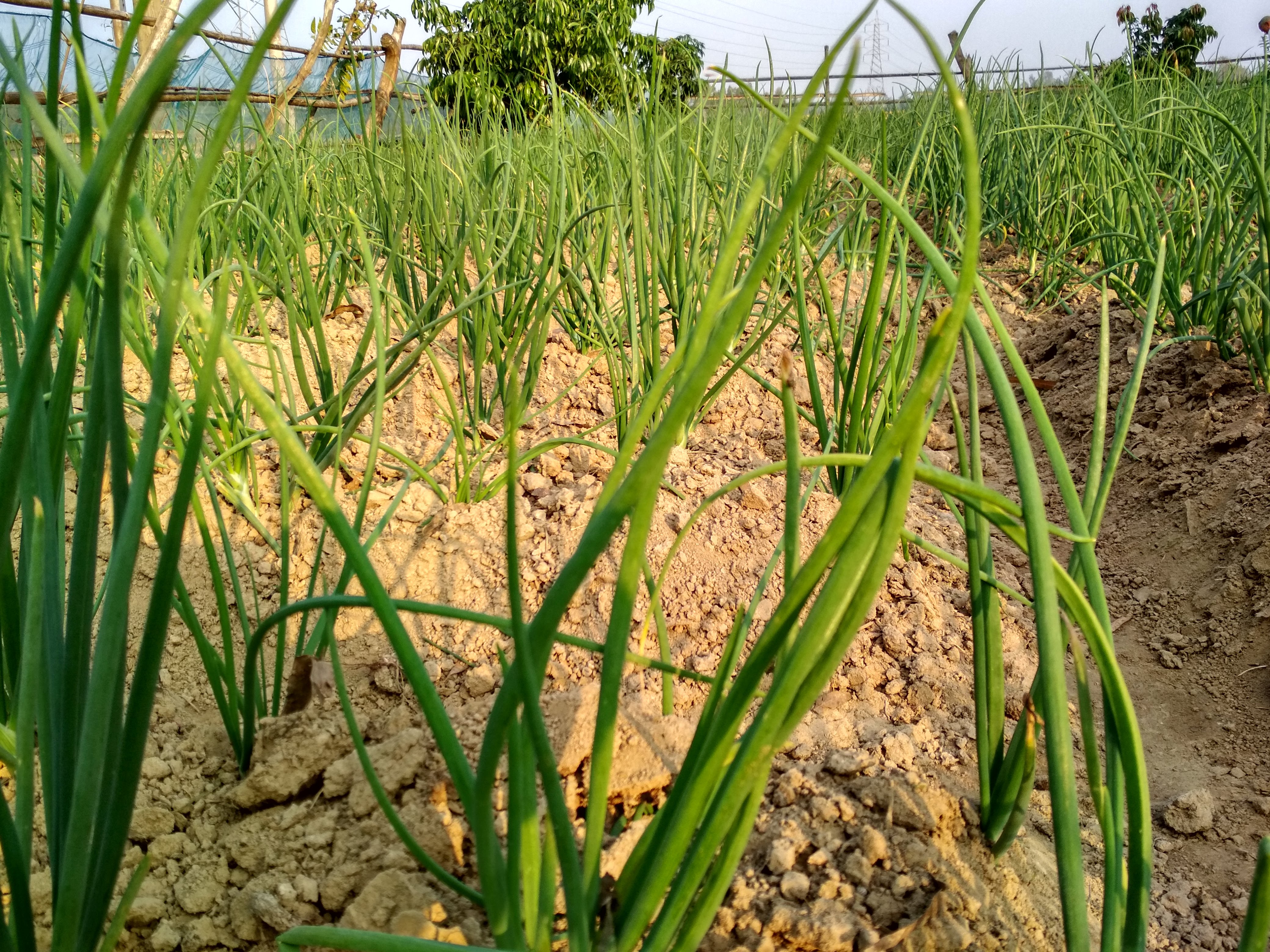
Photo: דינה שנן רמות, PikiWiki Israel / Wikimedia Commons (CC BY 2.5)
Sources: Jagonews24, Banglapedia (Asiatic Society of Bangladesh), The Business Standard, Prothom Alo, Tamil Nadu Agricultural University, Wikipedia

Comments
(0)