
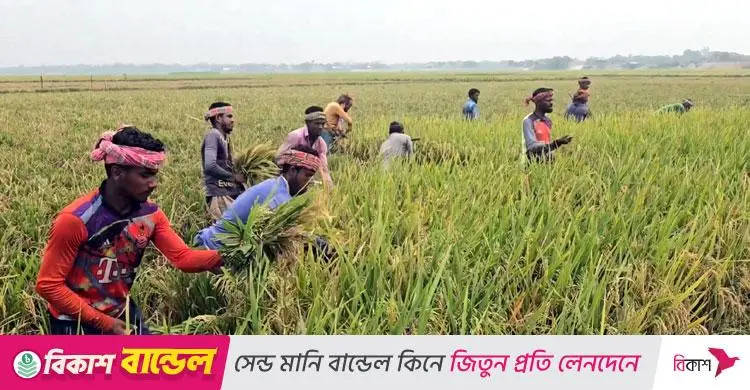
Kishoreganj district is known as a vast store of boro rice. There was a time when lakhs of farm labourers, local and from across the country, came to its haor wetlands for the boro harvest. But in recent years the labour shortage at harvest time has grown steadily worse.
Working in the fierce Baishakh sun and through storms and rain without a fair wage, many labourers no longer want to stay in the trade. Some are going abroad; others are taking jobs in garment factories, construction and other work. Farm mechanisation is also reducing the number of farm workers. Where lakhs once worked the boro harvest in Kishoreganj, some 45,000 are working this season.
Farmers struggle to find workers
Maruf Mia, a farmer in Mithamain haor, said workers are no longer easy to find as before and their numbers fall every year. Cutting paddy in the haor under the Baishakh sun and in storms and rain is very hard work, so many labourers are changing jobs.
Ashraful Islam, a farmer from Karagaon in Katiadi upazila, said that at boro harvest time a labour market used to be held every morning on the Karagaon school field, drawing thousands of workers from the area and across the country. That market is no longer held, and labourers no longer come from other regions.
Maqbul Hossain, a farmer in Nikli haor, said the main reason for the fall is mechanisation. Cutting one acre of paddy by hand took 5-6 hours; a machine does it in an hour. Farm work is also very hard, which is another reason.
"My team has shrunk from 60 to 16"
Ruhul Amin, in his sixties, has brought a team of 16 from Durgapur upazila in Netrokona to cut paddy in Nikli haor. He has come to Kishoreganj's haors as a harvest labourer for 30 years. "I used to see thousands of workers from Rangpur, Dinajpur and other parts of the country come to cut paddy in the haor. Fewer came last year and even fewer this year. Working in the sun and rain in the haor is very hard and the earnings are low. My own team used to have 60 to 65 people; now it is down to 16. Many have left the trade and gone abroad," he said.
Rahim Mia, who came from Mymensingh to cut paddy in Itna haor, said that although people have farmed for generations, many are now turning away from their forefathers' work. "We farm labourers work hard every day but do not get a fair wage. Seasonal work like harvesting brings little income in a year, and it is hard to run a family on it. Because of this financial uncertainty, many of us are taking up other work," he said.
Jilani Bhuiyan, a farmer in Mithamain haor, said that as education spreads, the new generation sees office or city jobs as more respectable and comfortable and regards farm work as a "low-status job", so local farm labour is also falling.
Farm labourer Moniruzzaman said lightning was not as common in the haor at boro harvest time before, but it has increased over the past few years and many labourers have been killed. Out of this fear, many do not want to work in the haor and are turning to safer jobs.
Farm labourer Nurul Islam said that now their children are being educated, many feel that working as farm labourers lowers their standing in society, so they want other work, especially the young.
Manik Hossain, a farmer in Nikli haor, said combine harvesters, power tillers and other machines have made farming faster and cheaper. "Labourers can't compete with machines, so many are forced to quit," he said.
Syed Faiyaz Hasan Babu, chairman of Austagram Sadar union parishad, said many young men used to be seen working in the haor as farm labourers. But young people today prefer jobs, business or going abroad, and many see farm work as undignified, so they do not want to follow their fathers.
Calls for fair wages and security
Experts say growing use of technology, migration to cities and the undervaluing of labour are worsening the shortage of harvest workers. For a sustainable solution, they say, fair wages, health and dignity must be ensured for workers and their social security strengthened. If these problems are not solved quickly, they fear production will suffer and both farmers and labourers will lose out.
Khaled Hasan Jummon, president of the Kishoreganj district unit of Bangladesh Sramik Kalyan Federation, said fair wages must be set for farm labourers to keep the sector alive. Alternative work must be created beyond the seasonal jobs, the government must take steps to raise farm labourers' social standing, and young people must be encouraged into farming through modern training and education in using machines.
Dr Md Sadiqur Rahman, deputy director of the Department of Agricultural Extension (DAE) in Kishoreganj, said that where lakhs of farm labourers once worked in the haors alone, 45,060 are working in the district this boro season. Every farmer wants to bring the crop home quickly, because natural disasters can destroy it in the haor at any time, so mechanisation is spreading. This boro season, paddy in Kishoreganj is being cut by 571 combine harvesters. Because of these machines, the haor harvest is nearly finished, and farmers feel safe having brought their paddy home quickly.
Source: Jagonews24. First published in Bengali on The Agro News.
Comments
(0)