
Most of the country's edible oil is imported, costing a huge amount of foreign currency every year, and ways to become self-sufficient in edible oil have been explored for several years. As part of this, efforts are under way to expand sunflower cultivation on saline land in several districts of Khulna division, bringing smiles to farmers' faces.
Four main types of edible oil are used in the country: mustard, rice bran, soybean and sunflower. The government is trying to raise production of all of them, and as part of that, sunflowers are being grown on fallow land in the Khulna region with government support.
In the 2024–25 fiscal year, 14,406 tonnes of sunflower oil were imported. The country usually produces 10,000 to 12,000 tonnes a year, and efforts are under way to raise this further.
The PARTNER project
In the region, farmers are being encouraged to grow sunflowers with the support of the Department of Agricultural Extension's (DAE) Program on Agricultural and Rural Transformation for Nutrition, Entrepreneurship and Resilience in Bangladesh (PARTNER). Under the project, farmers have been given seed, fertiliser, pesticide and the necessary training. As a result, saline land that lay fallow year after year is now growing sunflowers.
The agriculture department says about 57 per cent of the land in the Khulna region, made up of the four districts of Narail, Satkhira, Khulna and Bagerhat, is saline. Usually about two and a half lakh hectares lie fallow in the Kharif-1 season after the aman rice harvest, and a large plan has been made to grow sunflowers on that land through the PARTNER project.
Salinity is the region's biggest problem. Land is usually called saline when salinity reaches 8 dS per metre, but sunflowers can tolerate salinity of up to 15 dS per metre. Agriculture officials therefore say the sunflower is now one of the most promising crops for the region.
Farmers try it for the first time
Kamrul Islam, a farmer from Chanchra village in Tularam union of Narail Sadar upazila, has grown sunflowers on several plots for the first time this year. "A few years ago nothing grew on this land after the aman harvest; it lay fallow," he said. "Because salt comes up, I thought growing anything would only add to the cost. But this time I grew sunflowers on the advice of agriculture officers. The yield has been a bumper one, and I am amazed."
Visits to several demonstration fields in the four districts found good sunflower yields in large fields. From a distance the fields look like a yellow carpet; up close, thousands of sunflowers can be seen swaying in the wind.
Farmers and local people present said that land which used to lie fallow for several months after the aman harvest is now blooming with the yellow flowers of the BARI Surjamukhi-3 variety. They said the crop could change not only the land but the rural economy too.
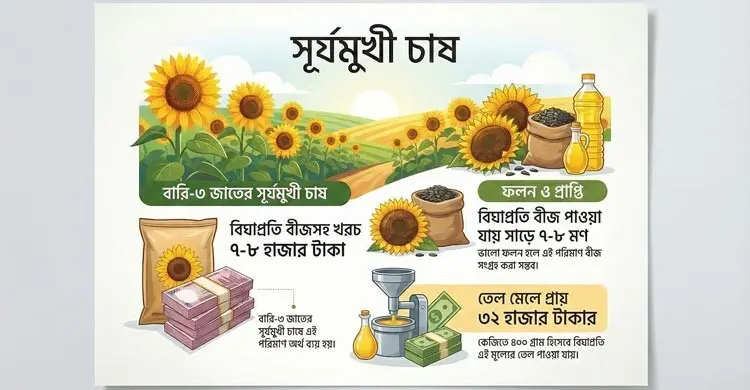
Agriculture officials said this saline land lies fallow from November to March. Growing sunflowers on one acre costs farmers three and a half thousand taka, against a financial return of about Tk 25,000. In some places a single sunflower head (the seed disc) weighs more than a kilogram. This year 1,600 hectares have come under sunflower cultivation.
In Alka village of Damodar union in Phultala upazila of Khulna, the picture is the same: six farmers have together grown sunflowers on two acres. One of them, Rezaul Karim, said: "This is the first year we have grown it. If the yield is good, we will make twice the profit of rice. The land used to lie empty; now a crop is growing at low cost. Another big advantage of sunflowers is that they don't need much irrigation water."
Another farmer in the village, Anisur Rahman, said: "I am 32 years old and have never seen a crop like this in the area. So I too have grown it on one bigha."
In Atjuri union of Mollahat upazila in Bagerhat, sunflowers are also yielding well. At one field, sub-assistant agriculture officer Sumala Biswas said: "Four farmers of Atjuri village, including Peyari Begum, Bachchu Mia, Nizam Molla and A. Halim Molla, have grown the BARI Surjamukhi-3 variety on two acres. Each flower here is 15 inches in circumference and has produced more than a kilogram of seed. This is very profitable for the farmer."
Phultala upazila agriculture officer Arif Hossain said: "We encouraged these farmers to grow sunflowers, and they are growing it for the first time this year. The number of farmers is increasing. Because ordinary farmers don't want to grow it at first, we first grew it in important places such as the cantonment and police lines. Seeing the good yields there, interest has now grown among ordinary people."
Costs and returns
By agriculture officials' reckoning, sunflowers cost relatively little to grow. For 33 decimals, or one bigha, of the BARI-3 variety, Tk 4,000 worth of seed is needed, and with other costs the crop can be grown for about Tk 7,000 to Tk 8,000.
If the yield is good, seven and a half to eight maunds of sunflower seed can be harvested per bigha, and one kilogram of seed gives at least 400 g of oil. At seven and a half maunds (300 kg) a bigha, that comes to about 130 litres of oil, worth roughly Tk 32,000 at Tk 250 a kg. The oilcake and the plant, which can be used as fuel, also have considerable value.
The crop can also be grown between the aman and boro rice seasons, because its life cycle is 85–105 days. After it is harvested, jute, rice, sesame, mung bean and other crops can be grown.
Cutting the oil import bill
Md Mosaddek Hossain, senior monitoring officer of the PARTNER project for the Khulna region, said: "The PARTNER project has taken this fine initiative to increase sunflower production on the saline land of the coast. It will reduce the amount of uncultivated land and, on the other hand, greatly reduce the country's dependence on edible oil imports."
He said: "The crop needs little money and little labour. Considering these aspects, the PARTNER project is getting local farmers interested in growing sunflowers."
He also said: "Only 15 per cent of the country's edible oil is produced locally; the remaining 85 per cent has to be imported. The country imports about Tk 16,000 crore worth of oil a year. If sunflower cultivation on fallow land can be increased, a great deal of foreign currency will be saved."
Mosaddek said: "If we can grow sunflowers on land that lies fallow and saline after aman, our oil imports will fall a lot. Only 15 per cent of the country's oil demand is met from mustard, sunflower, sesame and other sources; the remaining 85 per cent has to be imported. If sunflower cultivation can be increased on the country's fallow and saline land, a great deal of foreign currency will be saved. Otherwise we will be held hostage by oil importers."
He said that since the country imports Tk 16,000 crore worth of oil a year, growing sunflowers could save a great deal of money, because apart from fields they can be grown on pond banks, field ridges, homesteads and almost any high ground. The hope is that 50 per cent of the oil demand can be met from fallow land alone. The Khulna region has 13 lakh 13 thousand hectares of land, of which 18–20 per cent lies fallow after the aman season.
Agriculture officials said sunflowers also improve soil fertility. Rice roots go 6–8 inches deep, while sunflower roots reach 15 inches, so the plant survives even without irrigation. Its fallen leaves become fertiliser, so the following crop needs less fertiliser.
Government support
Md Rafiqul Islam, additional director of the DAE's Khulna region, said: "About 57 per cent of the land in the Khulna region, made up of the four districts of Narail, Satkhira, Khulna and Bagerhat, is saline. Usually about two and a half lakh hectares lie fallow in the Kharif-1 season after the aman harvest. Land is usually called saline when salinity reaches 8 dS per metre, but sunflowers can tolerate up to 15 dS per metre. So this is a promising crop for the region."
He said: "To encourage farmers to grow sunflowers, the government gives one kilogram of seed and 10 kg each of DAP, TSP and potash, among other inputs, for one bigha of land. This costs the government about three and a half thousand taka, but a crop worth at least about Tk 26,000 can be harvested from that land."
Md Rafiqul Islam said: "Farmers have been given seed of two types, hybrid and BARI Surjamukhi-3. Farmers cannot save hybrid seed, but BARI Surjamukhi-3 seed can be saved. So far 10,350 farmers have been given seed and fertiliser for one bigha each. Under the PARTNER project, seed, fertiliser and financial support have been given for two acres in each of 40 blocks. Altogether sunflowers are being grown on about 1,600 hectares. In addition, under the Khulna region agricultural adaptation project, eight oil extraction machines have been given, shared among 30 upazilas. There are plans to provide a machine to every upazila in future."
He added: "If the two and a half lakh hectares that lie fallow after the aman harvest can gradually be brought under cultivation, it will be possible to grow more not only sunflowers but also mung bean, dhaincha and green manure crops. If a farmer gets about 100 kg, or two and a half maunds, of sunflower seed, the oil produced from it alone can meet a family's needs for the whole year."
PARTNER project programme coordinator Abul Kalam Azad said: "Because of climate change, the Khulna region is one of the most vulnerable areas. As salinity rises, a lot of land lies fallow. We have encouraged farmers to grow sunflowers, and they are already getting good results. Many more farmers will join in future. Sunflower oil is also good for health, but because of import dependence it is expensive. If domestic production rises, it will become more affordable for people."
Source: Jagonews24. First published in Bengali on The Agro News.

Comments
(0)