
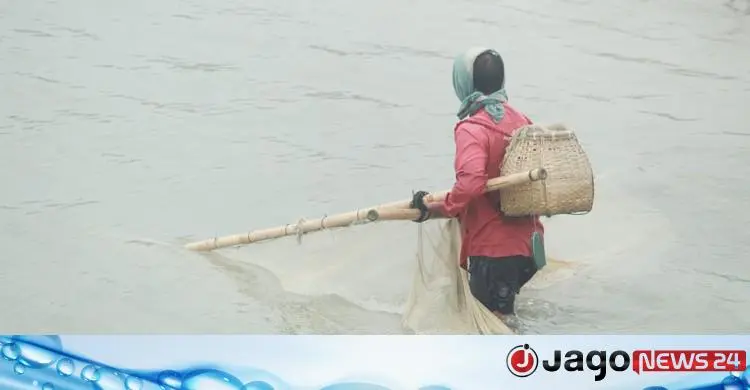
A man standing waist-deep in the shallow water of a river seems a symbol of a struggle against time. He is catching fish with a net spread between his two hands: the khuchin net, called the fenni net in some regions. He is not just catching fish; he carries centuries of knowledge, labour and culture. Fishing techniques that are disappearing in the face of modern machinery still survive, as silent witnesses to tradition, in some of rural Bangladesh's rivers, canals and estuaries.
To an urban reader the khuchin net may seem just a "rural scene". Yet it combines work ethics, environmental thinking and folk knowledge, which are closely linked to modern debates on development.
What is the khuchin?
The khuchin is a traditional hand-operated net. Attached to two or more bamboo poles, it spreads out like a triangle or a wide funnel. The fisher walks slowly through the water, pushing the net ahead. Fish enter the net with the current and finally the mouth of the net is lifted. Small fish, fry and shrimp are all caught this way, including puti, chela, tengra, koi, shing and many other species. There is no engine and no noise, only the rhythm of the human body working with the river's current. Fish caught in this net usually reach the market fresh and alive, so they are prized in local markets. When demand for small indigenous fish rises in particular, khuchin fishers get relatively good prices.
Where livelihood meets culture
The khuchin net is not just a fishing tool; it is part of the life of many families. Going into the river before dawn, drying the nets in the midday sun and taking the catch to market in the evening: this is the cycle of a khuchin fisher's day. In many areas the skill is passed down from generation to generation, without books or training. In many riverside areas women also play an active role. Some go into the water themselves; others mend nets, tie thread or sort the catch. Women's labour and skill are closely bound up with the method.
The net still appears in rural folk tales, memories and stories, and many folk beliefs surround it. Many fishers follow special rules before putting a new net in the river for the first time: some only lower it on a particular day, others give away the first fish caught. These beliefs reflect a spiritual side of people's relationship with the river.
A test of skill and patience
Working a khuchin net is not easy. The fisher has to judge the water depth, the speed of the current and the riverbed; a small mistake can leave the net empty. The net is not used equally all year. When rivers swell in the monsoon, it is worked in calmer stretches near the banks; in winter it is more effective in canals and tributaries. Fishing this way needs long experience, patience and an ability to understand the river. As many fishers say: "If you don't understand the river's language, the khuchin net won't work."
Eco-friendly fishing
Unlike modern trawls or current nets (fine monofilament nets), the khuchin net is relatively safe for the environment. It does not damage the riverbed or kill excessive numbers of small fish, and large fish and brood fish escape easily. Because the net can be drawn in as needed, unwanted fish can be released alive, putting less pressure on biodiversity. In short, the khuchin net is very safe and important environmentally. There is none of the indiscriminate killing of current nets or trawls, so the natural breeding of fish is relatively protected.
A tradition at risk
Making a khuchin net is a separate skill. Everything is done by hand, from cutting and drying the bamboo to measuring and knotting the thread, and in many areas particular families or craftsmen make the nets. But the reality is that this age-old culture is in crisis. Silting rivers, pollution, the spread of machine-operated nets and young people's lack of interest are pushing the khuchin net to the margins. Because of low income and hard work, the new generation is turning away from it, and in many places the net is now seen only in the hands of older fishers. As many say: "Low income, hard work, so the new generation is choosing the easier path."
Conservation needed
Keeping the khuchin net alive needs awareness and incentives. Locally, the method could be recognised as a model of eco-friendly fishing. Showcasing it through tourism or documentation could create fresh interest. People need to understand that the khuchin net is not just a net but a quiet heritage of riverine Bengal, and that keeping it alive is our responsibility.
Arifur Rahman, Amtali-Taltali (Barguna) coordinator of the environmental citizens' platform Dharitri Rokkhay Amra (DHORA), said: "The khuchin net could be recognised as an eco-friendly traditional fishing method. With river-based tourism, documentaries, local training and government support, this culture could come back to life."
Coastal fisher Anisur Rahman explained that working a khuchin net means standing in cold water for hours on end, so rheumatic pain, skin diseases and muscle cramps are constant companions for fishers in winter. Yet with no alternative, many put up with the hardship; it is a silent chapter in the reality of the khuchin net. Even so, fishers believe the net is not just a fishing tool but a story of riverine Bengal's centuries of experience, labour and coexistence.
The man standing in the river reminds us that the real way to survive is not to fight nature but to come to terms with it.
Source: Jagonews24. First published in Bengali on The Agro News.

Comments
(0)