
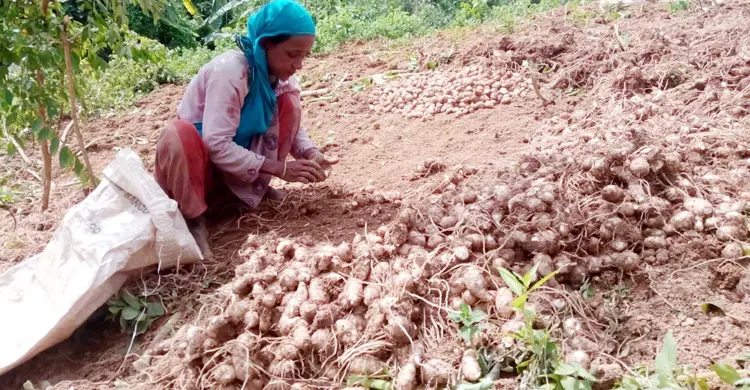
Mukhi kachu (taro) is grown to some extent in many parts of the country. Keeping pace with the rest of the country to meet demand for vegetables, Khagrachhari has also seen its cultivation grow over the past few years. The crop is also known as gura kachu, kachu, chhara kachu, duli kachu and binni kachu. The cormels are used as seed, and the crop is lifted once the plants turn yellow and dry.
Mukhi kachu is grown in every upazila of the hill district of Khagrachhari, but most of all in Matiranga, Guimara, Manikchhari and Ramgarh. On a visit to the area, it was seen that the crop is grown on the slopes of large and small hills. As far as the eye can see, the rolling hills are covered in green taro plants.
Changing the local economy
Local people said Khagrachhari's farmers are growing mukhi kachu on the hill slopes alongside rice and other vegetables, and the crop has brought financial security to farming families. Md Shishu Mia and Md Shafiqul Islam, farmers from remote Tabalchhari in Matiranga, said mukhi kachu has changed the area's economy over the past few years, and the area under the crop is growing because it is profitable.
Md Abdul Kuddus, a taro grower from the Nakapa area of Ramgarh, said local farmers are making a profit because production costs are low. At the start of the month of Chaitra, weeds are cleared and the soil is dug to make it ready. When it rains in mid-April, the seed is sown. After the plants come up, the weeds are cleared, the crop is earthed up in rows and fertiliser is applied a few times as needed. Harvesting and selling begin in early September.
Wholesalers Md Shahjahan and Md Nurul Alam said that after meeting demand in the hills, mukhi kachu has found a place in big wholesale markets including Noakhali, Cumilla, Chattogram and Dhaka. There are depots for it at Hatimura and Gachchhabil in Manikchhari, Nakapa in Ramgarh, and Tabalchhari and Taindong in Matiranga. Because prices here are relatively low, the traders are making a profit.
Sub-assistant agriculture officer Md Amir Hossain said: "Farmers are turning to taro because the profit per hectare is double the cost of production."
Matiranga upazila agriculture extension officer Md Masum Bhuiyan said: "There is hardly any chance of financial loss in growing mukhi kachu."
Source: Jagonews24. First published in Bengali on The Agro News.
Comments
(0)