
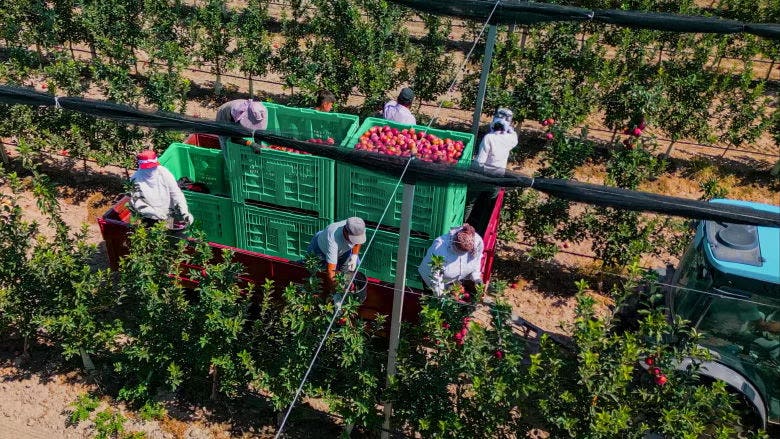
On the outskirts of Kyzylorda in southern Kazakhstan, plots that were bare a few years ago now carry rows of apple trees, melon vines and small ponds. The Karakat farming enterprise has planted a seven-hectare orchard, built a 25-ton fruit storage facility and dug ponds on four hectares for fish farming, and its expansion reflects a wider effort across the country's southern regions to bring degraded land back to life.
The work is part of the Resiland Project, funded by the Global Environment Facility and implemented through the World Bank, which is helping Kazakhstan rehabilitate degraded land in the Kyzylorda, Zhambyl, Turkestan and Akmola regions. Years of wind erosion, dust storms and the drying of the Aral Sea have disrupted rural livelihoods, above all in agriculture, one of the largest employers in these regions. The project combines community-driven work with new technology and scientific support to restore land productivity, strengthen resilience and create income.
The most visible result is the ring of hardy, deep-rooted saxaul shrubs around Kyzylorda. More than 3.6 million seedlings were planted in 2023 and another 2.1 million were added during maintenance in 2024 and 2025. The belt now acts as a living barrier that reduces dust, improves the microclimate of nearby settlements and lays the foundation of a future forest zone that will shield the city, its infrastructure and its farms from harsh winds and recurring dust storms.
The larger goal is the dried seabed of the Aral Sea. An estimated 66 percent of the Kyzylorda region's land is affected by degradation, about 4 percent is already desertified and roughly 76 percent is highly sensitive to further desertification. A new 33.5-hectare forest nursery was built in the Kazalinsk district between 2023 and 2024 to supply planting material for the seabed. "Its annual production capacity is three million black saxaul seedlings, along with 55,000 hardwood and fruit-bearing species," said Serik Aymish, Deputy Director of the Kyzylorda Regional Kazalinsk State Institution for Forest and Wildlife Protection. In 2023 and 2024 alone, more than 74,000 hectares of seabed were planted or seeded with saxaul and other salt-tolerant shrubs, stabilising sandy soils and reducing the spread of toxic dust.
Long-term restoration also depends on the country's forest genetics, since blights and pests could undermine the saxaul belt and the livelihoods around it. In Shchuchinsk, Resiland is supporting the national forest seed genetic bank, now equipped with 65 types of specialised laboratory instruments, including low-temperature storage and seed counters, and holding samples from 156 species of trees and shrubs. "Seeds can be preserved for up to 20 years or more," said Natalia Zakharova, Deputy Director of the Forest Breeding and Seed Center. The bank supplies quality seed to forest institutions nationwide and tests, catalogues and monitors for diseases that threaten forests and agricultural produce.
Farmers have taken the lead where the project has offered a way in. In the Zhambyl region they have set up 120 hectares of pilot agroforestry sites, planting orchards that diversify their crops, hold water in the soil and add income. Back in the orchard outside Kyzylorda, farmer Sabit Karamyrzaev put the change simply: "We have been cultivating previously unused land. Now it feeds our families."
Source: World Bank

Comments
(0)