
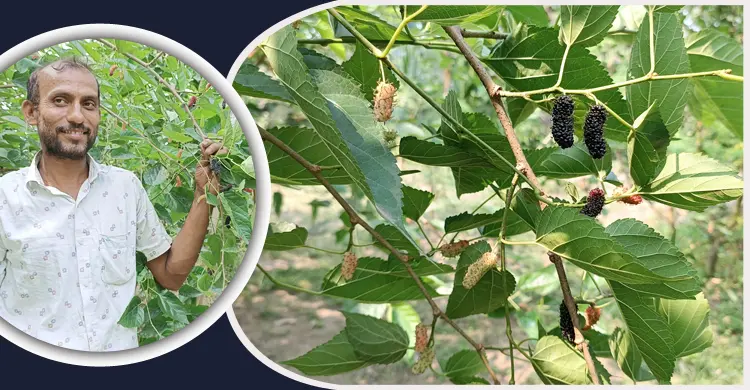
Mulberries hang in clusters from the trees, some green, some red and some ripened to black; there seems to be more fruit than leaves. This high-value, nutritious foreign fruit is now being grown in Kaliganj upazila of Gazipur district, near Dhaka. Md Mostafa Molla (40) of Chupair village in Jamalpur union collected three varieties from different countries on a trial basis and succeeded at the first attempt. Having started experimentally, he is now planning to grow them commercially after seeing the yield.
Mostafa's mulberry trees have oval leaves with attractive serrated edges and pointed tips. The fruit is a little smaller than a grape. It is green at first and gradually turns red, then black when fully ripe. The attractive fruit is juicy with a sweet-and-sour taste when ripe. Each tree yields 8–10 kg, seedlings can be raised from it, and it can easily be grown on rooftops.
Low cost, high demand
"This fruit is farmed and marketed commercially abroad, and there is huge demand for it," Mostafa said. "On a trial basis I collected three varieties from Thailand, India and Pakistan. Even though it was an experiment, every tree has borne plenty of fruit."
"Mulberry farming has very few diseases and needs hardly any pesticide. Production costs are low too. With only organic fertiliser you get fruit almost all year round. Since mulberry is an imported fruit, there is strong demand in the market. In superstores in Dhaka and other divisional cities it sells for about Tk 4,000–5,000 a kg."
He added: "I started with 25 seedlings, which I got by courier at Tk 300 each. Although I bought them expensively, I now sell seedlings for just Tk 30. You simply dip a cutting in old honey as a natural hormone and plant it in the soil. With proper care, the tree bears fruit the month after planting."
Health benefits
Health experts say mulberry, known locally as tunt fruit, is good for health. Ripe mulberries help relieve constipation, and the sweet-and-sour juice of the ripe fruit is used against bile disorders, burning sensations, phlegm and fever. Juice from the bark and roots of the mulberry tree acts against worms, and it is very helpful for fever or cough caused by a cold.
Kaliganj upazila agriculture officer Farzana Taslim, an agriculturist, said: "Mostafa Molla is a successful farmer. He has been growing green fodder grass for a long time, and as a hobby he also planted 25 mulberry seedlings of three varieties. Each tree will give around 8–10 kg of fruit. However, higher authorities are researching how suitable the soil of this upazila is for mulberry."
Source: Jagonews24. First published in Bengali on The Agro News.


Comments
(0)