
Md Feroz Alam Linkon, 39, is from Palashpara village in Sadar upazila of Gaibandha district. He is the eldest child of Md Mokbul Hossain and Shefali Sarkar of the same village, and one of three brothers and two sisters, all in different professions. Feroz is an export-import trader, mainly with China. Travelling to China on business, he met a schoolteacher there, Wang Lu Fing Sufi. They fell in love and married, and Sufi later moved to Bangladesh with Feroz.
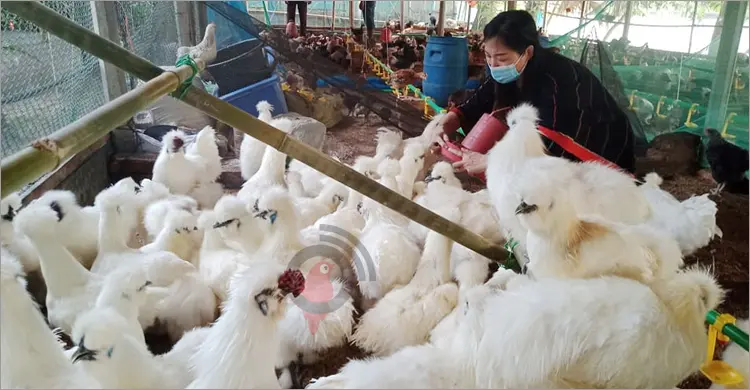
But the energetic Sufi was not willing to sit idle. The couple leased some land in Nagarbhela village of Nagari union, Kaliganj upazila, Gazipur, and there, as a hobby, began rearing various Chinese chicken breeds under the name SS Rare Breed and Agro Farm. They brought eggs from China and at first got 84 chicks by incubator. Their farm now has more than 3,500 chickens of various Chinese breeds.
Crossing Chinese and local breeds
Besides the Nagarbhela farm, they have set up three more farms at Uttarkhan in Uttara in the capital. One houses laying hens, one hatches eggs by incubator, and at the third Chinese and local chickens are being crossed, so that a new breed can be developed from the two countries' birds. The aim is to keep the taste of Bangladesh's local chicken with the growth of the Chinese birds, making more profit in less time.
SS Rare Breed and Agro Farm keeps the Chinese Silkie, Kadanad, Hung Yang Chi, Ho Yangchi and Cho Ko, along with other breeds. It also has local chickens.
Feroz Alam said he brings goods from China and sells them wholesale in various places, but his business slowed because of Covid. It was then that he and his wife, Wang Lu Fing Sufi, brought some chicken eggs from China as a hobby, hatched them and raised the chicks. Bringing live chickens from China involves many rules, he said, so they bring eggs through customs clearance at the airport and then hatch them.
He said a local chicken reaches 800-900 grams in four months, while a Chinese chicken grows to as much as two and a half kilos within two months. If a new breed could be produced by combining the two, its disease resistance would be better than that of local chickens. Many people lose patience rearing local chickens, he said, so many would be keen to raise a cross between the two, as it is more likely to grow fast.
Adapting to Bangladesh
He said rearing chickens from China was not easy at first. Gradually they were adapted to the environment and made suitable for rearing through disease control. Problems with cold or heat were watched over time and the necessary steps taken, and some medicines not available in Bangladesh were brought from China. He wants to put unemployed young people to work: anyone who wishes can contact him, buy these breeds and rear them to escape unemployment and financial hardship.
Feroz's wife, Sufi, said she used to be a teacher. Now that she lives in Bangladesh she is trying to depend more on agriculture or farming, a wish that grew out of a hobby. As she is entirely new to this, when a chicken falls ill or dies she tries to find out why, searches online, and then treats the birds with medicine brought from China or what is available in Bangladesh. In this way she is trying gradually to adapt the Chinese chickens to Bangladesh's conditions.
Kaliganj upazila livestock officer Dr Md Kamruzzaman said he had already inspected the farm. The Chinese Silkie chickens there are very promising: they start laying within a very short time and grow and gain weight quickly. As the breed is entirely new to the country, the couple will be given every help in dealing with disease.
Source: Jagonews24. First published in Bengali on The Agro News.
Comments
(0)