
The 10-kilometre Pakhimara canal flows through 16 villages of Nilganj union in Kalapara upazila of Patuakhali. Seven branches of the canal reach another 10 villages in the union.
Fifty to sixty years ago, dams were built at both ends of the Pakhimara canal to protect against floods. Since then, water from the Andharmanik river has flowed into the Pakhimara canal through a branch, the Jugir canal, one end of which joins the Andharmanik and the other the Pakhimara. The canals are a main source of fresh water. About 30,000 people in at least 26 villages depend on them for their livelihoods; the canals are an inseparable part of their lives.
But in Kumirmara village, a few powerful families caught fish by stretching nets on bamboo across different parts of the Jugir canal, blocking the flow of water. Because of the grabbers, villagers could not use the canal water, and there is no other source of irrigation. Apart from aman in the monsoon, nothing could be grown for the rest of the year, and large areas lay fallow for lack of irrigation. Most of the men in the villages left to look for work in other parts of the country. Their struggle to survive went on like this for more than two decades.
After nearly two decades, the canals were freed from the grabbers through the intervention of Kalapara upazila nirbahi officer (UNO) Munibur Rahman. There was no longer any obstacle to using the canal water, but a different problem arose: the canal's sluice gates were dilapidated, so salty tidal water came in and flooded farmland.
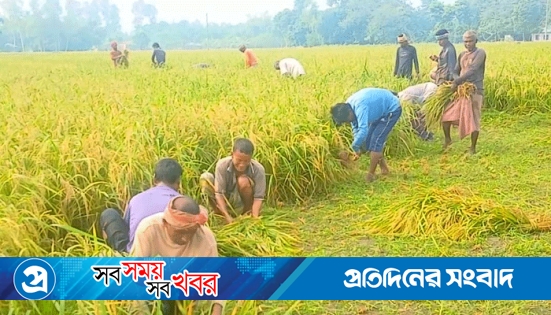
This time too the UNO stepped in to help, giving money from government funds to build dams on the canal. Villagers contributed what they could, and with that money three dams were built to keep out salt water. The dams have transformed farming in the villages. About 500 acres of fallow land around the canal are now green, and the villages are full of activity. Nilganj union has become known as the model union for farming and vegetable growing in the whole upazila, and the 30,000 people of these once-poor villages are now prosperous.
Canals and grabbers
According to the upazila agriculture office, Nilganj union has 52 villages. The Pakhimara canal flows through 16 of them, including Ghutabachha, Naobhanga, Gamurtala, Purba Sonatala, Neyamatpur, Elempur, Majidpur and Faridganj. The canal has at least seven branches, among them the Jugir, Hajir, Majidpur, Amirabad and Jonab Alir canals, which reach 10 villages in the union.
Farmers in Nilganj union say the Jugir canal is two and a half kilometres long. In Kumirmara village, a few powerful families fished by stretching nets on bamboo across parts of it, and villagers could not use the water. With no other means of irrigation, nothing but aman could be grown in the monsoon.
Over time the villagers began to demand the use of the canal water for irrigation, and a struggle to free the canal began. The Kalapara UNO joined that struggle, and after nearly two decades the combined efforts of the villagers and the UNO freed the Jugir canal from the powerful families.
After that, salty tidal water got into the land through the canal's dilapidated sluice gates. Visits to the Water Development Board and other offices to have the sluice gates repaired achieved nothing. Again the UNO came forward, giving Tk 25,000 from government funds to build dams on the canal. Villagers contributed what they could, and the Tk 40,000 raised in this way paid for three dams. The dams have brought sweeping change to farming in the villages. Nearly 500 acres of unused land are now green. Local farmers have grown watermelon, bottle gourd, beans, tomato, cabbage and cauliflower, radish, chilli and other vegetables, and boro has been grown on about 50 acres this year.
Local farmer Zakir Gazi said his father owns two bighas beside the canal, but in the past nothing but aman could be grown there, because farming needs irrigation. Water flowed through the canal, but there was no chance to use it: 15-20 people led by Shamsuddin of Majidpur and Monir Howlader and Kuddus Howlader of Chhoto Kumirmara farmed fish in the Jugir canal. They had a force of 40-50 men, and anyone who protested against the fish farming was attacked. So villagers did not dare to speak out.
Villagers organise
He said that from 2017 he and a few others began going round the villages to persuade people. In 2018, hundreds of people from three villages gathered at a meeting, where the Nilganj Adarsha Krishak Shramik Samabay Samiti was formed to recover the canal. A 34-member committee was formed with village elder Sultan Gazi as president, Abu Bakar Mridha as general secretary and Zakir Gazi as treasurer.
Then UNO Munibur Rahman, who took up his post in July 2019, came forward. In August he led a drive to remove the grabbers' nets from the canal, but a few days later they set nets again and blocked the flow. Two more drives followed on the UNO's initiative, and in the last one he gave the grabbers a stern warning. After that they did not dare to set nets again, and farming began in the village.
New incomes
Hemayet Uddin of Kumirmara village, who is sitting his master's examinations, said: "Instead of thinking about a job, I took up farming. I have grown vegetables and crops on land my father gave me, and I have grown Bombai chilli on 10 decimals of land I took on mortgage. It has cost me about Tk 50,000, and I hope to earn Tk 2 lakh from the Bombai chilli."
Liton Howlader of Majidpur village said: "I used to support my family by working as a day labourer in Dhaka and Barishal. Now I farm land I have taken as a sharecropper. Growing vegetables has ended my hardship."
Sultan Gazi, president of the Nilganj Adarsha Krishak Shramik Samabay Samiti, said that in the past there was no chance to use canal water to irrigate the fields. Crops did poorly, so want was constant in Kumirmara village, and single-crop land was the villagers' only hope. Now the picture has changed in Kumirmara and several nearby villages, and farmers are growing vegetables.
Upazila agriculture officer Abdul Mannan said that with irrigation available, more than 500 acres in at least 26 villages of Nilganj union had been newly cultivated this year, about 50 acres of it with boro and the rest with vegetables. In the past a bigha of paddy earned Tk 14,000 to Tk 18,000 a year; this year farmers hope to earn at least Tk 1 lakh 20 thousand a bigha on average from vegetables. Vegetable growing has changed the farmers' fortunes and greatly improved their lives, he said.
Nilganj union parishad chairman Nasir Uddin Mahmud said the success in farming achieved by people in 25-30 villages of Nilganj union after gaining irrigation was unbelievable. Their way of life has changed; they have improved their circumstances by farming the land. The land used to lie idle; now they farm it and have become self-reliant. The best news, he said, is that their children are moving ahead in education and socio-economic development.
Kalapara UNO Munibur Rahman said: "The job of the administration is to serve the public. I have only done the duty the state gave me. The villagers overcame extreme adversity through their combined efforts. A few villages of Nilganj union are a shining example of how village people can change their socio-economic condition when they get support."
Source: Jagonews24. First published in Bengali on The Agro News.
Comments
(0)