
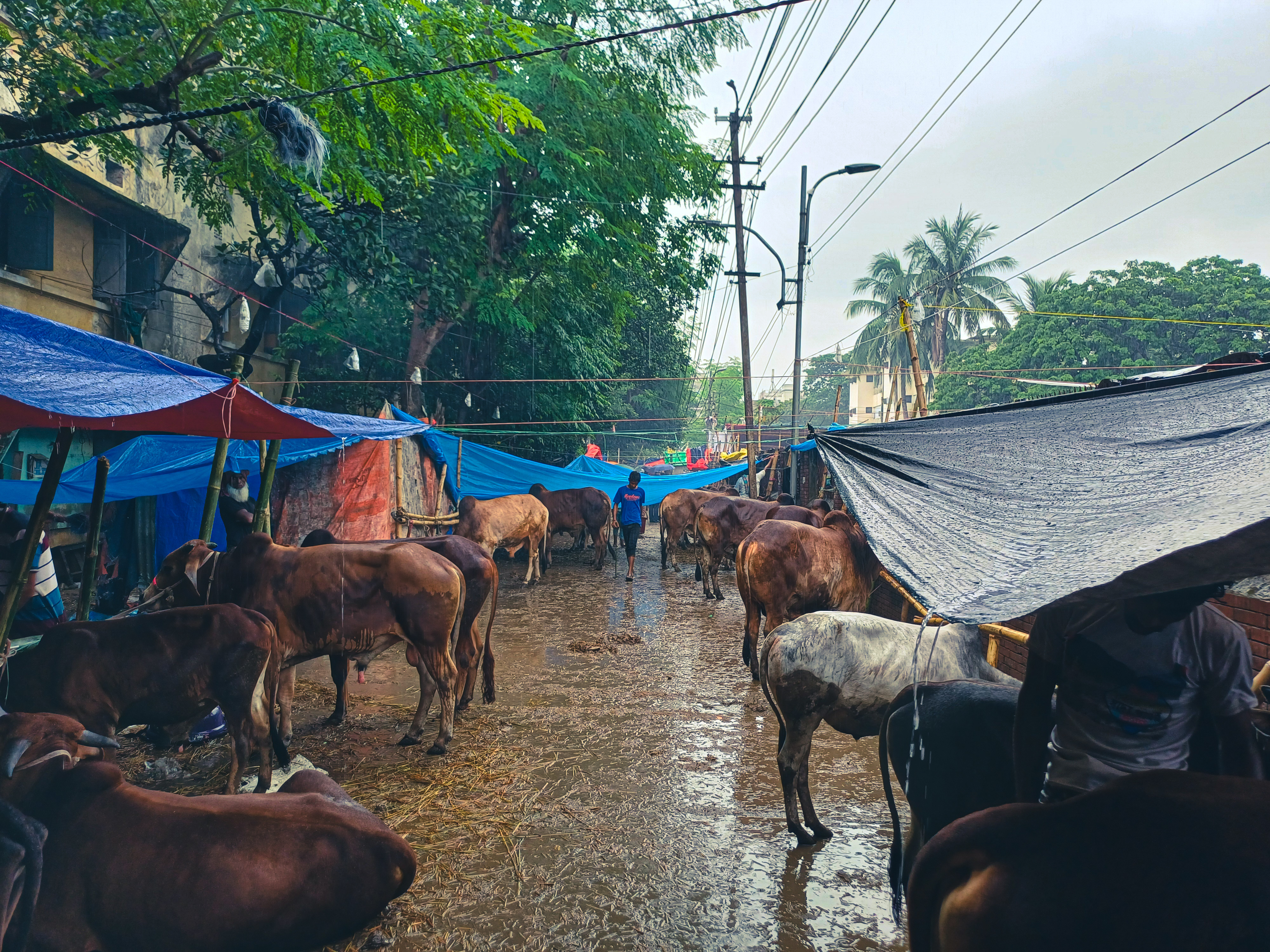
With only one day to go before Eid-ul-Azha in 2026, the sacrificial animal markets of Dhaka were in full swing. But rain had left them caked in mud, and buyers and sellers alike went through real hardship. Amid it all they haggled over cows, and in many cases they could not agree on a price.
That was the scene at the Kajla and Shanir Akhra markets in Dhaka's Jatrabari after rain at midday on Tuesday, 26 May, as Jagonews24 senior reporter Muhammad Fazlul Haque found on a visit. There was no shortage of cows and goats, he reported, but traffic jams and mismanagement were plain to see, so the festive business of buying a sacrificial animal carried a mark of discomfort. Eid-ul-Azha was due to be celebrated in Bangladesh on Thursday, 28 May.
Markets under mud, and water that would not drain
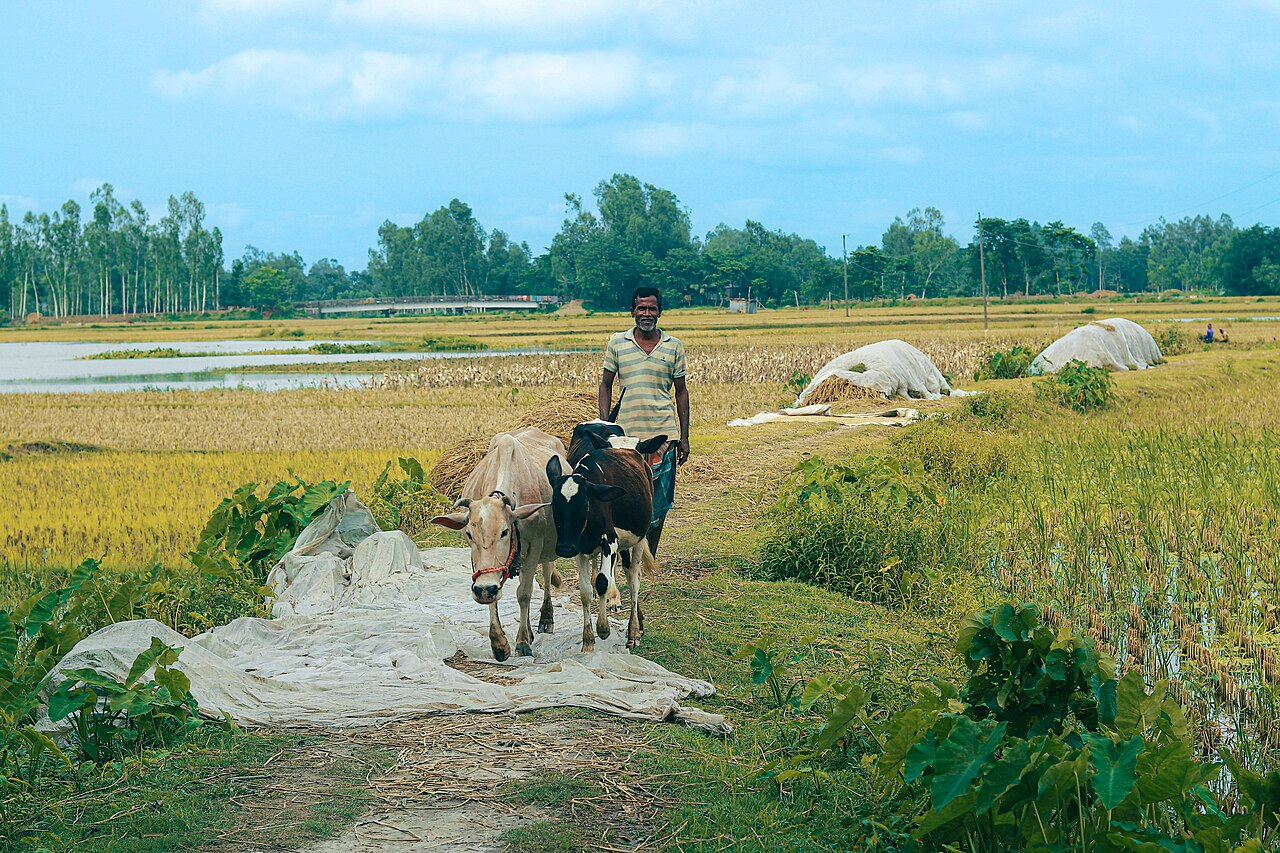
When rain fell on the capital at midday the day before, Monday, conditions at the markets became serious. Traders who had come from across the country with their cattle were stuck in mud, knee-deep in places and ankle-deep in others. Buyers were asking prices from a distance and walking away, the traders said.
Inside the market, cows stood in mud in some places, while elsewhere sellers were laying bamboo and straw to make temporary dry patches. Several traders alleged that although the market lessees had paid thousands of taka for their leases, they had made no effective arrangement to drain the rainwater, so buyers were losing interest in going inside. The report carried no response from the lessees. Farmers and traders from Kushtia, Madaripur, Jamalpur, Faridpur, Chuadanga, Manikganj, Rajbari, Tangail and Jhenaidah were in difficulty as a result.
A bdnews24.com report published at midday the same day described the same temporary market at Jatrabari. Two days of gusty wind and rain had torn away tarpaulin covers and left cattle pens under water, it said. Even light rain sent water pooling across the market, and it took hours to drain. Water, mud and dung turned the pens into slippery sludge, and traders and lessees were spreading straw and sand to give the animals some relief. Traders said the water from Sunday evening's rain had not fully drained until midnight.
The same report explained why the water stayed. Most of the rainwater from southern Dhaka drains through Jatrabari into canals and channels that carry it to the Shitalakkhya and Buriganga rivers. Those channels once cleared rainwater quickly, but encroachment and pollution had reduced the canals at Kutubkhali, Kajla, Mridha Bari and Shonir Akhra to little more than drains, so water backed up after even light rain. Traders feared that exhausted cattle sitting down in waterlogged pens risked illness or even death, and many said that if the weather did not improve they would have to sell below their expected prices.
Buyers' budgets and sellers' asking prices
Abir Hossain, a resident of Merajnagar, told Jagonews24 he had spent two hours looking for a medium-sized cow. His maximum budget was Tk 1.6 lakh, but the cow he liked was priced at Tk 2.5 lakh, so he was thinking of taking a share in a sacrifice rather than sacrificing an animal alone.
Another buyer, Ayub, said his family's budget was Tk 2 lakh to Tk 2.5 lakh, but the cows they liked were priced at Tk 3.5 lakh to Tk 4 lakh.
A Supreme Court lawyer and his family chose a handsome red cow at Shanir Akhra but could not agree on the price. They offered Tk 2 lakh; the seller wanted Tk 3 lakh.
Haji Ibrahim of the Konapara area bought a cow for Tk 1.88 lakh. Many people had not wanted to buy earlier because of the rain, he said, but on that day buyers were coming in reasonable numbers. In his view cow prices were a little higher than the year before.
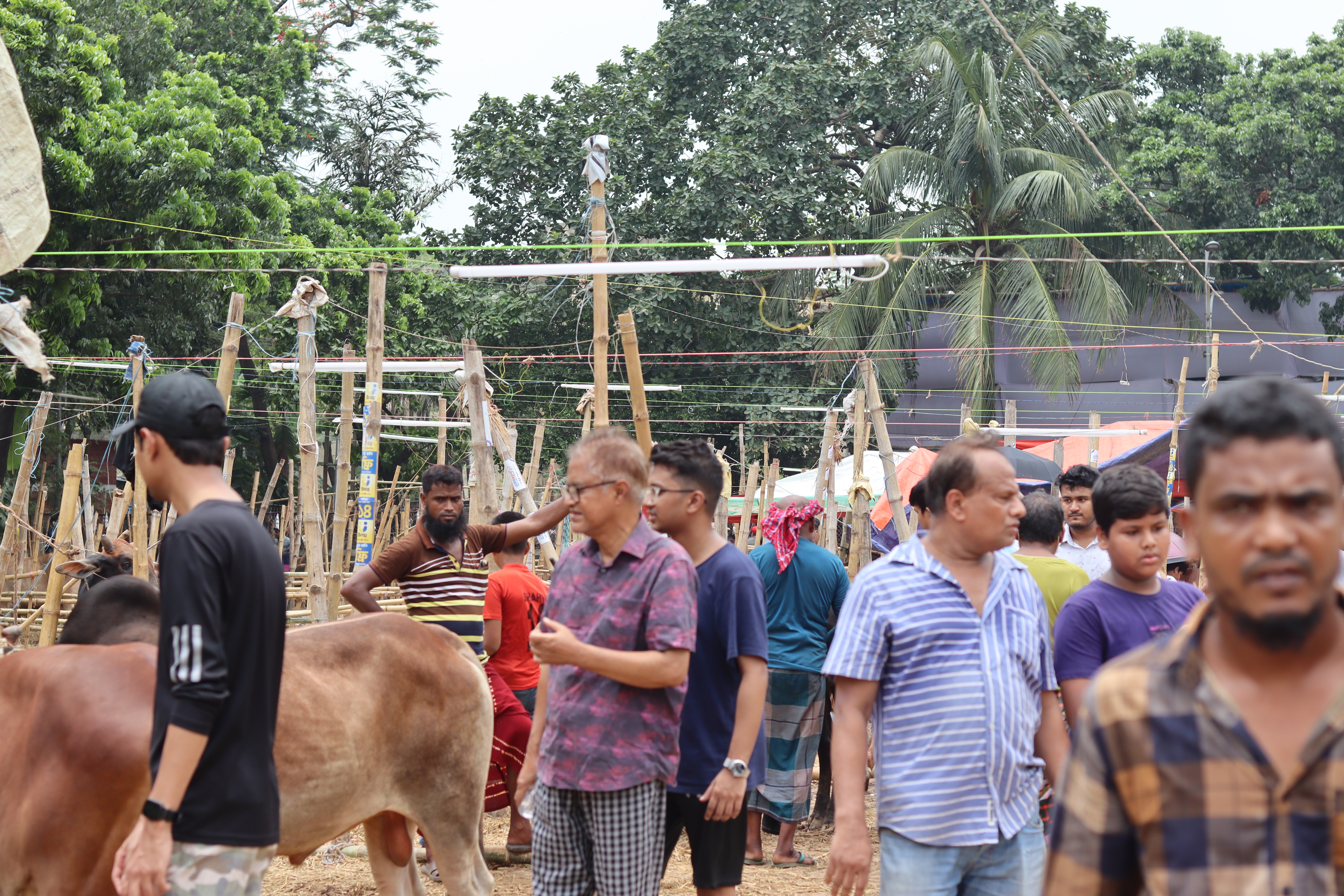
The same tug of war over prices was seen at other markets that day. Dhaka Tribune reported at midday on 26 May that, with a day left before Eid, sales had picked up at markets across Dhaka South City, but at the traditional Dholaikhal market sales were below expectations because of a gap between buyers and sellers. Some buyers there said prices were still high, while others said that, with the price of everything rising, cattle prices were manageable.
The cost of feed, transport and labour
Sellers, for their part, claimed that fodder prices had almost doubled in a year, on top of rising transport and labour costs. Selling at the prices buyers wanted, they said, would mean a large loss on each animal.
Shariful Islam, who came from Kalukhali in Rajbari, said: "Buyers are offering Tk 20,000 to Tk 30,000 less per cow. It is not possible to sell at that price."
Farmers had been making the same complaint about costs for weeks before Eid. After visiting several farms in Demra and Meradia in the capital on 8 May, Bangla Tribune reported that farmers blamed the higher cost of feed and transport for higher prices. A senior vice-president of the Bangladesh Dairy Farmers Association told the paper that cattle feed was very expensive, that the cost of bringing cattle to Dhaka was higher than ever and that herders' wages had also risen; by his reckoning, a medium-sized cow that used to sell for a little over Tk 1 lakh would now cost around Tk 1.5 lakh.
Writing about farmers in Tangail on 9 May, the Daily Inqilab reported complaints from smallholders that the prices of oil cake and bran had risen several-fold from the year before, leaving them unsure whether they would get a fair price at the markets. The farmers said they were raising their cattle on straw, oil cake, bran, molasses, rice and pulse meal and Napier grass they grew themselves. According to the district livestock office, Tangail's demand for sacrificial animals that year was about 2 lakh, against 2.34 lakh animals ready.
The weather added to the strain in the final days. New Age reported on 26 May that many traders had reached the markets two or three days earlier but had sold only a few cows; they also said the extreme heat of the previous few days had left their animals weak and uncomfortable.
Lower prices than in the village, and a hurry to go home
Md Iyadat Hossain had come from Alfadanga in Faridpur with 14 cows, nine of which were still unsold. He told Jagonews24: "Cows are not selling as targeted. Prices here are lower than in the village. All the cows I've sold went for between Tk 1.14 lakh and Tk 1.40 lakh. Nobody is bargaining over the slightly bigger ones worth Tk 2.5 to 3 lakh. Yet the traders who were with us have sold their cows in the village for more than this. They have gone home and we are still at the market."
Munaj Uddin, who brought 18 cows from Bakshiganj in Jamalpur, had managed to sell seven. "Cow prices are high in Bakshiganj, but in Dhaka I find them on the low side. I bought this red cow for Tk 1.70 lakh, and now I'm being offered Tk 1.40 lakh. The truck fare came to Tk 1,800 to Tk 2,000 per cow. How am I supposed to sell?" he said.
Another trader from the same area said he had brought 17 cows and sold seven so far. In his view people had less money that year, so they offered lower prices.
Md Hossain, who came from Char Fasson in Bhola with 30 medium-sized cows, said he had arrived on the night of Sunday, 24 May, and had sold nine by Tuesday evening. "I really started selling on Monday. With the rain and few buyers, the cows are not selling," he said.
Baharul Islam, who brought four cows from Magura to Kajla, was on the phone to his brother-in-law, telling him in his local dialect that it was raining hard there, that he would come home as soon as the cows were sold, and that he would not haggle much.
Speaking to Jagonews24 afterwards, Baharul said: "These are cows raised in our own shed. There's no reckoning of profit or loss. But my family is saying that in this rain the price doesn't matter; the cows have to be sold. Two of us came with the cows on Sunday night, but my brother-in-law went home this Tuesday morning. He phoned when he got home and I was talking to him."
He said he had sold one of the four cows for Tk 1.27 lakh and another for Tk 1.35 lakh. The truck fare from home to the market had been Tk 2,680 per cow. Once the remaining two were sold, he could go home.
bdnews24.com gave a price range for the Jatrabari market that day: cattle were priced from as little as Tk 70,000 to as much as Tk 500,000, with most animals between Tk 130,000 and Tk 220,000. It added that most buyers at Dhaka's temporary markets come in the two days before Eid, because they lack the space, staff and means to keep an animal longer in the city, which makes the final stretch the most important for traders.
Where the traders came from
The traders in the report had come from many parts of the country. Kalukhali is an upazila of Rajbari District in Dhaka Division, made up of seven union parishads, with a population of 172,347 in the 2022 census. Alfadanga, an upazila of Faridpur District, has six unions and had 119,631 people in the 2022 census.
Bakshiganj in Jamalpur is a border upazila of Mymensingh Division, with the Indian state of Meghalaya to its north and the Garo Hills to the north-east. It consists of a municipality and seven unions and had 239,857 people in the 2022 census. Char Fasson in Bhola is a coastal upazila of Barisal Division covering 1,440.04 square kilometres, bounded by the Bay of Bengal to the south, with more than 100 islands and chars, among them Char Kukri Mukri, Dhal Char and Char Nizam. Its population in the 2022 census was 518,817.
Magura is a district of Khulna Division, about 176 kilometres from Dhaka, lying on the flat plain of the Ganges delta, with four upazilas: Magura Sadar, Mohammadpur, Shalikha and Sreepur. The truck fare for bringing cattle from such districts is part of every trader's costs: Baharul Islam spoke of Tk 2,680 per cow, and Munaj Uddin of Tk 1,800 to Tk 2,000.
The Jatrabari market and Dhaka's rules for cattle markets
Jatrabari is a metropolitan thana of Dhaka South City Corporation at the start of the Dhaka-Chittagong Highway. It covers 13.19 square kilometres and had a population of 492,180 in the 2022 census. It is bounded by Sabujbagh and Demra to the north, Kadamtali and Shyampur to the south, and Gandaria and Sutrapur to the west.
According to bdnews24.com, that year's temporary market at Jatrabari stretched about one kilometre from Kajla to the Mridha Bari intersection and spilled onto the connecting roads. It had previously been held around the Dania College grounds but was moved to the Demra highway that year to ease congestion. A man in charge of one of the market's fee counters told the outlet that the new site had drawn more cattle than the year before.
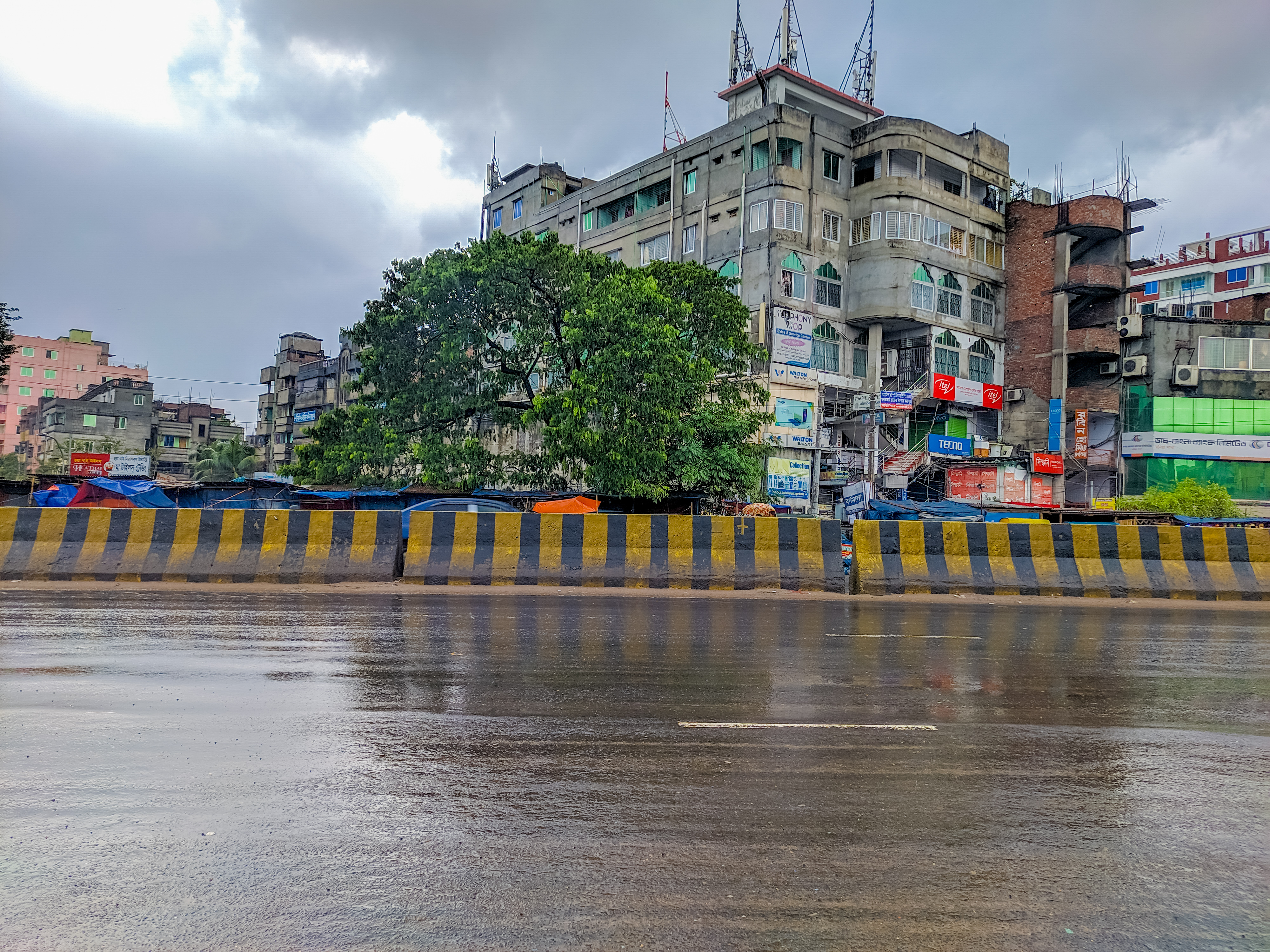
Dhaka Tribune reported on 19 April that 24 temporary markets were being prepared in the capital for Eid, 12 each under the south and north city corporations. The Dhaka South list included the roadside areas from Kajla Bridge to the Matuail Mridha Bari water pump, the site of this market. Citing the corporation's chief property officer, the paper said the markets would run for five days including Eid day; lessees had to pay the lease rate along with cleaning fees, 15 percent VAT and 10 percent income tax; and the authorities reserved the right to cancel or move any market if necessary.
A later Dhaka Tribune report, on 11 May, said 26 markets would be set up in the capital, 13 in each city corporation, and that most had already been leased. The permanent Sarulia market would not operate that year because the Water Development Board had acquired the land. The Dhaka South administrator warned that strict action would be taken against markets set up outside the designated areas or before the scheduled date. On 26 May New Age reported that 22 cattle markets, including the permanent ones, were operating under the two city corporations, and that official selling had begun on Sunday.
Rain had been forecast
The pre-Eid rain did not come unannounced. Citing UNB, The Financial Express reported on 24 May that the Bangladesh Meteorological Department had forecast rain in different parts of the country from 25 May to Eid day on 28 May, possibly continuing beyond. Its regular bulletin spoke of light to moderate rain or thundershowers with gusty or squally winds at many places in Rangpur, Mymensingh and Sylhet divisions and at a few places in Rajshahi, Dhaka and Chattogram divisions. A mild heatwave was meanwhile sweeping Khulna Division and districts including Dhaka, Faridpur and Madaripur.
On Monday, 25 May, bdnews24.com reported that the sky over the capital had darkened around 11:30am and heavy rain had begun at about 11:45am. A meteorologist at the department said a local thunder cluster that had developed to the north was moving slowly southward. In the 24 hours to 9am that day Dhaka recorded 17mm of rain, while the country's highest, 101mm, fell in Feni. A special weather warning said the Dhaka, Tangail, Cumilla and Sylhet regions, among others, could see gusty winds of 45 to 60km per hour with rain or thunderstorms, and river ports were asked to keep signal No. 1 hoisted.
New Age wrote on 26 May that torrential rain on Sunday and Monday had dampened trading at the capital's makeshift markets: many buyers who had arrived earlier left once the rain began, and trading resumed only when the weather returned to normal.
The supply of sacrificial animals in official figures
Official figures also pointed to ample supply. At a press conference at the secretariat on 3 May, the fisheries and livestock minister, citing the latest data from the Department of Livestock Services (DLS), said 12,333,840 animals were ready for sacrifice that year against a projected demand of 10,106,334. By his count, around 2,227,506 animals were likely to remain surplus.
- Cattle and buffaloes: 5,695,878
- Goats and sheep: 6,632,307
- Camels, dumba (fat-tailed sheep) and other species: 5,655
The year before, in 2025, 12,447,337 animals had been available. According to the DLS, 9,136,734 were sacrificed that year: 4,705,106 cattle and buffaloes, 4,430,668 goats and sheep and 960 others. Dhaka Tribune reported a surplus of around 33.10 lakh at the time. On 10 June 2025 The Business Standard, citing DLS data, reported that Rajshahi Division had the most sacrifices, 2,324,971 animals, and Sylhet Division the fewest, 319,823.
The wider picture of the country's livestock comes from the DLS publication Livestock Economy at a Glance (2023-2024). It put the cattle population in 2023-24 at 250.13 lakh, buffaloes at 15.24 lakh, goats at 271.17 lakh and sheep at 39.03 lakh. At constant prices, livestock made up 1.80 percent of GDP and 16.33 percent of agricultural GDP (provisional figures). The publication states that 20 percent of people are employed in the sector directly and 50 percent partly. Meat production that year was 92.25 lakh metric tonnes.
Rain and mud had also marked Dhaka's markets at the previous Eid. Prothom Alo English reported on 5 June 2025 that the capital's 22 designated markets were crowded despite intermittent rain and muddy conditions, and some buyers said prices seemed a little lower than the year before. Animal health services are also arranged at the markets each year: in 2023 the Daily Ittefaq reported that the DLS had formed 22 veterinary medical teams for Dhaka's markets and 1,697 across the country.
The rules for a shared sacrifice
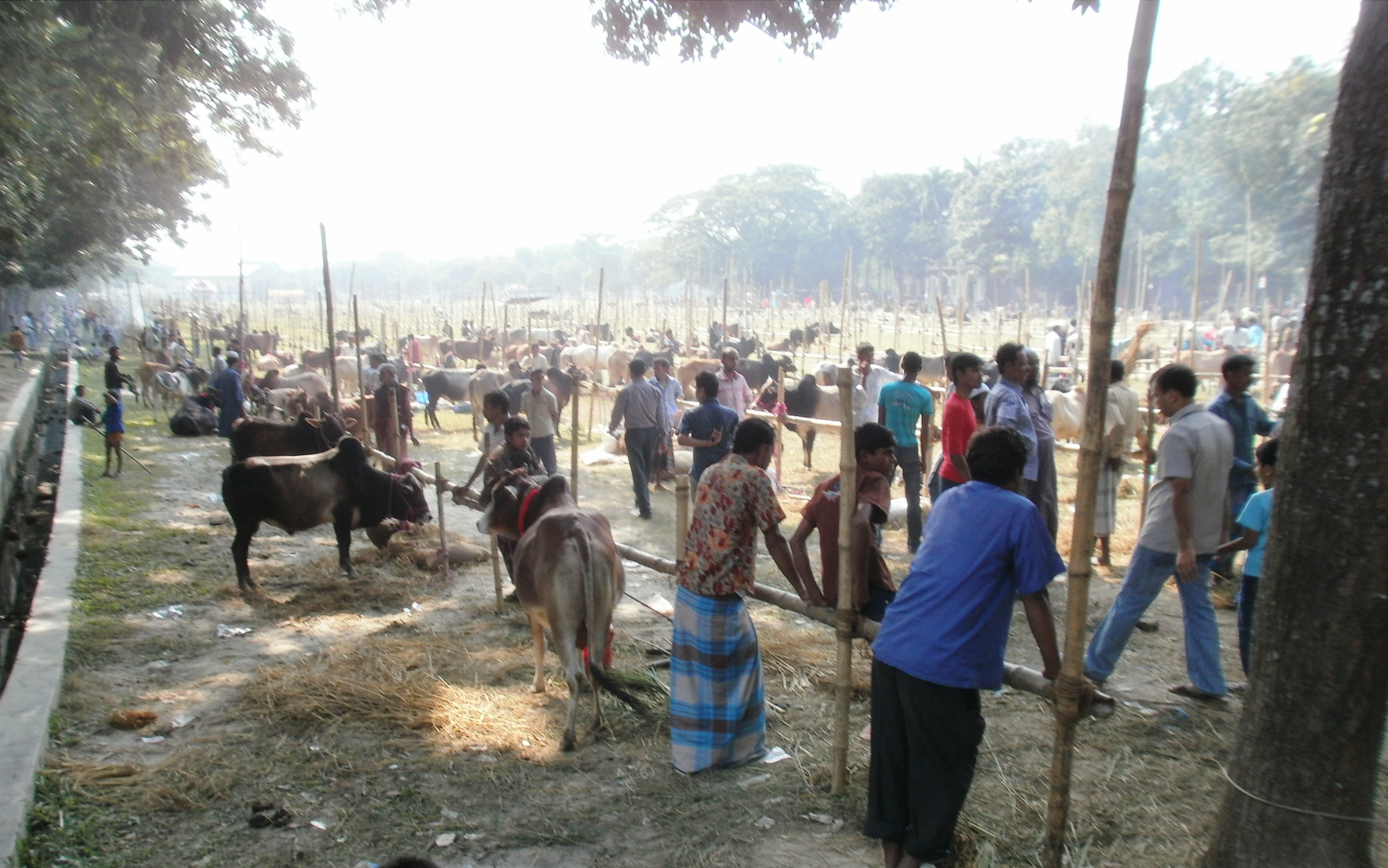
The shared sacrifice that Abir Hossain was considering when his budget fell short is common in Bangladesh. An article in Prothom Alo's religion section on 24 May said that under Islamic law up to seven people may share a cow, buffalo or camel, and that with more than seven the sacrifice is not valid. It cited a hadith in Sahih Muslim in which Jabir said that at Hudaybiyyah they had sacrificed with the Prophet, seven sharing each cow and each camel.
The article added that each sharer's portion must be at least one seventh, and that the meat of a shared sacrifice must be divided equally by weight, not by estimate. It also said it is better to settle the sharers before the animal is bought.
Under Islamic law the sacrifice may be made from the morning of the 10th of Dhu al-Hijjah to sunset on the 12th, or to sunset on the 13th in the Shafi'i school. The animal must be healthy and free from disease, and may not be blind, one-eyed, or missing parts of its tail or ears. By custom the meat is divided into thirds: one for the person making the sacrifice, one for the family and one for the poor and needy. In Bangladesh, Eid-ul-Azha is widely known as Korbanir Eid, and temporary cattle markets begin to appear across the country from the start of Dhu al-Hijjah.
Photo: S.M.M.Musabbir Uddin / Wikimedia Commons (CC BY-SA 4.0)
Sources: Jagonews24, bdnews24.com, New Age, Dhaka Tribune, The Financial Express, Bangla Tribune, Daily Inqilab, Prothom Alo, The Business Standard, The Daily Ittefaq, Department of Livestock Services, Wikipedia
Comments
(0)