
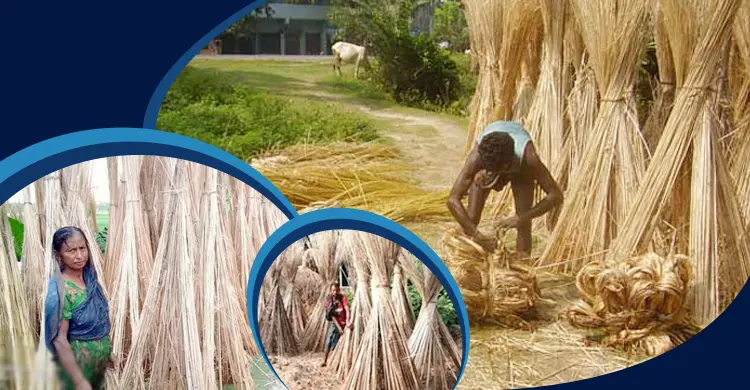
Farmers in Sharsha and Benapole in Jashore are gaining this season as the price of jute sticks has risen. The golden fibre has yielded well this year. Retting is under way and new jute has started selling in local markets. Along with jute, jute sticks are also in greater demand this season, with local traders buying them straight from growers' homes. Farmers say they are happy with the strong demand and higher prices.
According to the agriculture department, people in rural Bengal use jute sticks as fuel all year round, especially in winter and the rainy season. Besides fuel, jute sticks are used to make particle board, and the ash from burnt jute sticks is used as ink for computers. As a result, jute sticks, like jute itself, are fetching good prices in the upazila this year, and farmers are earning well from selling them.
Farmers' earnings
Jahan Ali, a jute grower from Shyamlagachhi village in Sharsha, said he had grown jute on 5 bigha this year. If he can dry the jute sticks from that land well and sell them, he will earn an extra Tk 20,000-25,000.
Ali Azgar, a farmer from Mandartala village in Lakshmanpur, said: "Jute prices are good this time too. On top of that I sell each bundle of jute sticks for Tk 10-20 depending on size. Wholesale, 100 bundles are selling for Tk 900-1,900. Farmers can meet their fuel needs and still bring home extra money. Jute sticks are selling at double last year's price."
Nur Islam and Karim Gazi, traders from the Baropota area of Benapole, said: "We buy jute sticks from farmers' homes in every village and sell them in town. There is good demand in both villages and towns. Jute sticks are used for fences around houses and vegetable fields and for trellises. Many farmers also burn jute sticks and use the ash as fertiliser in their fields."
Area under jute
Upazila agriculture officer Dipak Kumar Saha told Jagonews: "The largest area under jute this time is in this upazila. It includes tossa, deshi, mesta and kenaf varieties. In the current 2023-24 fiscal year jute was grown on 5,465 hectares, 5 hectares more than last year. In 2022-23, jute was grown on 5,460 hectares in Sharsha upazila. Jute sales have already begun, with a maund selling for Tk 2,500 to Tk 3,000 depending on variety. Besides jute, farmers are earning extra from selling jute sticks."
Source: Jagonews24. First published in Bengali on The Agro News.
Comments
(0)