
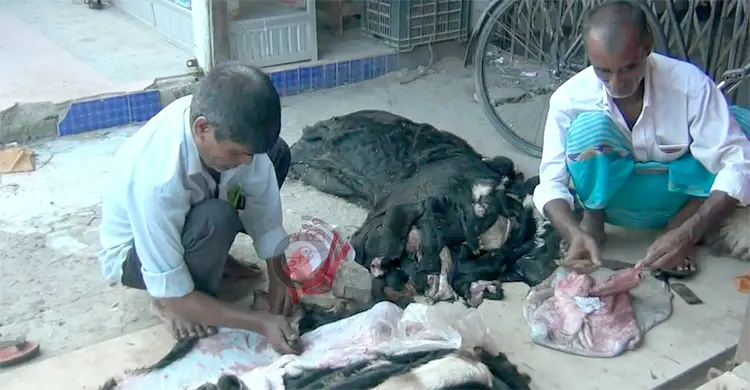
The market for the hides of sacrificial animals has collapsed in Joypurhat. Seasonal hide traders complain that in the district's markets they are having to sell hides for a quarter of the price of previous years. With prices so low, hides are lying on the ground in many places.
Middlemen and seasonal traders hit by the crash are at a loss. The poor people who each year receive a share of the money from the sale of sacrificial hides will get nothing this time. Where a pan (betel leaf) costs Tk 5, a goat skin is also selling for Tk 5.
From Tk 400 to Tk 5
Local traders believe prices have fallen because of a shortage of capital and money owed to them by tannery owners. In previous years a goat skin sold for Tk 200 to 400 in the district's markets; this year, depending on size, it is selling for only Tk 5 to 10. A cow hide that sold for Tk 800 to more than Tk 1,000 is now fetching only Tk 200 to 400. Seasonal traders are making losses.
People who sacrificed animals across the district, including Babu Mia of Teghar village in Joypurhat Sadar upazila, Afzal Hossain of Molamgari village in Kalai upazila, Hanif Hossain of Dashra village in Khetlal upazila and Ahsan Habib of Fiskaghat village in Panchbibi upazila, said the poor receive a share of the money from sacrificial hides every year but will get nothing this time. They had not seen such a depressed hide market in several years. No leather product can be bought for less than Tk 500, yet hides are cheap, they said, and the government should look at the industry.
Seasonal traders including Babulur Rahman Selim of Shantinagar in Joypurhat town, Shahidul Islam of Pramanikpara and Motiur Rahman of Jamalganj Bazar said they were at a loss over the price fall. Every year they invest money in this one- or two-day trade at Eid and make a good profit, but this year they are counting losses.
Speaking on condition of anonymity, many small middlemen (foria) said that if the border were not so tightly guarded they could have sent hides across and made some profit, but that is not happening this time.
Dues owed by tanneries
Joypurhat town hide traders Altaf Hossain and Sardar Nabab said: "Tannery owners owe us lakhs and lakhs of taka. With no money in hand, we can't buy as many hides as we want. So demand in the market is low and hide prices have fallen."
Some traders also claimed that because the BGB has increased border patrols to stop hide smuggling, hides must for now be traded in the local market, and the slightly lower demand is causing the price fall.
Ohedul Hossain Chhoton, a leader of the Joypurhat hide traders' association, told Jagonews that tannery owners, acting as a syndicate, were making all sorts of excuses not to pay dues from past years. At the same time, they ignore the prices set by the government and fix prices as they please. "As a result we are forced to sell hides for next to nothing," he said.
He added that his father and grandfather had been in the trade, and now they were. "This business is in our blood. Even if we want to give it up, we can't."
Border guarded
Lt Col Rafiqul Islam, commander of the Joypurhat-20 BGB battalion, told Jagonews that the border under the battalion was about 41.5 kilometres long, of which 22 kilometres was fenced with barbed wire and the remaining 18 kilometres was not. Smugglers mainly use this unfenced stretch, so it is kept under constant surveillance and extra BGB members have been deployed.
He said not a single cow had been allowed to come across the border this time, and efforts continue to make sure sacrificial hides are not smuggled into India. Instructions have been given to the battalion's 120 posts and camps.
Source: Jagonews24. First published in Bengali on The Agro News.

Comments
(0)