
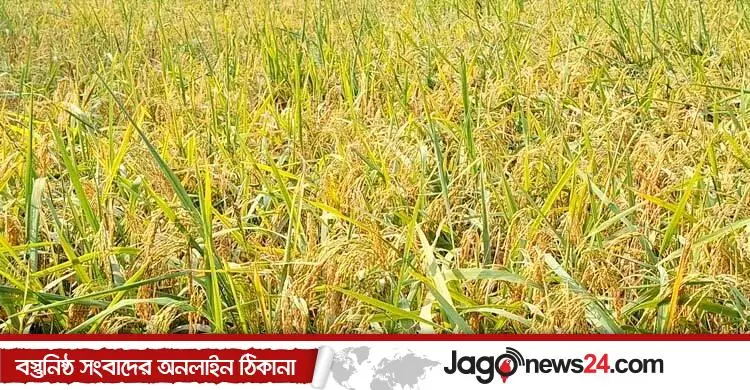
Jhum paddy is grown on hill slopes, but this year it has been grown on plain land in Jhenaidah. Using little irrigation, fertiliser and pesticide, farmer Abdur Rahim has got an excellent yield. Rahim, of Ramnagar village in Kumrabaria union of the district's Sadar upazila, grew the variety "Sentu Pajam 21". With a hill variety giving a high yield on plain land, the district agriculture department sees a new opportunity.
Sentu Pajam 21 is grown in Sherpur, Jamalpur, Netrokona and the hill regions, on the slopes of hills and hillocks. It was developed by Sentu Kumar Hajong, a farmer of Nalitabari upazila in Sherpur, and the variety is named after him. Sherpur's hill jhum paddy Sentu Pajam 21 is a high-yielding variety made mainly by crossing local Pajam with Indian Ranjit (Pajam) paddy, and is grown as jhum paddy in Jamalpur, Sherpur and hill areas.
Seed ordered online
Abdur Rahim became interested after seeing this unusual cultivation on the internet. He ordered just 3kg of seed online and planted it on fallow land. He told Jago News: "I made contact online and bought 3kg of seed, which came to my address by courier. I planted that seed. This paddy did not need even 10 per cent of the irrigation aman paddy needs. Fertiliser and pesticide use was very limited. The production cost is Tk 7,000-8,000 per bigha."
He said: "I planted this paddy on 10 katha. I also gave seed to my nephew and one other person, and they got excellent yields too. This paddy gives more yield at half the cost of aman. I will get about 25-26 maunds from my 10 katha. I plan to grow it on more land next season."
Elahi Mondal, a farmer of Ramnagar village, told Jago News: "I see this paddy every day going to and from the field. My neighbour Abdur Rahim grew it. I thought, he has planted it on fallow land beside a bamboo grove, it won't yield. He doesn't irrigate or fertilise, so it won't be good. Now I'm amazed at the yield. You rarely see such a high yield at such a low cost. Next season I will grow this paddy too."
Sadar upazila agriculture officer Md Nur-e-Nabi told Jago News: "We too were quite surprised to see how this paddy was grown. The land it was grown on is high ground. The farmer did not need extra irrigation as for aman, and used fertiliser and pesticide sparingly. The grain is somewhat coarse. Cultivation and yield on plain land have been very good. We found more than about 300 grains on each panicle. We hope cultivation of this paddy will increase."
Source: Jagonews24. First published in Bengali on The Agro News.
Comments
(0)