
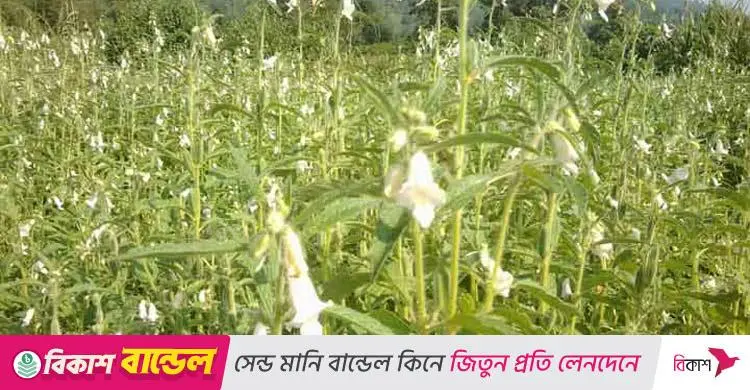
Costs and diseases are low, and it needs little care, so sesame cultivation is growing in Jhalokati. Strong demand in local markets and across the country brings good prices. Because it is three times as profitable as other crops, farmers are becoming more interested day by day, and they hope to get back on their feet by growing more sesame.
Area under sesame
In 2024 sesame was grown on 392 hectares in Jhalokati district; this year it has been grown on 396 hectares. Most is grown in the remote upazila of Kathalia. Sesame covers 86 hectares in Jhalokati Sadar, 35 hectares in Nalchity, 110 hectares in Rajapur and 165 hectares in Kathalia.
Farmers including Salam, Abu Bakar, Masum and Jalil Sikder said that besides local varieties, farmers in the district are succeeding with BARI Til-2, BARI Til-4 and BINA Til-3. They can harvest the crop within just 3 months of sowing. Sesame involves less trouble than other crops and has few diseases, so little pesticide has to be sprayed, and no chemical fertiliser is needed.
The Department of Agricultural Extension (DAE) says the agriculture department provides demonstration plots as well as the necessary training and advice for good sesame yields. The DAE expects sesame cultivation to increase further.
Agriculturist Abdullah Al Mamun, deputy director of the DAE, said: "This season sesame has been cultivated on 396 hectares in the district. We believe that if its cultivation expands across the country, it will be possible to meet the shortfall and demand for edible oil."
Source: Jagonews24. First published in Bengali on The Agro News.
Comments
(0)