
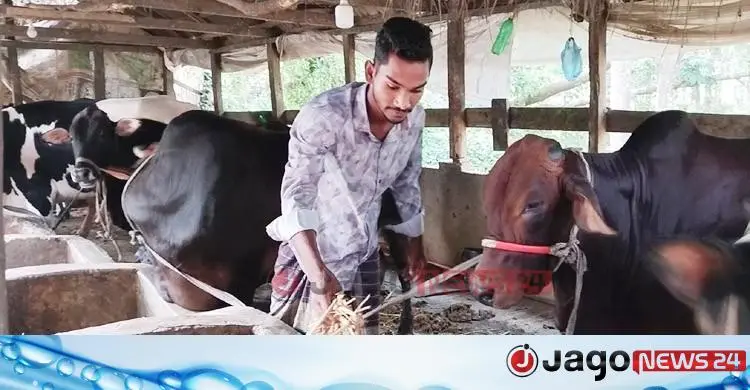
Local farmers in Jhalakathi are now profiting more from raising deshi (local) cattle. Instead of chasing work abroad or jobs, hundreds of educated young people in the district have found a path to prosperity on their own land. By fattening cattle the traditional way, they are becoming self-reliant while also meeting the district's demand for meat.
According to the district livestock department, demand for sacrificial animals in the district this year has been set at 30,234. Against that, farmers have 30,588 animals ready for Eid-ul-Adha, 354 more than needed.
The district has 1,535 farms in total, 163 registered and 1,372 unregistered, and all of them are busy with last-minute preparations.
Natural feed and no hormones
Farmers Md Khalil Rahman and Md Yasin of Sadar upazila said they had found more peace of mind and profit in livestock than in the uncertainty of life abroad or other jobs. They started with just one cow each, and through hard work their farms now have up to 20 to 22 improved cattle.
"We are raising our animals on natural feed such as oilcake, bran, grass and straw, without any harmful injections or hormones," the farmers said. "With uncertainty over Indian cattle and buyers' strong interest in deshi cattle, we now hope for a fair price and a good profit."
It is the same picture at the farm of Bahadur Sikder in Azimpur, Nalchity upazila. He said that although cattle feed prices had risen abnormally, deshi cattle suffer less disease and are in special demand, so small farmers are escaping losses. The district's former dependence on animals from other districts has now ended completely, he said.
The district Department of Youth Development has played a big role behind this change, with many unemployed young people turning their lives around through its training and easy-term loans. One successful entrepreneur, Md Saidul Mollik, said: "I gave up the idea of going abroad, took technical training from Youth Development, and started a farm by buying one cow. Now 17 well-fed cattle on my farm are ready to sell for Eid."
Md Alauddin, deputy director of the district Department of Youth Development, told Jagonews: "Young people in Jhalakathi are now much more aware. Instead of wasting money on middlemen to go abroad, they are becoming self-reliant by training and raising livestock. We are building them up as entrepreneurs with loans and all kinds of technical support, which is having a positive effect on the district's economy."
Vet teams for the cattle markets
Assuring buyers of safe and healthy animals, district livestock officer Dr Nirod Baran Joydhar said: "There has been a quiet revolution in raising deshi cattle in Jhalakathi. Farmers are now fattening animals by fully scientific and natural means. The 1,535 farms on our list are being monitored regularly. For Eid, veterinary medical teams will be active in the field to ensure the health of every animal and to detect sick animals at the markets."
Of the 30,588 animals ready in the district, 9,808 are bulls, 8,870 bullocks, 1,774 cows, 139 buffaloes, 9,965 goats and 32 sheep. Local farmers say that if the illegal entry of Indian cattle stays stopped, they will get a fair return for their work and the number of farms will grow further.
Source: Jagonews24. First published in Bengali on The Agro News.

Comments
(0)