
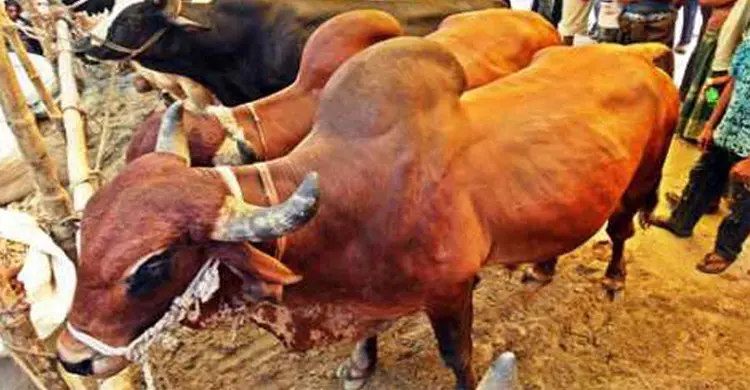
Ahead of Eid-ul-Azha, about 19,000 animals have been prepared in Jhalakathi district this year. There are no commercial farms in the district; the animals are being raised by families. They have been fattened naturally on green grass, straw, various kinds of bran, pulse powder, rice, rice starch, oil cake and some vitamins. Hoping for extra profit, farming families are busy giving the animals extra care in the final days.
According to the district livestock office, the district's demand for Qurbani animals is 18,121, and 18,862 are ready. They include 8,111 bulls, 3,231 oxen, 2,188 cows, 37 buffalo, 5,296 goats and 17 sheep. There are more than 3,000 family farmers, large and small, in the district.
Meanwhile, cattle feed prices keep rising ahead of Eid. Farmers' daily feed costs have gone up by 25 to 30 percent. On top of that, if seasonal traders import cattle from India and farmers cannot sell at fair prices, they will suffer heavy losses.
Fattening on home farms
Farmers say some are fattening animals in their home cowsheds and others on family farms, feeding them naturally grown green grass. Besides straw, many are feeding oil cake, wheat bran, maize powder, rice bran, mung bean husk and chickpea husk. These farms have also created jobs for many people, and farmers hope to earn extra income by selling the animals at the coming Qurbani Eid.
Waliur Rahman of Darakhan village in Sadar upazila said 10 bulls, local and foreign breeds, are being fattened on his family farm, with cattle priced from Tk 80,000 to Tk 1.2 lakh.
Kankan Bepari of Dumuria in Sadar upazila said he has built a family farm with 12 cattle: four dairy cows and five for Qurbani, while the rest are not fit for sale. But with feed prices rising as they are, covering costs and making a profit is very difficult.
Feed and labour costs
Sujan Sarkar, who runs a family farm, said feed prices have risen. A 37 kg sack of wheat bran now sells for Tk 2,200, up from Tk 1,800. A 74 kg sack of oil cake is now Tk 3,400 to 3,600, against Tk 2,800 last year. Fifty kg of rice bran costs Tk 900, up from Tk 700 last year. Straw is now Tk 15 a kg, up from Tk 10. Grass pea and chickpea bran have also gone up by Tk 10 a kg. Feed prices have risen seven or eight times over the past few years.
Other farmers said farm workers were paid Tk 500 a day two years ago but now have to be paid Tk 750. With the cost of raising animals rising, no one is interested in commercial farming, and farmers are hardly seeing a profit after paying the high interest on bank and NGO loans.
District Livestock Officer Krishibid Dr Md Saheb Ali said that, in line with central bank instructions, the office has spoken with various banks in the district, and bank staff will be at every cattle market. Buyers and sellers will be able to use e-banking with any bank account and QR code. "We expect about 19,000 animals to be bought and sold in the district. We are visiting every farm in the district's four upazilas and giving the necessary advice and medicines," he said.
Source: Jagonews24. First published in Bengali on The Agro News.
Comments
(0)