
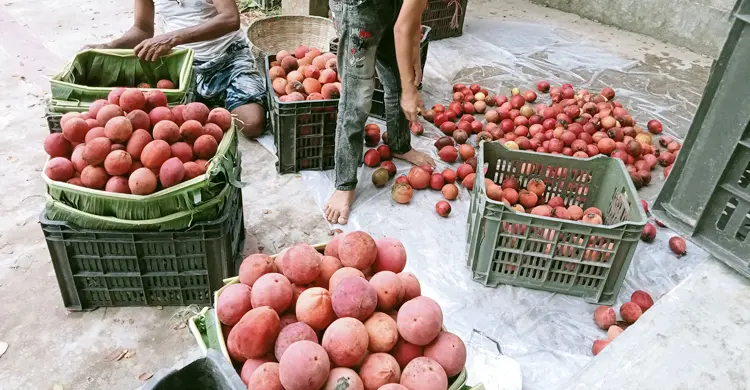
Bilati gab trees spring up in gardens without any sowing, planting or care. Once a tree is five years old it starts bearing red fruit weighing about 300 grams, known locally as bilati gab. The tasty fruit has now gone beyond the villages and is reaching different parts of the country. Wholesalers collect it from rural areas by announcing over loudspeakers, buying a kuri (20 fruits) for Tk 80 to Tk 100 depending on size, and send it by passenger transport to different parts of the country, especially Dhaka, Chattogram, Cumilla and Sylhet.
Trader Khalil Howlader has set up a collection depot on the grounds of an ebtedayee madrasa in Mobarakkathi village of Rajapur upazila, with 10 to 12 others helping him. This season they all help collect bilati gab from the villages and pack it.
From village to city depots
Khalil Howlader said the fruit is collected from surrounding areas by loudspeaker announcements, paying Tk 4 to Tk 5 a piece depending on size. It is brought to the depot and washed in the pond next door to clean off dirt, which makes it shine. It is then packed in plastic crates wrapped in banana leaves.
He said it is sent by passenger transport to aratdars in Dhaka, Chattogram, Cumilla, Sylhet and other big cities, who sell it by the kilogram and send the money owed. The trade runs in the Bengali months of Asharh and Srabon; at other times of the year other trades are run the same way.
Local people say ripe gab is in season for the two months of Asharh and Srabon, when markets across the district are filled with its fragrance.
Traders buy gab wholesale at many markets and from house to house and supply it commercially to towns and ports across the country, including Boro Bazar, Chandkathi Bazar, College Mor and Kathpatti in Jhalakathi town, Bagri Bazar in Rajapur, Sadar Bazar, Putiakhali, Lebubunia Bazar, Pakapul Bazar, Galua Bazar, Nalbunia Bazar, Fakirer Hat, Charakhali Hat, Badurtala Hat, Kachari Barir Hat, Balarjor Hat, Gazir Hat, Parer Hat and Bypass Mor Bazar.
Grows without care, but trees are declining
Majid, Altaf and Sultan of Kistakathi village said bilati gab trees need no seed sowing, sapling planting or care. Fruit falls from the trees and is spread by birds that eat it, so the trees grow naturally. Because bilati gab is tasty and chemical-free, demand is high, and it is now served to guests too. Everyone likes this nutritious fruit, free of adulteration and formalin, they said.
Almost every home in Jhalakathi district has a few gab trees. They need no fertiliser or pesticide, but they do need upkeep. For lack of care, the number of gab trees is falling. Planting and tending more gab trees could earn large sums every year.
Wholesale gab traders Shahidul Islam of Galua Bazar in Rajapur and Harun Sardar of Pakapul Bazar said a kuri (20) of ripe gab can be bought at markets across the district for Tk 80 to Tk 100 depending on size. The fruit then sells wholesale at the arats for Tk 700 to Tk 800 per 100, and city aratdars sell each gab to consumers for Tk 10 to Tk 12.
Monirul Islam, deputy director of the Department of Agricultural Extension (DAE) in Jhalakathi, said the soil in the region is very fertile, so gab, like all fruits, yields well, with a bumper crop every year. After meeting local demand, the fruit is now being supplied commercially to different parts of the country.
Dr Mehedi Hasan Sani, resident medical officer of Jhalakathi Sadar Hospital, said gab is a local fruit free of formalin and adulteration, and is as nutritious as it is tasty.
Source: Jagonews24. First published in Bengali on The Agro News.
Comments
(0)