
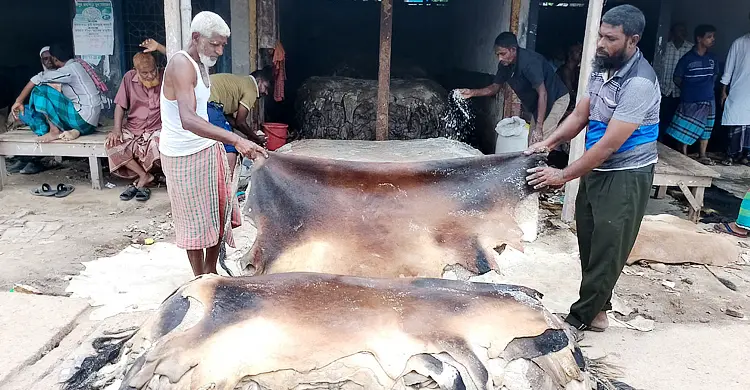
Hide traders at Rajarhat in Jashore, the largest rawhide market in the south-west, are worried by a triple crisis: a cash shortage because tannery owners and wholesalers in Dhaka owe them money, uncertainty over how hide prices will be set, and soaring prices for salt, which is needed to process hides. Traders are preparing for the post-Eid hide market with these three problems.
Around 10,000 small and large traders from the south-west do business around the Rajarhat market. At least Tk 10 crore worth of hides change hands at the post-Eid market alone. Besides traders from the 10 districts of Khulna division, large traders from Gopalganj, Faridpur, Madaripur, Jhalakathi, Rajshahi, Pabna, Ishwardi and Natore trade hides here, and major wholesalers and tannery owners in Dhaka also keep an eye on the Rajarhat market.
Usually more than a lakh hides are bought and sold at Rajarhat on the market day after Qurbani. But besides the impact of the coronavirus and lockdowns, the hide market has seen a notable fall in prices in recent years, and the pressure of unrecovered dues from tannery owners has added to it.
Unpaid dues and a cash shortage
Rajarhat traders said tannery owners and wholesalers in Dhaka and other regions owe them about Tk 10 crore. If the dues are not recovered as hoped, they will be short of cash to buy sacrificial hides. Animal prices are also comparatively high this year, while high commodity prices and market conditions may reduce the number of animals sacrificed, which would cut the supply of hides. They are worried about all this, but since the country has returned to normal after the coronavirus shock, they hope the hide market will recover this Eid-ul-Azha.
Traders said many have not recovered dues from tannery owners and are under the pressure of continued losses, so many at Rajarhat are short of capital.
They claim tannery owners owe Jashore traders at least Tk 10 crore. Government loan facilities are not available either: big traders get bank loans but small traders do not. So small traders have to depend on borrowing and NGO loans for cash to buy hides at the post-Eid market, and this year too each is trying to raise cash in their own way.
Worries over prices
Besides unrecovered dues and the cash shortage, traders are anxious about how hide prices will be set. They expect that, as every year, good-quality cowhide may be priced at Tk 35-40 per square foot. If hides are not bought from the field according to that price, there is a risk of losses.
Seasonal traders often destabilise the market by buying hides at higher prices, so traders want the price set a little higher. Hide trader Hasanuzzaman Hasu, a former lessee of the Rajarhat hide market, said the market is fairly good at the moment, with medium cowhides selling for Tk 800-900 and large ones for Tk 1,200-1,300. But it is too early to say how the post-Eid market will go, because small traders are short of cash, with about Tk 10 crore owed to them by tannery owners and wholesalers, and they are anxious about how they will buy hides.
He said there are also worries about hide prices, and in the current situation a price of Tk 40-45 per square foot would be good.
Costly salt
On top of these problems, salt, the input needed to process hides, has become very expensive. Salt that traders bought last year at Tk 900 to Tk 1,000 a sack (70 kg) now costs Tk 1,300 to Tk 1,400. At this price, processing each hide now costs more than Tk 200 including salt and labour, and this extra cost is adding to traders' fears.
Alauddin Mukul, general secretary of the Greater Jashore District Hide Traders' Association, said the rising price of salt is increasing the cost of processing hides, so small traders will face challenges in buying raw hides, processing them and selling them. And because money is owed by wholesalers in Dhaka, they are worried about how small traders will buy hides.
In addition, the administration has said hides from the district cannot be sent to Dhaka for a week after Eid. The decision was taken centrally, so traders will have to store hides locally during this period.
Jashore deputy commissioner Md Tamizul Islam Khan said no hides may be sent to Dhaka for a week after Eid under a central directive, taken to keep the hide market stable.
He added that since Rajarhat is one of the region's biggest hide markets, all steps have been taken to ensure post-Eid trading goes smoothly. A meeting has been held on the matter, and the administration is working to ensure the market's security and all other facilities.
Source: Jagonews24. First published in Bengali on The Agro News.

Comments
(0)