
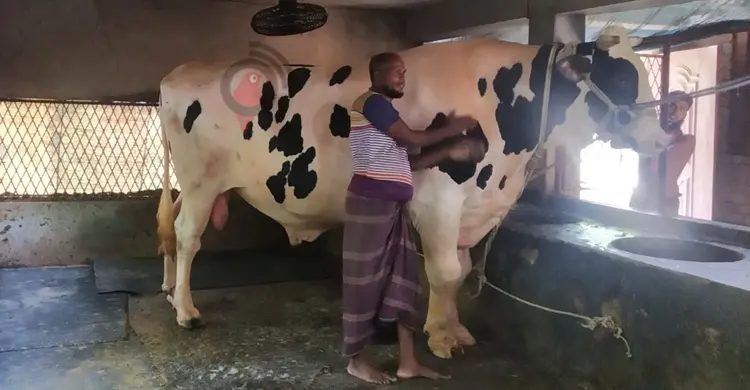
Farmers in Jashore are ready to catch the market for Eid-ul-Azha. About 10,000 farmers in the district have prepared more than 80,000 cattle and goats for sale, including 31,000 cattle and about half a lakh goats.
Besides farmers, many individuals have also prepared cattle and goats for sacrifice, and the total may exceed 90,000. The district livestock office said the district's surplus animals will therefore go to other parts of the country.
Upazila by upazila
According to the Jashore district livestock office, 9,131 farmers in the district have a total of 31,021 cattle on their farms. Chaugachha has the most, with 8,975 cattle on 2,483 farms, and Abhaynagar the fewest, with 1,574 cattle on 593 farms. Jashore Sadar upazila has 3,444 on 1,041 farms, Manirampur 4,964 on 2,009 farms, Jhikargachha 3,747 on 881 farms, Sharsha 2,910 on 938 farms, Keshabpur 3,462 on 543 farms and Bagharpara 1,945 on 643 farms. Demand for cattle at Eid in the district is about 29,000, leaving a surplus of more than 2,000.
Farms also hold 49,075 goats and sheep. Household goats, kept one or two at a time, are still being counted; as the list is updated continuously, the number should reach about 60,000 before Eid. Demand for goats in the district is also about 60,000.
Farmers hope for good prices
Kamal Hossain, a farmer in the Basundia area of Jashore Sadar upazila, said he has 22 cattle and will take 12 of them to market for Eid. Because of the coronavirus and other reasons, he could not sell as many animals as he wanted last year. With no coronavirus this year, he hopes for a good price.
Afzal Hossain, a farmer from Dhakuria village in Manirampur upazila, said livestock feed prices have risen this year, pushing up the cost of raising cattle, so cattle prices are also higher. If Indian cattle do not come in through smuggling routes, cattle will sell at good prices, he said.
Abdus Sobhan of Bejiatala village in Panisara union, Jhikargachha upazila, said he has 24 cattle, of which he will sell 10 to 12 at Eid. All are local breeds, and he hopes to sell them for Tk 1.1 lakh to Tk 1.2 lakh each.
Tanvir Hossain of Bashuari, Radhanagar village, in Bagharpara upazila is raising 14 cattle on his farm this year and hopes to sell each for Tk 1.5 lakh to Tk 2 lakh.
Farmers say that after the coronavirus most of them raised animals for Eid with their own savings, while many took loans from NGOs or banks. With feed prices up, the cost of raising animals has risen, and if they do not get prices to match, farmers will be ruined.
Medical teams and cashless payments
The district livestock office said there will be 24 cattle markets across Jashore's eight upazilas, with 24 medical teams working at them for Eid. Along with online buying and selling, the markets will offer cashless payments this year, so buyers and sellers will not have to worry about mugging, counterfeit notes or carrying cash. Customers of Dutch-Bangla Bank, BRAC Bank, Islami Bank and Mutual Trust Bank can use the cashless service.
Jashore district livestock officer Rashedul Haque said: "We have made every preparation for Eid. This year the sacrifice will be of local animals; no animals will be imported. Jashore has a surplus of 2,000 cattle over demand. The list of how many goats are on farms and in homes is still being updated, and I hope there will be more goats than needed as well."
He added: "Twenty-four markets will be held in Jashore this time, and our medical teams will work there. If any animal is sick, the medical team will identify it. The markets will also have a cashless system, and buyers can pay for animals through mobile banking if they wish."
Source: Jagonews24. First published in Bengali on The Agro News.

Comments
(0)