
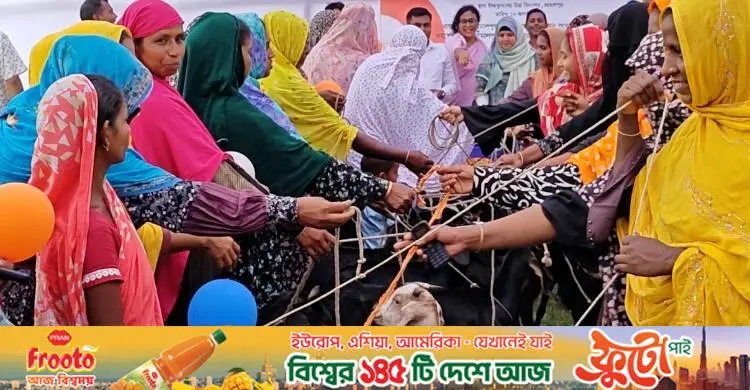
Two years ago she received just three goats. With training, care and hard work, those three have become 15. Having made her own family self-reliant, Amena Begum is now sharing that success with a neighbour by giving her a goat from her herd. And not only Amena: in Jamalpur, 300 families are each handing a goat from their own gains to another poor family.
The scene came at a "Asset Transfer to Neighbours and Joy-Sharing" event held at 2pm on 17 August at Izzatunnesa High School in Jamalpur. At the event, organised by World Vision Bangladesh's Jamalpur Area Programme and Unnayan Sangha, beneficiaries told their stories of becoming self-reliant and of standing by their neighbours.
From three goats to fifteen
Two years ago, with support from World Vision Bangladesh's Jamalpur Area Programme, each of 300 families was given three goats. Alongside goat rearing, family members received regular training on growing vegetables, raising household income, encouraging children in their studies, maintaining good family relations and avoiding quarrels between husband and wife to create a peaceful home.
After the training the families began rearing goats and raising household income on their own. With regular care and breeding, many families' three goats have grown to 12-15. Having become self-reliant, they are now giving one goat each from those assets to a poor neighbouring family.
Amena Begum is one of them. After receiving three goats two years ago, regular care and breeding have brought her herd to 15. She is delighted to give one of those hard-earned goats to her neighbour Surovi Begum.
"Two years ago I got three goats through World Vision. I raised them with care, and now I have 15 goats. I'm very happy to be able to give one of my own goats to my neighbour. I want Surovi to raise the goat she got from me and one day become self-reliant too," Amena Begum said.
Surovi Begum, who received the goat from Amena, now dreams of becoming self-reliant. She sees the goat as the start of future possibilities and wants one day to help another poor person, not only to change her own family's fortunes.
"My neighbour got three goats through World Vision. Now she has 15. She gave me one. I will try to raise it with care. If one day I can become self-reliant like her, I want to help another poor person too," Surovi Begum said.
Help that spreads
The organisers said the aim of the programme is not just one-off help for poor families but to build their capacity to earn through training and assets. When a beneficiary helps someone else from their own gains, the support spreads from one family to the next.
So an initiative that began with three goats is now not only a story of 300 families becoming self-reliant but also an example of responsibility and kindness towards neighbours. Those who once waited for others' help are now able to stand by others.
Jahangir Selim, director (human resources) of Unnayan Sangha, said: "We don't want to finish our responsibility just by giving assets. Through training, people have built the capacity to manage those assets. Today, when a beneficiary gives a goat from their own gains to a neighbour, that is our work's greatest success. The main aim of this initiative is that assets given to one person will light a lamp of hope in another's life."
Jamalpur Sadar Upazila Nirbahi Officer Naznin Akhter said: "Alongside making people self-reliant, building a sense of responsibility towards neighbours is very important. When a family improves its own condition and stands by another family, the bonds of cooperation and humanity in society grow stronger. Such initiatives are undoubtedly praiseworthy."
Source: Jagonews24. First published in Bengali on The Agro News.
Comments
(0)