
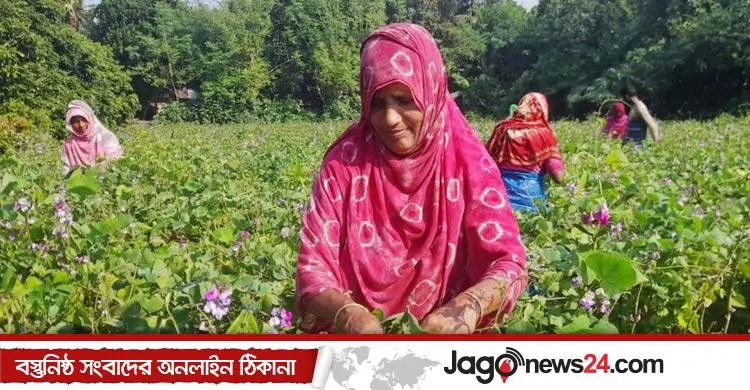
Beans (shim) have been grown commercially in Ishwardi, Pabna, for about 25 years, and women workers and the women of farming families make the biggest contribution. Growers say women account for 70 percent of the work in bean cultivation, and agriculture officials also highlight their role.
Bean growers say that although the crop is profitable, it is costly and labour-intensive to grow, and yields suffer without proper care. That care is provided by women farmers or women workers, and the bean season creates work for several thousand women in the upazila. Men prepare the beds for sowing, plant seedlings, and spray fertiliser and pesticide; women do almost all the rest.
Care begins on the day the seed is sown. Women take responsibility for irrigation, tending seedlings, building trellises (jangla) from jute sticks and dhaincha, looking after the plants, untangling the vines, removing dead leaves, picking off damaged flowers, harvesting beans and even marketing them.
Women farmers and workers
Abida Parveen, a woman bean grower from Sheikh Para in Muladuli, said beans are now the main crop in the area. Early beans are sown every year in the Bengali month of Jyoishtho and the crop lasts until Chaitra, so eight to nine months of the year are spent on beans. Growing beans on a bigha costs Tk 35,000 to 40,000, but with a good yield it is possible to earn from Tk 1 lakh 50 thousand to Tk 2 lakh. Prices were good this year and growers have profited well; her one bigha sold Tk 1 lakh 70 thousand worth of beans.
She said women work harder than men in bean farming. Men only make the beds and sow the seed; women can now do everything else, including irrigation and crop care. There is no longer any need to take the harvest to market: wholesalers buy beans from the field, and certain van drivers carry them to the wholesale depots. She fixes the price by talking to depot traders on her mobile phone. Beans need a lot of care, she said, and women farmers and workers grow them with great attention.
Woman worker Selina Khatun said she earns Tk 300 a day working in bean fields. With that she pays for her children's schooling, tries to buy a goat, and spends on the household. Because bean farming offers work for a long period, she can support her family reasonably well.
Milon Hossain, a bean grower from Jhajharpara in Muladuli, told Jagonews that women workers do more of the work than men. He uses men only to make the beds for sowing and to put up trellises; women do all the crop care, including sorting vines and flowers, picking beans and irrigating. This year he has made a profit of about Tk 90,000 a bigha so far, and the beans can be sold for another one and a half to two months.
Lower wages, more jobs
Muladuli union sub-assistant agriculture officer Rumana Parveen told Jagonews that women workers play the leading role in bean farming, doing every job except sowing, spraying pesticide and building trellises, which men do. Growers use women more because of their lower wages: a woman working from 7am to 2pm is paid Tk 300, whereas men doing the same work would have to be paid Tk 600-700. This makes farmers more profitable while giving the women extra income. Most of these workers are housewives and students, she said.
Upazila agriculture officer Mita Sarkar told Jagonews that Ishwardi is famous for early bean cultivation, and beans have been grown on about 1,400 hectares this year. Women workers are directly involved at every stage from the start of cultivation to harvest, and their participation in agriculture is increasing day by day. "It is encouraging that women's role in the country's economic development is growing," she said.
Source: Jagonews24. First published in Bengali on The Agro News.
Comments
(0)