
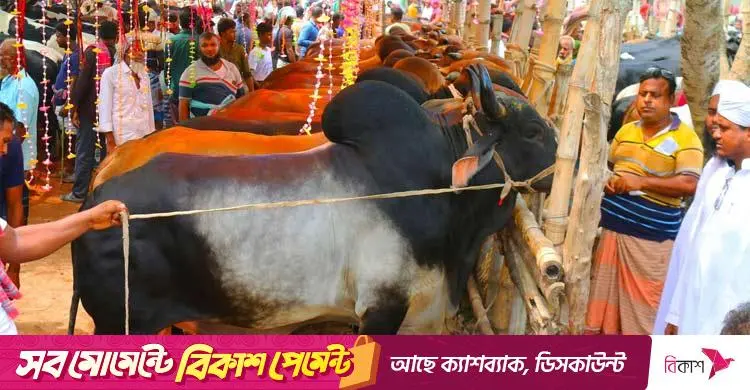
Abdul Mannan of Manikanagar village in Ishwardi upazila, Pabna, is a marginal farmer. He has been raising two bulls for eight months and prepared to sell them before Eid-ul-Azha. One weighs 4.5 maunds and the other around 4 to 4.25 maunds. For the past 20 days traders had been coming to his home to look at the cattle and bargain. Abdul Mannan was asking Tk 2 lakh 50 thousand for the two.
On Monday (26 May), cattle trader Amjad Hossain of Mirkamari village in the upazila bought the two cows after bargaining for Tk 2 lakh 40 thousand.
On Tuesday (27 May), Amjad Hossain took the two to the Oronkola cattle market in the upazila to sell. Cattle traders from Dhaka and other districts bargained over them, and Amjad Hossain asked Tk 2 lakh 70 thousand. Finally, shortly before evening on Tuesday, Dhaka cattle trader Rafiqul Alam bought the two for Tk 2 lakh 65 thousand. He bought 16 cattle including these two at the market and took them to Dhaka that night.
Three sales on the way to Dhaka
Asked about the Dhaka market value of the two, Rafiqul Alam said they were healthy and good-looking. At current Dhaka prices, the 4.5-maund cow could sell for Tk 1 lakh 40 thousand to 1 lakh 45 thousand and the 4.25-maund one for Tk 1 lakh 30 thousand to 1 lakh 35 thousand. He said the cattle would sell in Dhaka for Tk 2 lakh 80 thousand to 2 lakh 90 thousand, and if market prices rise, the two could fetch Tk 3 lakh.
After marginal farmer Abdul Mannan sold his two cows for Tk 2 lakh 40 thousand, the bulls were sold again for Tk 2 lakh 65 thousand, and now, having reached Dhaka, they await another sale. The trader expects that sale to fetch about Tk 2 lakh 80 thousand to 2 lakh 90 thousand. In this way the farmer's two cows change hands three times, and each time the price rises by Tk 10,000 to 15,000.
Traders and farmers
Cattle trader Afsar Ali told Jago News at Oronkola market on Tuesday that more cattle had come to the market than last time and prices were comparatively lower. Almost all those who bring cattle to the market are traders; ordinary village farmers rarely do. They sell at home to local traders, who bring the cattle to the market. The biggest buyers at the market now are cattle traders from Dhaka and other districts, who are buying hundreds of cattle there and taking them to Dhaka. Many local people who will sacrifice have also come, but they are buying very few cattle at this market.
Abdul Alim, a cattle trader from Jatrabari in Dhaka, said Ishwardi's marginal farmers raise cattle for the sacrifice, and there are also many small and large cattle farms there where sacrificial cattle are raised. These cattle have now started coming to market. Most Ishwardi cattle are good-looking and healthy and are valued in the Dhaka market, so every year he collects cattle from Oronkola market and various farms. If they could buy directly from marginal farmers, traders would benefit and farmers would also get a fair price, but that is not possible for them, he said.
Golam Kibria Sohan, owner of Tanvir Dairy Farm at Oronkola in Ishwardi, told Jago News that when a marginal farmer raises two cows at home, it costs much less than it does for farms like his. Farmers can raise cattle cheaply on vegetable scraps, rice starch water and grass cut from the fields, buying very little feed from the market. Eating fresh grass also makes these cattle look healthy.
He said small cattle traders usually buy these cattle from farmers at their homes and then sell them to local traders and at markets. Farms like his have to raise cattle entirely on bought feed; they even have to buy grass. Raising cattle costs them more than it costs marginal farmers, so small traders profit by buying from marginal farmers at somewhat lower prices and selling at markets.
Source: Jagonews24. First published in Bengali on The Agro News.


Comments
(0)