
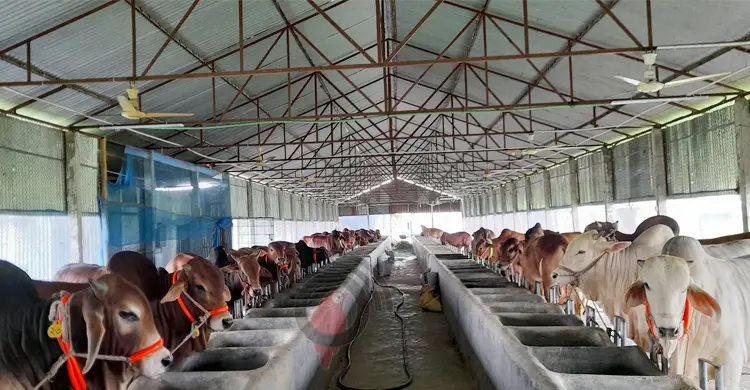
Eid-ul-Azha is knocking at the door. Cattle top the list of sacrificial animals for this religious festival of sacrifice, so demand for them rises whenever the Eid comes round, and so does talk of prices. After repeated rises in the price of cattle feed, traders fear sacrificial animals will cost more again this year.
Farmers say feed prices keep rising in stages, and their daily feed costs have gone up by 25-30 per cent this year. They blame feed millers and company owners. Unless they can sell at a fair price that covers the higher cost of rearing sacrificial animals compared with last year, they fear losses, so farmers and traders are targeting the Eid cattle markets.
Feed prices, year on year
Setting out two years of feed price rises, farmers said a 37kg sack of wheat bran now costs Tk 2,200, against Tk 1,800 last year and Tk 1,500 two years ago. A 74kg sack of oilcake costs Tk 3,400-3,600, up from Tk 2,800 last year. A 50kg sack of rice bran costs Tk 900, up from Tk 700. Straw is Tk 15 a kg, up from Tk 10. Khesari and chickpea bran are up Tk 10 a kg. Feed prices have risen seven or eight times in the past 10 years. Two years ago farm workers were paid Tk 8,000-10,000; now no worker will take less than Tk 15,000.
With costs up, most farms are limping along. High interest on bank and NGO loans and higher wages mean farmers see little profit from cattle.
Golam Kibria Sohan, owner of One Stop Cattle Ranch Dairy Farm in Aranakola, Ishwardi municipality, said higher feed prices mean farmers cannot profit. A good-breed calf costs Tk 1 lakh to Tk 1 lakh 20 thousand and is reared for two years to make it ready for sacrifice. Keeping a bull on a farm costs about Tk 1.5 lakh a year, or about Tk 3 lakh for two years. With the calf's price and feed, a bull costs about Tk 4.5 lakh.
At market, that bull fetches Tk 4 lakh to Tk 4.5 lakh, he said, so farmers lose money year after year. Their one demand of the government is to keep feed prices at a tolerable level; otherwise, facing constant losses, farmers will be forced to stop rearing cattle.
"Prices haven't kept up with feed"
Bachchu Pramanik, owner of Muntaha Dairy Farm in Aranakola, said that after paying for dearer feed and wages farmers cannot make a profit. Good-quality bran costs Tk 2,200 a sack this year, against Tk 1,800 last year. A 70kg sack of oilcake cost Tk 2,800 and is now Tk 3,400-3,600. Cattle prices have not risen in line with feed, and if this continues rearing cattle will become very hard, he said.
Sabina Khatun, a cattle farmer at MS Colony in Fateh Mohammadpur, said she rears three or four cattle at home every year. "Because feed is expensive there is no profit in cattle any more. The money I spend on bran and oilcake all year comes back in one go when I sell the cattle at the end of the year, so it feels like some profit. But counting feed prices and the labour of rearing, there is none. Still, I keep cattle alongside the housework. It has become a kind of hobby and habit for us."
Abdur Rahim, a cattle trader in Aranakola, said prices have already begun rising in Ishwardi's cattle markets before the Eid, up by Tk 10,000-20,000 a head within a month. With prices rising before the sacrificial markets even open, they may be high this year, he said.
Upazila livestock officer Dr Nazmul Hossain said genuine farmers should grow improved fodder grass to meet their feed needs, which would cut feed costs considerably, and grass is also very good for cattle health. Farmers who depend only on bran, oilcake and straw will find it very hard to profit from cattle, he said.
Source: Jagonews24. First published in Bengali on The Agro News.
Comments
(0)