
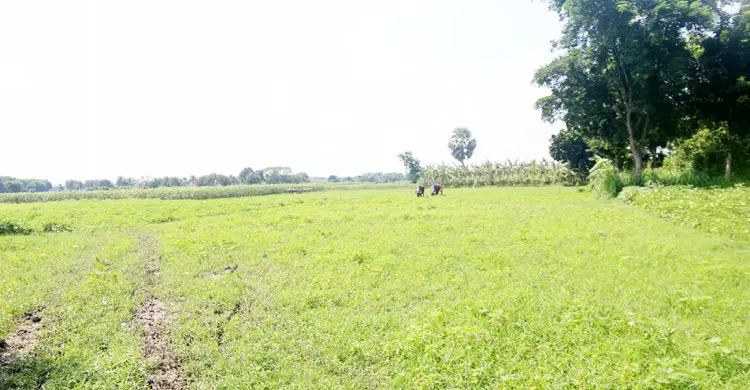
Farmers in Ishwardi upazila of Pabna could not plant aman on 270 hectares this season because of a lack of rain. Land that relied on rain alone for aman every year has been left fallow. Rising fertiliser prices, load-shedding, higher diesel prices and labour wages have deepened the farmers' crisis.
Hundreds of bighas of fallow land were seen in Arkandi, Potirajpur, Dublachara and Arpara in the upazila's Muladuli union, and in Marmi and Sultanpur in Dashuria union. Farmers said paddy was grown on this land every year but could not be planted this time because of the drought.
According to the upazila agriculture office, the aman target in Ishwardi was 3,785 hectares, of which 3,515 hectares have been planted, leaving 270 hectares fallow.
Lowest rainfall in 42 years
According to the Ishwardi weather office, 361.6 mm of rain fell in the three months from June to August this monsoon, compared with 833.1 mm in the same period of 2020 and 1,031.6 mm from June to August 2021.
Weather office observer Nazmul Haque Ranjan told Jagonews that June to August is the peak of the monsoon, and only 361.6 mm of rain fell in that period in 2022. Such low monsoon rainfall is rare. "I have learned that this was the lowest monsoon rainfall in 42 years."
Farmers' losses
Kabir Malitha, a farmer from Potirajpur village, told Jagonews that he grows paddy on 22 bighas every year but has planted only three bighas this time. About 19 bighas are lying fallow because the drought made planting impossible, and he will face heavy losses.
Robiul Malitha grows paddy on 23 bighas every year in the Bali Kukra bil of Arkandi village in Muladuli union. This time, because of the drought, he could not plant eight bighas. He told Jagonews that in the aman season this land is normally full of rainwater and has never needed irrigation. This is the first time the drought has prevented planting. Arranging other irrigation is not possible, he said, because at current diesel prices growing paddy with pumped water would bring heavy losses. Many farmers like him have left land fallow this year.
Santu Molla, a farmer in the Arkandi Borobil area, said farmers face trouble on every side: no rain, and high fertiliser and diesel prices. He grows vegetables on his other land and paddy on two bighas every year to feed his family. "This time I could not plant because there was no rain. I will have to buy rice all year. I shudder when I think how hard it will be. This has never happened before."
Officials' views
Muladuli union deputy agriculture officer Aliuzzaman Zia told Jagonews that for lack of rain, farmers could not plant paddy on a good deal of higher land in the bil this year. Seeing that they would not profit from planting with irrigation after the diesel price rise, they left the land fallow. With some rain recently, planting is still going on.
Asked whether paddy planted a month and a half late would yield well, he said the seedlings must be pushed to grow quickly with fertiliser; only then could the yield be good. About 150 to 200 bighas in this area were not planted this time, and other unions are in the same state. The aman target may not be met this year, he said.
Upazila agriculture officer Mita Sarkar told Jagonews that farmers could not grow aman on 270 hectares in the upazila because of low rainfall, but many have grown maskalai (black gram) on that land, which will make up for some of the loss.
On meeting the aman production target in the upazila, she said there may be a small shortfall, but aman has been planted on more than the target area in Pabna district as a whole.
Source: Jagonews24. First published in Bengali on The Agro News.
Comments
(0)