
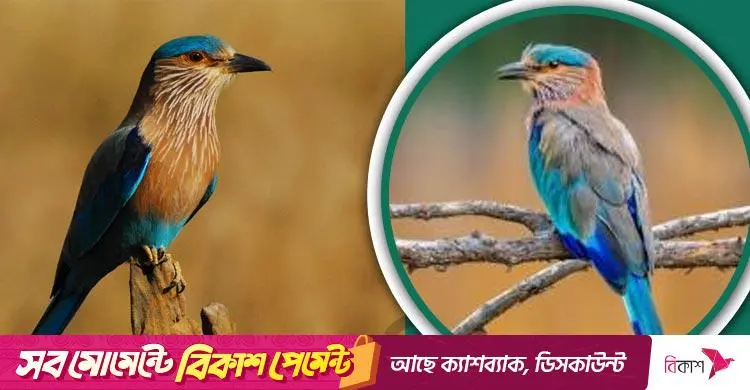
In the still darkness of night, something like a spark of shimmering blue electricity sits motionless at the top of a tree. At first sight the bird seems mysterious. Suddenly it spreads its wings and touches the sky, a fire of colour flashing for an instant and drawing an impossible streak of light across the night. Before the glow fades it escapes the frame and darts down like an arrow, vanishing in search of prey. This enchanting bird is known to us as the nilkantha.
Its scientific name is Coracias benghalensis and its English name is the Indian roller. Its body is brownish-grey, but its wings and tail are a striking blend of deep blue and turquoise. In flight, a broad, bright blue-black panel shows on the primary feathers. It is on average 30 to 34 centimetres long and weighs 166 to 176 grams. A broad, strong bill and medium tail give it the classic roller shape. In different parts of Bangladesh it is also known as beguni kala, thormocha, keowa, nilachal, nilghughu and nilkabutar.
Hunter of crop pests
The nilkantha sits alone on power lines, dry branches or the tops of posts, watching all around, and swoops as soon as it spots prey. It can catch grasshoppers, swarms of rose beetles, winged termites and even small lizards and frogs. When it sees a swarm of grasshoppers, it can catch 30 to 40 in no time. Because it eats insects, it helps control harmful pests on farmland. At night it is busy catching insects drawn to lights. It is quite bold compared with other birds. In the monsoon or breeding season it attracts a mate with spectacular acrobatic rolls in the sky, which is why it is called the roller.
The nilkantha is easily seen in open fields, cropland, trees beside railways and roads, riverbanks and woods in every district and upazila. Its range extends beyond the subcontinent from Iraq to Indochina, but it has no large-scale seasonal migration. It nests in natural tree holes, old woodpecker holes or high gaps in buildings. In the breeding season it usually lays four or five eggs, and both male and female incubate them. The chicks learn to fly 17 to 19 days after hatching.
Folklore and threats
In Hindu society the bird is considered auspicious; seeing a nilkantha on the day of Bijoya Dashami in particular is a symbol of good fortune. In rural folklore its blue wings are a sign of the favour of Nilkantha Shiva, so there is a customary taboo against killing it. The Bengali name beguni kala is said to come from its speed and aerial rolls.
The IUCN lists the bird as Least Concern, meaning its numbers are stable. Even so, loss of habitat from tree felling, electrocution on roadside wires and poisoning from eating pesticide-contaminated insects are increasing its risk of death. With open land and trees shrinking because of urbanisation, sightings of the nilkantha are becoming rarer day by day in the suburbs.
With its natural range in Bangladesh, the nilkantha can without doubt be called a native bird. It is not a caged import but an inseparable resident of our fields and environment. It saves farmers' crops by eating insects and adds beauty with its play of colour in the sky. The nilkantha is part of the land, water and sky of Bengal.
Source: Jagonews24. First published in Bengali on The Agro News.


Comments
(0)