
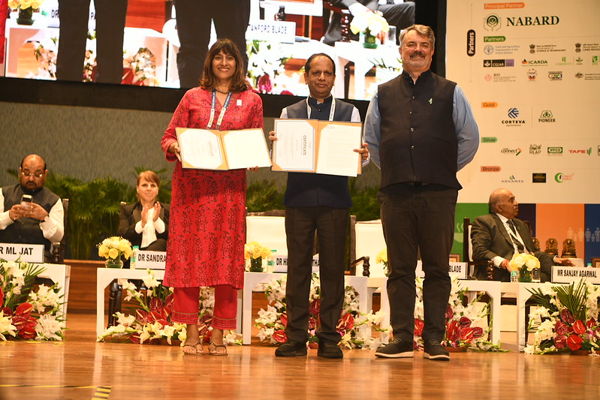
ICRISAT has secured long-term funding from the Crop Trust to conserve more than 50,000 samples of groundnut, chickpea and pigeonpea at its genebank in India, keeping them safe and available for research and crop improvement.
The agreement was signed on 12 September at the Dryland Congress 2026 in New Delhi by Dr Himanshu Pathak, ICRISAT's director general, and Dr Sarada Krishnan, the Crop Trust's director of science and programmes. It replaces an earlier arrangement with more robust support from the Crop Trust Endowment Fund; ICRISAT joins a group of genebanks that meet the trust's performance targets and FAO genebank standards. The money will pay for seed testing, growing plants to replenish stocks, secure backups and preparing samples for distribution, and ICRISAT will also collect traditional varieties and wild relatives missing from its collections.
ICRISAT's legume collections have contributed to 88 varieties: 38 chickpea, 33 groundnut and 17 pigeonpea. Groundnut diversity produced GPBD 4, an early-maturing, high-yielding variety resistant to late leaf spot and rust, whose economic benefits were estimated at ₹1,760 crore (about US$185 million) between 2006 and 2022. One groundnut sample from India, resistant to rosette virus, helped breeders release varieties in Africa, including Baka in Malawi, Serenut 4T in Uganda, Nematil in Mozambique and Msandile in Zambia.
"An answer to a farmer's problem may come from another continent, or from a wild relative never cultivated," Pathak said. Stefan Schmitz, the Crop Trust's executive director, said: "A seed conserved today can help breeders respond to a drought or disease decades from now."
ICRISAT shares seed free of charge for research, breeding and teaching under the International Treaty on Plant Genetic Resources for Food and Agriculture; by December 2025 its genebank had supplied more than 1.72 million samples to 151 countries. The partnership with the Crop Trust dates to 2007, when it began supporting sorghum and pearl millet conservation, extended to chickpea in 2011, and complements CGIAR's support for the genebank.
The agreement comes as India pursues self-reliance in pulses and edible oils through national missions that promote improved varieties and quality seed.
Source: ICRISAT


Comments
(0)