
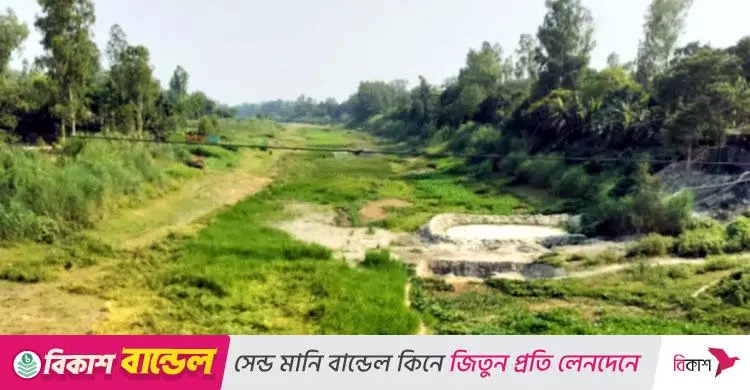
The Hurasagar river flows north to south through the heart of Porjana union in Shahzadpur upazila of Sirajganj. Farmers once grew their crops in summer using the river's water, and in the rainy season rainwater collected in reservoirs, meeting farmers' water needs all year round. But for several years now the river has had no water in the dry season.
It stays dry for more than half the year, and this is affecting farming. The groundwater table has also fallen, so even tube-wells are not drawing water, leaving local farmers in difficulty. Yet it is said that people of this area once travelled to Kolkata by ship along it.
A river turned into a dead canal
On the ground, the Hurasagar has become dry over time. A footpath now winds across the lifeless riverbed. Having lost all its beauty, the river has turned into a dead canal, and farming has suffered. With no water in rivers, canals and beels, groundwater is being used for irrigation, which has raised the cost of producing crops and put pressure on the groundwater table.
Afsar Ali, a farmer from Porjana village, told Jagonews: "Hurasagar now has water for four months. Now even machines don't draw water. There is no way for me to water my land."
Another farmer, Korban Sheikh, told Jagonews: "There is no water in the river. Even tube-wells are not drawing water properly. Production costs are going up."
Moshkor Ali, additional deputy director (crops) of the district Department of Agricultural Extension, told Jagonews: "In the dry season, when the river has no water, the small rivers and canals are also dry. This causes problems for farmers growing crops. In particular the water table drops, so irrigation pumps do not draw enough water and costs rise."
The Hurasagar is a river of Pabna and Sirajganj. It is 66 km long, 60 metres wide and seven metres deep.
Causes and remedies
Dipak Kumar Kar, president of the Sirajganj district unit of Bangladesh Poribesh Andolon (BAPA), told Jagonews: "One of the main reasons the rivers, canals and beels of this area are drying up is India's desertification process. Although multi-pronged plans and approaches have been talked about to secure the country's share of water, there has still been no response from the Indian government."
Rokonuzzaman, executive engineer of the Department of Public Health Engineering in Sirajganj, told Jagonews there is no navigability left in the river at all. The rainwater received in the monsoon cannot be held, so the amount that should seep underground does not. As a result, the water drawn from underground each year is not being recharged, causing the crisis.
If the rivers are dredged and their navigability restored, he said, enough water will collect in the rivers, canals and beels and the water crisis will ease.
Mokhlesur Rahman, executive engineer of the Sirajganj Water Development Board, told Jagonews the water level drops in the dry season. Apart from the big rivers, the water level in small rivers falls far lower at this time, which is why there is no flow in the small rivers in the dry season.
Source: Jagonews24. First published in Bengali on The Agro News.
Comments
(0)