
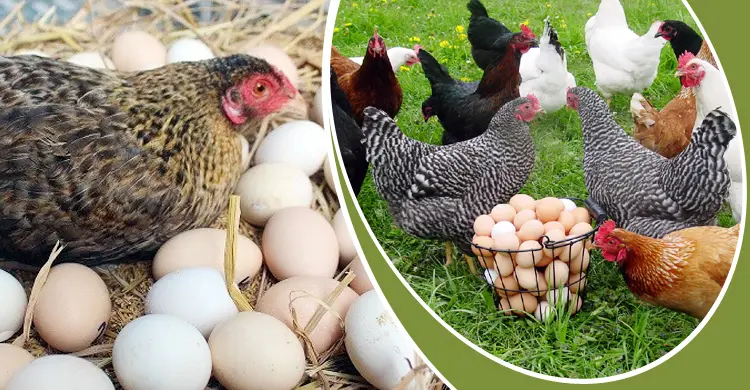
Eggs play an important role in meeting nutritional needs, and demand for them in Bangladesh is high, which makes poultry farming for eggs quite profitable.
To get more eggs from a farm, farmers must select hens of breeds that lay more. Without choosing good birds, a farm cannot be very profitable, so it is important to know how to recognise a high-laying hen, its behaviour and other signs. A hen's condition can be judged from its body parts and its behaviour.
Head, eyes and body
A high-laying hen has a small, light head with little fleshy tissue. The comb and wattles are bright red or pink, soft, well formed and fully developed.
The eyes are bright and always alert. The nose and mouth are clean and free of mucus, with no runny nose and no rattling sound in the throat.
The body is well formed. The hen eats and drinks properly, so the crop is full of feed. When there is an egg inside, she feels heavy. Such hens have a long, broad back, and no part of the body has defects or deformities.
Healthy hens have bright, well-ordered feathers. These hens usually moult around March, though the feathers on top of the head may fall out and leave a bald patch.
Egg production falls as a hen ages. Hens usually lay about 60 per cent of their total output by the age of 560 days, so older hens should be sold for meat and new birds brought into the farm.
Behaviour, vent and pelvic bones
A healthy hen is always lively and seems busy looking for food. At a sudden noise or sign of an enemy she makes a sound to warn the others, and runs away if someone tries to catch her. Her legs are well formed and she walks normally.
A laying hen's vent is wide and oval, and looks moist and reddish on inspection. The pelvic bones can be felt on either side of the vent; in a productive hen the gap between the two bones is two inches.
The abdomen shows the hen's capacity to hold eggs. While laying, it is wide and soft, and the distance from the lower end of the breastbone to the tips of the pelvic bones is two inches. There is no fat in the abdomen, and an egg can be felt inside when it is pressed.
A productive hen has no fat under the skin, which is thin and soft. She stands firmly and normally. Once laying begins, the colour of the vent, beak, comb, wattles and legs starts to change; when the change is complete, the laying period is over.
A high-laying hen is alert, calm and lively. She enters the nest to lay and never sits idle, and she squats readily when a hand is placed on her back.
Farmers should identify healthy, productive hens before rearing them. That lowers the risk of disease and makes the farm more profitable.
Source: Jagonews24. First published in Bengali on The Agro News.



Comments
(0)