
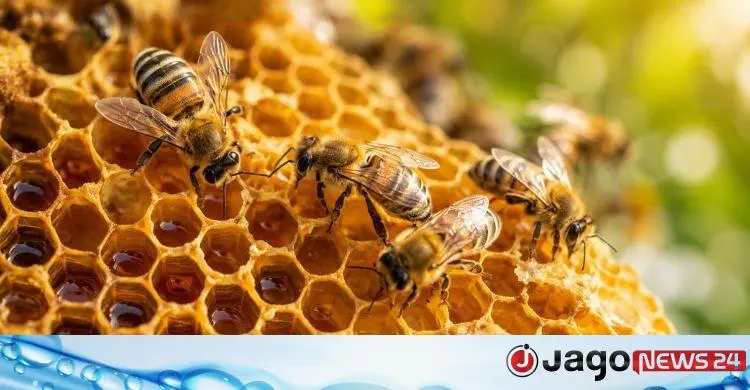
The honeybee is a truly wonderful creature. It builds its own home, which could fairly be called a palace, and this palace has a name: the beehive. Bees build it to protect themselves from cold or excessive heat, to store food and as a permanent shelter. Each hive holds about 20,000 to 100,000 bees, and they are very hard-working, helpful and social animals.
There are about 20,000 species of bee in the world. Some live alone and some in groups. Some store plenty of honey and some none at all. Some are wild and untameable, roaming the forests, but a few species have been domesticated by people. Beekeepers build bee farms with these domesticated bees, and most of the honey on the market comes from such farms.
One queen, hundreds of kings
Surprisingly, bees have classes much like people, and each class has its own work. There are three main classes: the queen, the drones (called "king" bees in Bengali) and the workers. Among all the bees in a hive there is only one queen, while there are several hundred drones, and all the rest are workers.
Though there is only one queen, she is the absolute ruler of the hive, and everyone obeys her. She is also bigger than the others, about 1.8 to 2.2 centimetres, and develops quickly: a full-grown queen emerges from the egg in just 16 days.
The queen's job is to keep the rest of the hive under control and to lay eggs, more than about a thousand a day. Interestingly, the queen lays eggs with her sting; bees use the sting both for self-defence and for laying eggs. A queen also lives a long time, about four to seven years. That may not sound much to us, but for bees it is a great deal, since a drone lives only a few days and a worker a few weeks at most.
If a new queen does hatch, the hive splits in two: the old queen leaves with some of the older workers, builds a new comb and moves there.
The idle drones
Drones take 24 days to develop from egg to adult. They are the kings of idleness: they do no work, and spend all day eating and wandering about. Because they sit and eat, they are a little larger than workers, about 1.5 to 1.7 centimetres. Drones also have bigger eyes than the others, which is how they are told apart from workers. But because they only sit and eat, when food runs short the workers drive them out.
Another curious fact is that drones have no sting. Even so, when there is danger they rush out buzzing as if to sting.
The workers who run the hive
Every kind of work in the hive is done by the workers: cleaning the cells, feeding the young, building the comb, storing honey and even defending the hive.
Workers are the smallest, about 1.2 to 1.5 centimetres, and take roughly 21 days to develop from egg to adult. As soon as they are grown they get to work. Their first job is cleaning the hive, their palace. Then they look after the young, and after that they collect and store honey.
Controlling the hive's temperature is also the workers' job. By fanning with their wings they can raise or lower the temperature, and in this way they always keep the hive at about 34 degrees Celsius. They knew the secret of air conditioning long before us.
The most experienced workers serve as guards. They patrol around the comb and keep watch over the hive. Their job is to stop bees from other hives that come to steal honey, and robbers. Just as in our society, there are good and bad in bee society too, and bees have their robbers: hornets and wasps, which store nothing for the future and live only by raiding bees. The guards are no pushovers; when raiders come, they attack together, without caring for their own lives.
Peaceful by nature
Otherwise bees are very peaceful and bother no one without reason. They sting only in self-defence, because a worker can sting only once. Its sting is shaped like a fishhook, with a barbed tip; once it stings, it cannot pull the sting out, and the worker dies immediately afterwards.
The queen's sting, by contrast, is straight and long and used mainly for laying eggs. There are also stingless bees in the world, about 14 species of them, found in Australia. People there love them because they have no sting. Their honey tastes a little different, sweet and sour with a light lemony scent, but they store very little of it.
90,000 kilometres for a pound of honey
Everyone knows bees give us honey. What is worth knowing is that to store just one pound (about 0.4536kg) of honey, they must fly about 90,000 kilometres and visit more than 100,000 flowers.
Interestingly, they never go more than 2 kilometres from their hive. They can go further, but then they cannot get back because they lose their way. So they cover all that distance around the hive, making trip after trip to bring the honey home. Bees store honey as food for their young and for the future.
Source: Jagonews24. First published in Bengali on The Agro News.


Comments
(0)