
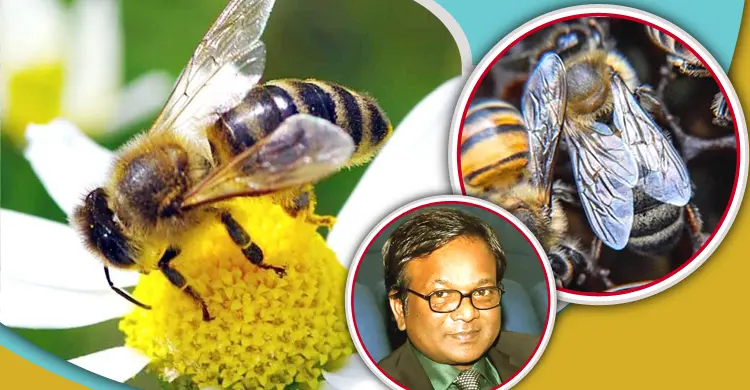
The honeybee is a honey-gathering insect closely related to wasps and ants. In Bengali literature it is also known as madhumakshika or madhukar. A poet, addressing the bee fondly, asked: "Honeybee, honeybee, where do you go, dancing as you fly?"
Many kinds of honeybees are found in different parts of the world. They are social creatures, building large combs on high tree branches, the cornices of buildings, cracks in trees and similar places. A single comb may hold thirty thousand to eighty thousand bees. Though so many live together, they do not move about haphazardly as people do; discipline is notable in their behaviour.
The species suited to beekeeping in Bangladesh and the Indian subcontinent is Apis indica. In keeping with Bangladesh's climate, this small bee builds its nest in enclosed places such as tree hollows, cracks in walls and boxes. The honey it produces is of excellent quality. Bees are known for producing honey and wax and for pollinating flowers. They are found on every continent except Antarctica, wherever there are insect-pollinated flowering plants. There are about twenty thousand bee species in the world, though most have not been described, and researchers believe the true number may be higher.
Queens, drones and workers
Animals are generally divided into two classes, female and male. Among honeybees, besides the female and male bees, there is a third class: the worker bees. The origin of the worker bee is remarkable. Most of the thousands of bees in a comb are workers. Researchers have observed that although three kinds of bees are seen in a hive, in reality they are of one sex, and their sex is determined in an unusual way. Female bees are born from fertilised eggs and male bees, or drones, from unfertilised eggs. The empty cells in the comb where the queen lays her eggs are of equal size. When it is time, the queen moves around the comb laying one egg in each empty cell, and once laying is finished she has no further work.
After that, all the work falls to the worker bees. They look after the eggs, and when the eggs hatch, the workers feed and rear the young. The young are fed a milk known as royal jelly, made by mixing a thick white fluid secreted from the worker's body with pollen. The same amount of food is not given to every cell: it depends on the size of the cell, with larger cells receiving more and smaller cells less. This difference in food leads to differences in nourishment. The young in the larger cells receive more nourishment and become queens. The young in smaller cells, receiving less, do not develop their reproductive organs fully, so although they are female, they are sterile. These are the worker bees. A queen lives two to three years, but a worker lives only six weeks.
Jobs that change with age
According to researchers, worker bees carry out all the duties of the comb according to their age and experience. Workers one to three days old usually clean the cells. Those aged four to nine days rear the larvae. At ten to sixteen days old, workers are responsible for building cells. Workers of 17-18 days make honey from pollen and keep the hive cool by fanning with their wings. Workers aged twenty-one to twenty-five days act as guards, and those older than twenty-five days collect pollen from flowers for making honey.
The workers that fly out of the comb in search of nectar are called scout bees. Their job is to find gardens full of flowers where plenty of nectar can be had. When a scout finds a suitable garden, it flies from flower to flower, and the pollen and scent of nectar cling to its body. After dancing from flower to flower for a while, the scout returns home to tell the others.
How the dance gives directions
Back at the hive, the scout begins to dance to show the other bees where the store of nectar is. When the dance begins, the other bees touch the scout's body with their antennae to work out the pattern of the dance, and then gradually begin to dance too. Their dance movements are known as the waggle dance, the round dance and so on.
The pattern of the dance reveals the route to the store, the distance of the garden and the amount of nectar. Researchers say that if a scout dances in the shape of the Bengali numeral four, the garden is more than a hundred metres from the comb; if it dances in a circle, the garden is less than a hundred metres away. As it dances it also waggles its tail, and the degree to which it wags its tail or sways its waist depends on the distance: the greater the distance, the less the waggling. In addition, during the dance the scout holds its tail bent at a particular angle to the vertical according to the position of the sun. According to Dr Adrian Wenner, a scientist at the University of California, if the nectar in a garden is of good quality and plentiful, scouts try to convey this by beating their wings hard.
The mystery of the link between this dance and honey gathering was unravelled by Karl von Frisch, Konrad Lorenz and Niko Tinbergen, and the three scientists were honoured with the Nobel Prize in 1973. The Nobel laureates agreed that just as people in different countries speak different languages, the dances of honeybees in different parts of the world also differ.
The writer is a science writer and researcher, and an MPhil scholar in the Faculty of Social Sciences, University of Dhaka.
Source: Jagonews24. First published in Bengali on The Agro News.



Comments
(0)