
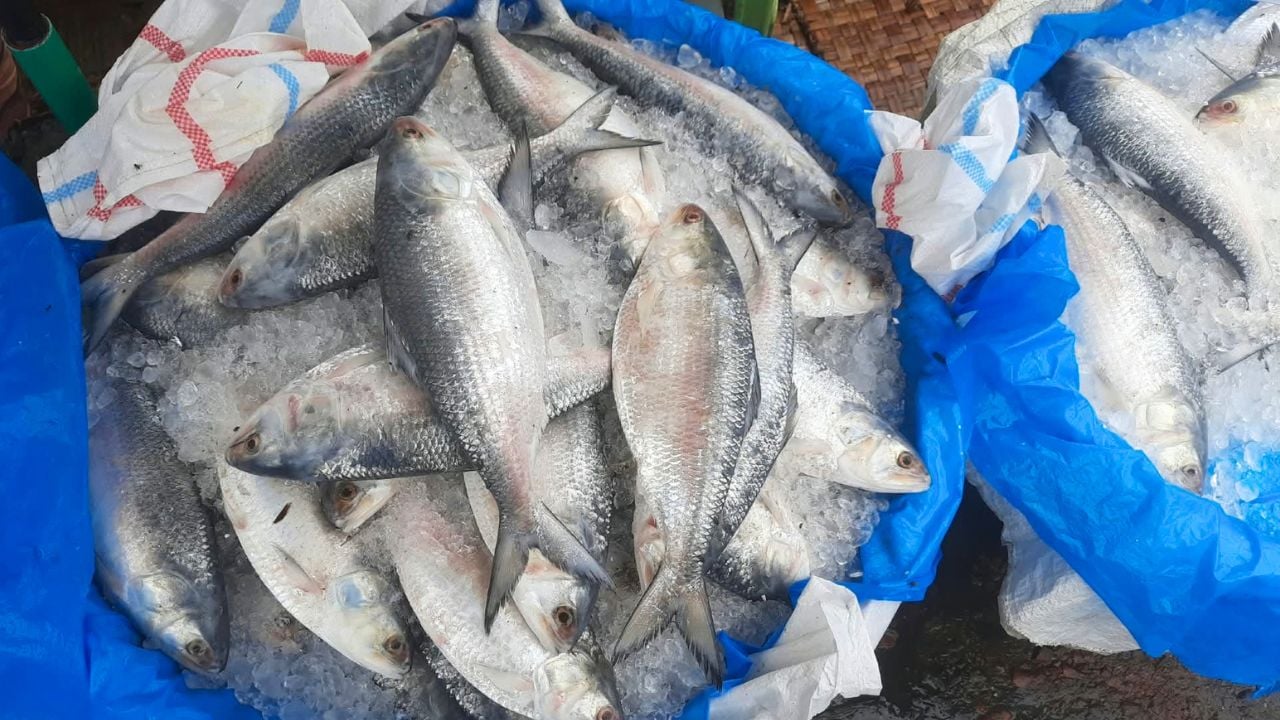
The price of hilsa in Dhaka's markets has reached a point where the appetite is there but the money is not. At the North Badda and Middle Badda kitchen markets on Friday, hilsa weighing 800 to 900 grams was selling at Tk 1,500 a kilogram, and fish of a kilogram or heavier at Tk 2,200 a kilogram.
At that rate a single 800 to 900 gram fish costs a buyer between Tk 1,200 and Tk 1,350, and one large hilsa costs more than Tk 2,000. Shoppers say that buying one fish leaves nothing for the rest of the week's groceries, and many are leaving the market without a hilsa in the hope that the price will fall.
Ramzan Ali, who came to the North Badda market for hilsa, said even an 800 to 900 gram fish costs Tk 1,500 a kilo. "Nearly Tk 1,300 goes on one fish. Buying hilsa regularly at this price is not possible," he said. Ilias, a buyer at Middle Badda, said a one-kilogram hilsa costs Tk 2,200 a kilo. "There are other household costs. However much I want it, I cannot buy it," he said.
Sellers say the high price has cut their sales. Haru Das, a trader at Middle Badda, said buyers ask the price and many then walk away, and that Tk 1,500 a kilo even for an 800 to 900 gram fish is a strain on the ordinary shopper. Md Mizan, a seller at North Badda, said many customers who hear the Tk 2,200 price for the larger fish start looking for something smaller.
Hilsa imported from India is also in the market, but there is little appetite for it. Several buyers said the taste and quality of the imported fish are not those of the local hilsa and they do not want to buy it. "The local hilsa tastes better. I did not much like the fish that came from India," said Md Siddiqur. "But the local hilsa is so dear that I cannot buy it even when I want to."
Md Sabbir, another buyer, put the question plainly: hilsa is the Bengali's favourite fish, but if the price stays out of ordinary people's reach, how are they to buy it? Between them the shoppers made the same point — when an 800 to 900 gram fish costs Tk 1,500 a kilo and a one-kilogram fish Tk 2,200, a low- or middle-income family cannot buy hilsa regularly.
Even in the peak hilsa season, the retail rate shows what the fish costs by the time it passes from the boat through the wholesaler to the plate; reports in the same week of hilsa output falling in the country point to one reason for the pressure on supply.
The report is by a staff correspondent of Dhaka Post.
Source: Dhaka Post

Comments
(0)