
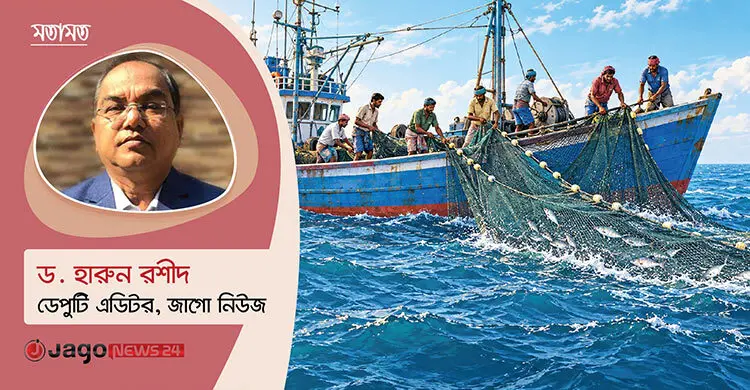
Once the story ran the other way. Hilsa from the Padma and Meghna crossed the border into the markets of West Bengal. For Bengalis in Kolkata, Bangladeshi hilsa was a special attraction, and news of it heading to India before Durga Puja created a festive mood in the media. Now the page seems to have turned: hilsa is coming from India to Bangladesh.
This is no isolated event in the fish market. Indian and Bangladeshi media, quoting traders, have reported that about 500 tonnes of hilsa have come from India to Bangladesh in the past two months, much of it through Bharuch port in Gujarat. Traders say another 150 to 200 tonnes may follow.
Hilsa is not only Bangladesh's national fish; it is a deep symbol of the economy, culture and Bengali taste. Such a commercial reversal is a signal to stop and think. The question is not just "why is Indian hilsa in Bangladesh?" The bigger question is why Bangladesh's hilsa production has fallen so far that we must look to another country to fill the gap.
The numbers behind the worry
The statistics make the concern clear. According to the Department of Fisheries, hilsa production was 5.71 lakh tonnes in 2022-23. It fell to 5.29 lakh tonnes the following year and to about 5 lakh tonnes in 2024-25, a drop of about 71,000 tonnes in two years. In 2023-24 production fell 7.83 per cent from the year before.
This decline cannot be dismissed as a temporary fluctuation. Hilsa production is not only a count of the fish in the rivers; it is tied to river flow, salinity, breeding grounds, sanctuaries, the survival of jatka (young hilsa), fishing practices, the timing of bans and, above all, environmental change in rivers and the sea.
Unlike other fish, hilsa does not live in one still body of water. It comes up from the sea into the rivers, breeds and returns to the sea. The Padma-Meghna basin is a key migration and breeding route. Research shows the life cycle of hilsa is closely linked with the Bay of Bengal and the Ganges-Brahmaputra-Meghna river system, so managing the fish within one country's borders is not practically possible.
The jatka question
This is where jatka comes in. If small hilsa are not allowed to grow, a shortage of large hilsa is inevitable. Saving a jatka swimming in the river today means saving the chance of a large hilsa months or years later. Yet under the pressure of hunger, debt, market demand and middlemen, many fishermen catch jatka even during the ban. The fish that could have raised tomorrow's production disappears into today's market.
Bangladesh has introduced long bans to protect jatka. In the 2025-26 season, catching, transporting, buying, selling and storing jatka under 25 cm was banned from 1 November to 30 June. Fishing was also halted in designated sanctuaries for two months in March and April. In 2026, all fishing was stopped in an important stretch of the Meghna from 1 March to 30 April to protect jatka.
There is no doubt that bans are needed. But are they timed to match the hilsa's life cycle as closely as possible?
Bans must follow the science
Policy needs to be more science-based. Research clearly says the breeding and feeding areas and seasons of hilsa are changing. Climate change, water temperature, salinity, siltation, river depth and changing flows are shifting its breeding grounds. It would be wrong to assume that following a ban schedule set many years ago will give the best results for today's hilsa.
Another important issue is the mismatch between Indian and Bangladeshi bans. When Bangladesh halts fishing in an area to protect hilsa and jatka, the effort remains incomplete if the same kind of ban is not in force at the same time in the neighbouring country's rivers and waters. A cross-border study many years ago also pointed to the need for Bangladesh and India to enforce bans at the same time.
The annual sea-fishing ban on India's east coast does not fully match Bangladesh's schedule either. West Bengal usually bans marine fishing from 15 April to 14 June, while Bangladesh's marine ban falls at a different time. This mismatch can create a management gap for a transboundary fish like hilsa.
When a Bangladeshi fisherman is rolling up his net and pulling his boat ashore while the same fish can be caught across the border, the benefit of conservation becomes one-sided. Nature does not check passports. The hilsa does not know which river is called the Padma and which the Ganges; to it, the river is one flowing aquatic ecosystem.
A joint management framework
To save hilsa, Bangladesh must see India as a partner, not a rival. A joint hilsa management framework is needed, with regular scientific consultation bringing together fisheries scientists, river and climate experts, administrators and fishermen's representatives from both countries. Where breeding grounds are shifting, when jatka density is rising and when brood hilsa are moving upriver should be collected and shared jointly.
Imposing bans is not enough; their timing must be reviewed every year on scientific evidence. The highest protection must come at the most critical stage of the hilsa life cycle, and ban dates brought forward or pushed back if needed. The two countries' bans should also be aligned as far as possible.
Fishermen must not be forgotten
For a person who feeds a family by fishing, a ban is not just a government order; it means income stops. There can be no irregularities in the distribution of VGF rice. Support must be enough that fishermen do not sink into debt during the ban or feel forced into the river illegally before it ends. Cash aid, food aid, alternative work, easy-term loans and training for income outside fishing should all be part of the same management.
Action against jatka catching must also be tougher. The use of small-mesh and banned nets, wholesalers (aratdars) and illegal traders, the whole supply chain, must be brought under surveillance. Arresting and prosecuting only the fisherman who casts the net will not reach the root of the problem. The trader who knows where the banned fish comes from, the aratdar who buys it and the transporter who carries it must all be held accountable.
Technology can also play a major role: tracking boat movements in sanctuaries, registering fishing boats, keeping digital records of landings, checking the origin of fish in markets during bans, and using modern surveillance at key points in rivers and the sea. Drives would then be based on data rather than indiscriminate.
Protecting hilsa habitat is just as important. If river flow falls, silt builds up, pollution rises or breeding and migration routes are blocked, controlling fishermen alone will not bring hilsa back. Research has identified water flow, silt, obstacles to migration and environmental change as important causes of falling hilsa production.
A warning, not only a failure
Still, it would be wrong to see hilsa coming from India only as a symbol of humiliation or failure. It is a warning. When a country's production falls, buyers find other sources. Today Bangladesh is buying hilsa from India; in future another country might capture this market more efficiently. There is no room for complacency in food security and fisheries management.
Bangladesh's hilsa was never just a fish; it was a living culture woven into our rivers, monsoon, boats, fishermen, mist, dawn markets and the Bengali palate. If production falls and dependence on foreign hilsa grows, the loss is not only economic but also one of cultural identity.
So the most urgent question today is not "whose hilsa is better". It is whether we are letting our hilsa live in its own rivers, in its own time, according to its own life cycle.
To stop hilsa's reverse journey, our relationship with the river must change. Jatka must be seen not as fish but as the future. Bans must be treated not as orders on paper but as scientific management. Fishermen must be made partners in conservation, not criminals. And the border rivers must be seen not as separate resources of two countries but as one shared, living ecosystem.
The hilsa coming today from Gujarat to Bangladeshi markets may meet a temporary shortfall. But if the natural abundance of hilsa cannot be restored in Bangladesh's rivers, our children may one day hear a story: once, in this country's rivers, there was a fish called hilsa.
We do not want to become the country of that story. The fight to stop hilsa's reverse journey is not really a fight to save a fish; it is a fight to save our rivers, livelihoods, food security and the future of riverine Bangladesh.
The writer is a journalist and columnist, and deputy editor of Jago News.
Source: Jagonews24. First published in Bengali on The Agro News.
Comments
(0)