
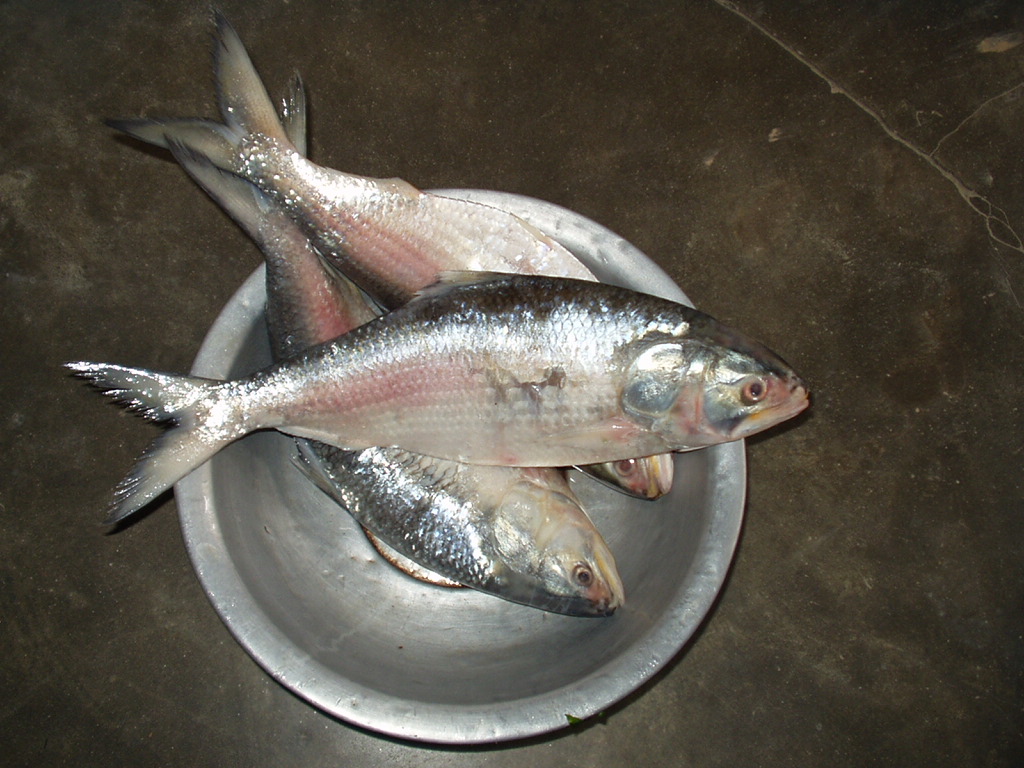
Hilsa were scarce in the rivers and sea of the south for the whole season that began in August, but catches rose suddenly in the last week of September. Fishing for hilsa is to be banned for 22 days, from 8 to 29 October, to protect spawning, and fishers and traders are asking for the ban to be delayed by at least 10 days, Prothom Alo's Barishal correspondent M Jasim Uddin reports.
According to the wholesalers' association at Barishal's Port Road fish landing centre, 1,280 maunds of hilsa arrived between 23 and 30 September, an average of 160 maunds a day, against 75 maunds a day the week before. With supply doubled, prices have fallen by Tk 14,000 to Tk 30,000 a maund depending on size. Hilsa over 1.5 kg that sold for Tk 150,000 a maund a week earlier now fetch Tk 120,000; fish of 1 to 1.2 kg have fallen from Tk 110,000 to Tk 96,000.
Zahir Shikder, president of the wholesalers' association, said last year's ban began on 4 October. Because the expected catch did not come this year, they have asked for the ban to start on 30 October or, failing that, to be pushed back by at least 10 days. He claims the hilsa are not yet carrying eggs.
The Department of Fisheries in Barishal division says 358,516 fishers will receive 25 kg of rice each under the VGF programme during the ban. The division has 422,275 registered fishers, so 63,759 will be left out. Israil Pandit, president of the Bangladesh Small Fishers' Association, wants 100 kg of rice for every fishing family.
Alauddin, a fisher in Bhola Sadar, says he could not catch enough hilsa this year to clear his debts, and that diesel takes much of what he earns. Another fisher, Helal Uddin, said that with diesel prices up, a small catch means more debt at the shop, and the ban should be delayed for the sake of fishers' livelihoods. Chowdhury Golam Mostafa, president of the Barguna district trawler owners' association, made the same demand.
Fishers believe the hilsa spawning season has shifted later. Prothom Alo notes that field experience is not a scientific conclusion, but it raises an important question for research, since the ban dates have been changed before on the basis of research and observation.
Photo: Mamun2a / Wikimedia Commons (CC BY-SA 2.5)
Source: Prothom Alo

Comments
(0)