
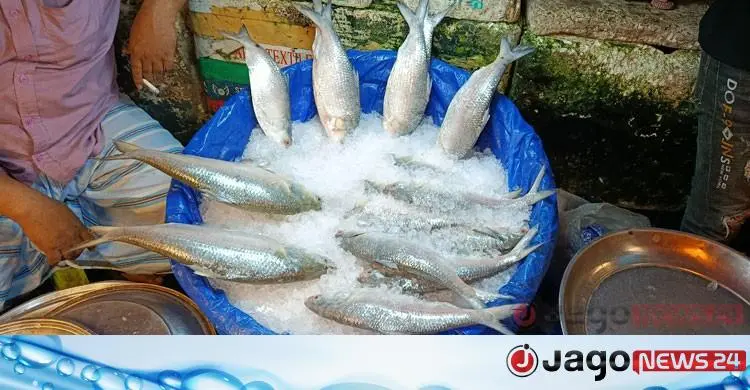
Pohela Boishakh once meant a festival of panta-ilish, but the market situation is changing that picture. For people on limited incomes, hilsa has become something of a "dream fish".
Although the traditional fish is available in the capital's markets around the new year, sky-high prices put it out of ordinary buyers' reach long ago. Unable to fit it into their budgets, many are going home empty-handed or turning to other fish.
Traders said hilsa of about one kilogram is selling at Tk 3,000 to 3,200 a kg. Medium-sized hilsa of 300 to 600 grams costs Tk 2,000 to 2,600 a kg, and even small hilsa of 200 to 250 grams is not cheap, at Tk 1,400 to 1,600 a kg.
Few buyers at the stalls
At Rampura market only one shop had hilsa. Large, small and medium fish were laid out, but there was no crowd of buyers. Some looked at the fish, asked the price and walked away.
Jamal Hossain, who came to buy hilsa, said: "Hilsa is part of our culture, and we have to eat it at Boishakh especially. But hearing today's prices is really disappointing. At Tk 3,000 a kg, people like us cannot buy it. We are struggling just to manage the other household costs."
Fish seller Milon said they have good-quality hilsa but few buyers; people leave as soon as they hear the price. Hilsa he sold at Tk 3,200 a kg yesterday is Tk 3,000 today, and he still cannot find buyers.
The picture was the same at Malibagh market, where the hilsa stalls were not as crowded as before. Buyers came, asked the price and moved on to other fish.
A buyer named Azgar Ali said eating hilsa at Boishakh brings a special joy, but in this year's market it feels as if that joy has become a luxury for many. It is not possible to buy hilsa at such prices, he said.
Md Khokon, who sells hilsa there, said: "Sales are usually good at this time, but this year buyers have fallen off because prices are high. Sales were fair yesterday. Prices have dropped a little today compared with yesterday, but there are no buyers. Without buyers we are in trouble ourselves. Wholesale prices are high, so we can't sell cheaply."
At Shantinagar market the picture was somewhat different. One shop had a crowd of several buyers, but each was seen taking small fish. Hearing the price of large hilsa, buyers did not even bargain.
Saiful Islam, who bought hilsa, said: "Everyone in the family wants to eat hilsa, especially for Boishakh, so I came to buy. I can't afford large hilsa at these prices, so I bought two small ones. Even so, they charged Tk 2,400 for the pair. Prices have gone up a lot. What used to be a festive joy for us has now become a source of pressure."
Md Parvez, a hilsa seller at Shantinagar market, said demand has risen a little because of Boishakh, so prices are higher. But the situation will not last long, and he hoped prices would come down somewhat within a few days.
Md Taher, a hilsa seller at Segunbagicha market, said: "Demand for hilsa is low this time because of the price. I sold some yesterday; today there are no buyers. If prices are high, sales will be low. However hard we try, we can't sell cheaper because of wholesale prices. But I hope prices will come down somewhat within a few days."
Why prices are rising
According to traders, prices have risen because of higher seasonal demand and limited supply. Demand for hilsa rises every year around Boishakh, when many people want to buy it to keep up the tradition, putting pressure on the market.
Parvez, the Shantinagar trader, said not enough hilsa is being caught in the rivers now, and what does arrive is in high demand, so prices are rising. Transport and other costs have also gone up.
Khairul Hossain, a trader at Malibagh, gave the same reasons for the high prices. Supply of hilsa in the market is low, he said, and transport costs have risen because of fuel problems.
Source: Jagonews24. First published in Bengali on The Agro News.

Comments
(0)