
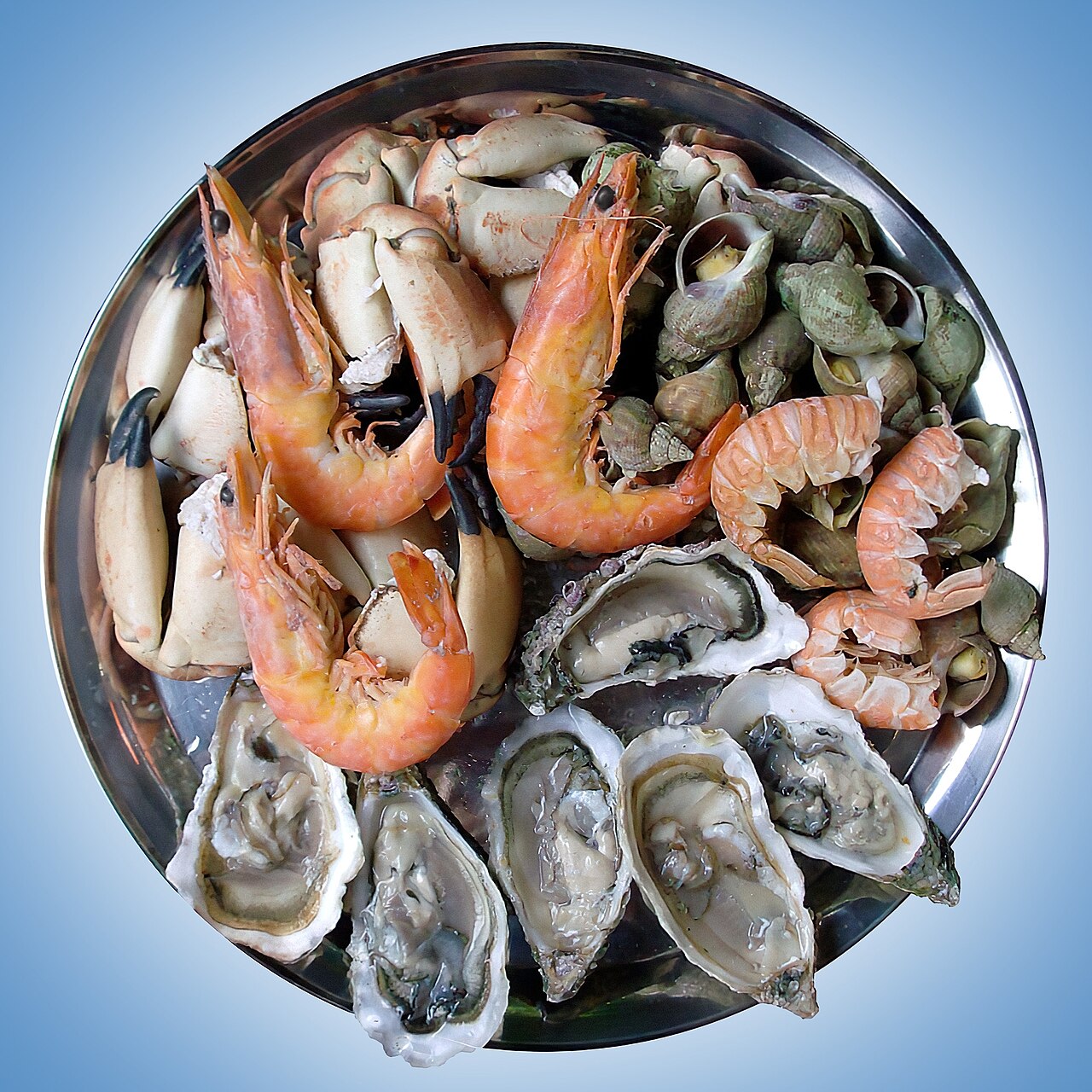
As seafood grows more popular, many Muslims ask whether shrimp, crab, snails, shellfish and octopus are all permissible to eat. A piece by Prothom Alo's religion desk answers from the Quran, the hadith and the legal texts of the four Sunni schools, and its starting point is that the Hanafi, Shafi'i, Maliki and Hanbali schools differ on the question.
Verse 96 of Surah Al-Ma'idah declares the game of the sea and its food lawful. The Hanafi principle is that among water creatures only fish are halal; frogs, crocodiles, turtles, crabs, snakes, snails, shellfish and octopus are makruh tahrimi, close to forbidden. Any fish may be eaten without slaughter, except one that has died naturally and floated to the surface.
The Shafi'i, Maliki and Hanbali schools hold that all fully aquatic creatures that do not live on land, such as fish, crab, octopus, squid, whales and sharks, are halal, citing the Prophet's (peace be upon him) saying about the sea: "Its water is pure and its dead are lawful" (Sunan Abu Dawud, hadith 83). Amphibious animals such as frogs, crocodiles and turtles are forbidden in the Shafi'i and Hanbali schools as well; only the Maliki school permits all sea creatures without condition.
Creature by creature: shrimp is halal in the Hanafi school (some jurists call it makruh tanzihi, merely less preferable) and fully halal in the other three. Crab is not permitted in the Hanafi school because it is not a fish and moves on both land and water, but is halal in the other three. Octopus and squid are makruh tahrimi for Hanafis and halal for the others. Snails and shellfish are forbidden for Hanafis; most Maliki and Shafi'i scholars allow sea shellfish but not land snails. Sharks and whales are halal in all four schools.
Shrimp is often a source of confusion in Bangladesh. Although zoology places shrimp and crab in the same phylum, Arthropoda, the Hanafi jurist Allama Ibn Abidin wrote that shrimp counts as fish in Arab and juristic usage and is therefore halal (Radd al-Muhtar, 6/306). The piece notes that Islamic rulings give more weight to language and common usage (urf) than to zoological classification.
Its conclusion is that because people in Bangladesh generally follow the Hanafi school, all kinds of fish and shrimp may be eaten there, while crab, snails, shellfish and octopus are best avoided under Hanafi law. Followers of other schools may follow their own school's rulings.
Photo: Frits Hoogesteger / Wikimedia Commons (CC BY-SA 3.0)
Source: Prothom Alo



Comments
(0)