
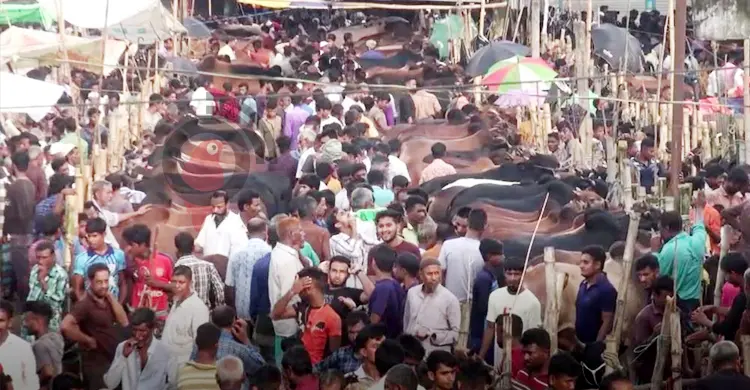
Qurbani cattle markets in Habiganj have yet to get into full swing. Buyers complain that prices are too high, so they are not buying. Plenty of animals have come to market this year, but sales are very low: buyers come, look and leave.
Tauhid Mia, a union parishad member from Chanpur village in Sadar upazila, said people are coming and looking, thinking prices are very high. "In fact animal prices are fair. Because feed is expensive, we have to sell at a slightly higher price," he said.
"We don't get a fair price. People say it's too expensive and walk away. Trade still hasn't picked up," he added.
Jabbar Mia of Atukura village in Baniachang upazila said there is still little trading; people come, bargain and go. He hoped sales would pick up at the last minute.
Farmers point to feed costs
Isak Ali Sebon, a farmer in Nurpur union of Shayestaganj upazila, said he started a cattle farm at home as a hobby in 2017. His farm now has improved-breed bulls and several cows, including six foreign-breed bulls for Qurbani, for which he is asking Tk 2 lakh to Tk 6 lakh. He said he was worried about the rising price of concentrate feed.
Harun Mia, a buyer who lives in the commercial area, said cattle prices seem a little higher than in other years. "I asked about two cows. The sellers said Tk 8 lakh 80 thousand, but I think the two are worth Tk 5 lakh."
Chhalek Mia, representing the leaseholder of the Habiganj cattle market, said sales are fairly good, but they are losing out because of small illegal markets nearby and because they leased the market at an inflated price.
Morshed Mia, in charge of the Chowdhury Bazar police outpost, said strict security is being put in place at the cattle market so that people can buy cattle and take them home safely.
Supply close to demand
District Livestock Officer Dr Prakash Ranjan Biswas said feed prices have risen this year, pushing up costs, and farmers have also suffered from the floods. So cattle prices should be a little higher than in other years, otherwise farmers will not break even. Cattle raised in the district and demand are roughly level, he said.
According to the district livestock office, about 40 permanent and temporary Qurbani markets have been set up in the district this year; there would have been more without the floods. Last year there were 43. There are about 5,000 farms large and small, which have raised about 35,000 cattle and 25,000 goats and sheep. Farmers have raised another 20,000 cattle for Qurbani. Demand in the district is for 90,000 animals, and the remaining 10,000 will be brought in from outside the district to meet it.
Source: Jagonews24. First published in Bengali on The Agro News.
Comments
(0)