
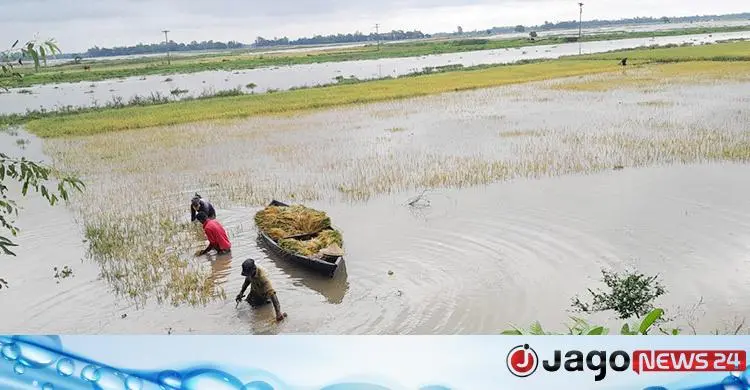
Frequent rain in Habiganj is submerging ripe paddy in the haors. Ripe paddy on 600 hectares went under in a single day, and as of Thursday (30 April) paddy on 3,300 hectares in the district had been submerged.
After several days of intermittent rain, the sun came out today. Hill runoff from upstream has eased and the rivers are falling. Even so, the risk of an early flood has not passed: if it rains, an early flood could come.
SM Suruj Ali of Subidpur village in Baniyachong upazila said that with intermittent rain for several days it had been impossible to cut or dry the paddy. "Today (Thursday) the sun came out, so I can dry my paddy. If it stays like this for a few days, there will be no more worry about bringing the paddy in."
Shibli Chowdhury of Sujatpur Shatamukha village in the same upazila said he had been able to bring in only enough paddy to eat, cutting paddy on 2 or 3 kedar of land. The rest is still in the field. Rainwater on one side, and water overflowing the Khowai river embankment into the haor on the other, has submerged the land, and paddy on about half the haor's land is still under water. "If we get four or five days of sun, there will be no problem," he said.
Hamidul Haque Akhanji, a wholesale paddy trader, said that because the government price for paddy has not been set, he cannot buy. "If I buy paddy at a high price and the government later sets a lower price, I will have to sell at a loss."
Officials' figures
Additional deputy director (horticulture), agriculturist Dipak Kumar Pal, said the sun had come out today (Thursday) after several days, and if it stays like this for four or five more days, farmers will be able to bring in all their paddy and there will be no further problem.
He said another 600 hectares went under water in the past 24 hours. He put the total submerged in the district as of Thursday at 33 hectares, against 2,710 hectares as of Wednesday; the report elsewhere gives the Thursday total as 3,300 hectares. "We are telling farmers to cut their paddy quickly. Because of several days of rain they had lost interest in cutting paddy, as they could not dry it," he said.
He said that for now he does not expect much of an early flood, but it cannot be ruled out entirely. If the rain increases again, there could be a flood.
Deputy commissioner Dr GM Sarfaraz said they are not yet expecting an early flood, but there is a flood forecast. Rain over the past few days raised the Khowai river, which overflowed the embankment at Sujatpur and entered the haor, submerging paddy on 24 hectares. The good news is that hill runoff from upstream has eased and the rivers are falling; once they fall, the haor water will also recede somewhat. But if the rain increases, an early flood cannot be ruled out, he said. The administration is monitoring the overall situation and has made all preparations, with enough dry food stocked, and a helpline has already been opened to deal with a flood. He urged those affected to contact it for any need.
Bumper crop, early rain
According to field visits and the Department of Agricultural Extension (DAE), Boro paddy was grown on 123,844 hectares in various haors of Habiganj this year, and the yield was a bumper one. But unseasonal, incessant rain began early.
Water also rose in the district's rivers, entered the haors and submerged paddy. Rainwater has already submerged paddy on 3,300 hectares, with the most damage in Baniyachong upazila, where about 1,700 hectares are under water, and about 1,000 hectares in Ajmiriganj upazila. The real picture is worse, the report says: in reality paddy on more than 3,500 hectares has gone under water.
Source: Jagonews24. First published in Bengali on The Agro News.
Comments
(0)