
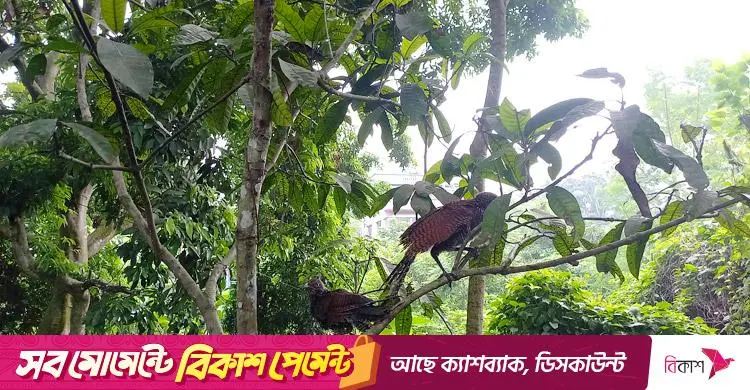
There was a time when, on a village morning or in the rain-soaked air of the afternoon, a sweet yet mysterious call would drift in from somewhere: koop-koop-koop. It was as if nature itself were calling out for attention. The elders would say, "Look, the kanakua is calling, it will rain now!" as though nature answered the bird. This belief is not only superstition, the writer argues, but evidence of a deep bond between nature and living things.
The kanakua is a familiar bird in rural Bangladesh. In English it is called the greater coucal, and its scientific name is Centropus sinensis. It belongs to the cuckoo family but, unlike the cuckoo, it is not a brood parasite. Where the cuckoo lays its eggs in other birds' nests, the kanakua builds its own nest in the undergrowth and raises its own family.
The bird has many names across Bengal. Some call it the koop bird, others kubo or kanakuo, and elsewhere kukkal, kanakoka or kana kubo. Although the word kana (blind) is used, the bird is not blind. The names come mainly from the sound of its call.
Appearance and habits
The bird is striking in colour. Its whole body is dark, but it shines in sunlight. Its wings are brown and its long tail is jet black. The pupils are black, surrounded by a reddish ring that gives it a mysterious look. Its legs and claws are black. It moves silently, like a quiet character of nature, rarely perching on branches and instead walking quietly through bushes, along canal banks or at the edge of paddy fields.
The kanakua is mainly carnivorous. It eats caterpillars, grasshoppers, lizards and frogs, and even the eggs and chicks of small birds, so small birds fear it. It is usually seen alone, but pairs move around together. Its movements are slow and self-possessed.
Rain, omens and folklore
In Bengali folk culture, the kanakua's call has become a meaningful belief. It is said that when this bird calls, it rains. In some areas it is also believed that hearing it may mean bad news is coming. There is no scientific evidence for any of this, but these beliefs have been handed down through generations as part of folk culture. People may have come to hold them after noticing that the bird's calls coincide with natural rhythms and the weather.
Harder to find
The bird was once easy to see in villages, but that has changed a great deal. Urbanisation, the loss of woodland, heavy use of pesticides and an unbalanced food chain are now pushing the kanakua towards danger, and it is disappearing amid the brick and concrete of towns.
Still, those who walk at dawn in a village or on the green edges of a town sometimes hear that familiar call: koop-koop-koop. A sweet memory then fills the air, and grandfather's stories come to mind, and grandmother, smiling, saying: "Look, the kanakua is calling. It will rain!"
Source: Jagonews24. First published in Bengali on The Agro News.

Comments
(0)