
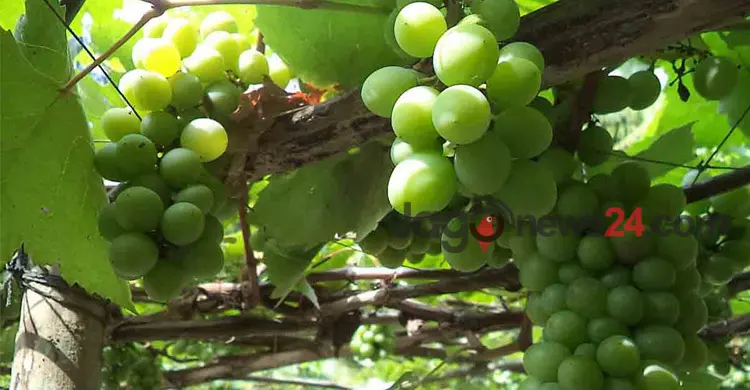
Demand for fruit growing is rising day by day in Bangladesh, because the country's natural environment favours fruit production. Planting fruit trees in homesteads, at educational institutions, beside roads, on pond banks and on khas and fallow land would fill every home with nutrition, create small and large orchards and bring development to society. Young people could find self-employment by growing grapes.
Bangladesh's favourable climate is particularly suited to growing various fruits. Few fruit trees bear all year round or two or three times a year on the same plant, but grapes are among those that fruit two or three times a year. That is why the prospect of growing grapes in Bangladesh has been considered.
Why grapes have not spread
Grapes are hardly grown in Bangladesh and are imported from various countries. Small-scale research or trials on grape production have been carried out from time to time, but they were not continued. A few people have planted grapevines as a hobby, but because they did not follow the necessary steps after planting, they got no crop, and what little they did get was too sour to eat.
The fruit has not spread in the country because of a lack of technical knowledge. Many people also believe grapes cannot be grown in the country's weather and climate, a belief that is simply wrong. The spread of the fruit has been blocked on the basis of the casual opinions of a few people, without any research or trials, which is why no one is interested in investing in grape research.
The climates of neighbouring India, Thailand, the Philippines, Taiwan and Malaysia are not very different from Bangladesh's, and the nature and quality of the soil are much the same. Yet those countries produce enough grapes to meet their own needs and export large quantities abroad. So Bangladesh has good reason for optimism.
Climate and temperature
The country's climate and temperature are suitable for grapes. Grapes need an average temperature of 29C, which is readily found in Bangladesh. It is better if it does not rain while the grapes ripen, and since grapes ripen in June, rain is not a problem. But if early rain comes, care must be taken that water does not collect at the base of the vines and that hail does not damage them.
Research at Bogura
In the light of scientific experience, it is urgent to develop production technology for fruits that bear year-round (twice a year) in Bangladeshi weather, and to stress their commercial cultivation. With this in mind, the Rural Development Academy in Bogura took up a research project on grape cultivation in 1999-2000. Under it, local and foreign varieties were collected from around the country and trialled in the academy's No 2 nursery from 2000 to 2003, and the promising varieties were moved to the No 1 nursery in 2004. Because of the move, 3 varieties in 2007, 5 in 2008, 6 in 2009, 7 in 2010, 8 in 2011, 10 in 2012 and 11 in 2013 flowered and fruited, 44 of a total of 55 plants, and this continues to date.
In winter the vines shed their leaves and pass the season dormant. With the arrival of spring (the last week of February), buds appear along with new shoots and leaves and later turn into fruit. RDA-11 ripens in the first week of June and the other varieties finish ripening by the third week. The best place for grapes is one with moderate rain where water does not stand on the ground, and where the weather is dry and warm. If it rains while the grapes are ripening, their quality and shape are spoiled and the berries crack. The grapes' greatest enemies are mynas and bulbuls: at least 10 percent of the grapes are eaten by birds before they ripen, and some rot because of rain.
Sun, disease and a call to growers
Grapes like hot, sunny weather. Because the temperature was high and the weather sunny at ripening time, the grapes became very sweet. Grapes generally do not like humid weather and cannot tolerate dense fog or frost. Bright light and low temperatures at flowering help produce more. Among the problems in grape farming, disease is one of the main ones, such as powdery mildew and downy mildew. Outbreaks are usually more common in summer and the rainy season, and if the vines are protected from these diseases, the expected yield is possible.
So let us come forward to grow grapes, and let grape farming help reduce unemployment in the country. Those interested can also contact the relevant government departments.
Source: Jagonews24. First published in Bengali on The Agro News.
Comments
(0)