
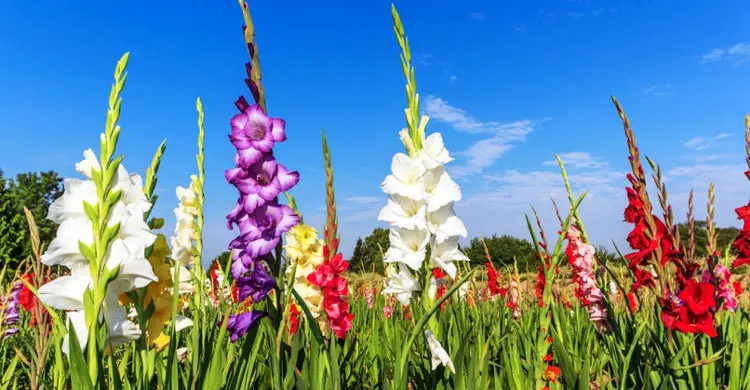
Growing gladiolus is both profitable and beautiful, and the flowers are in great demand in the market. You can grow them in the yard, on the roof or in any kind of soil. Here are the rules to follow.
Climate: the plants need humid, cool weather to grow properly and do well at 15 to 20 degrees Celsius. They need full sunlight, as the flowers do poorly in shade. If the soil is short of moisture before planting the corms and before the spikes emerge, yield falls.
Soil: the flower can be grown in any kind of soil, but sandy loam is best.
Season: Kartik (mid-October to mid-November) is the best time to grow gladiolus.
Planting and fertiliser
Planting: plant disease-free large (30 +/- 0.5g) or medium (20 +/- 0.5g) corms 3.5 to 4.5cm in diameter, 6 to 9cm deep. The corms must be free of dormancy. Keep 30cm between rows and 25cm between plants, though for commercial production they can be planted at 15 x 20cm.
Fertiliser: apply 10 tonnes of rotted cow dung, 200kg of urea, 225kg of TSP and 190kg of MoP per hectare. Mix the dung, TSP and MoP in well when preparing the land. Split the urea into two equal parts: side-dress half after four leaves appear and the rest after seven leaves appear, when the spike is emerging, 5cm deep on both sides of the row.
Care of the crop
Irrigation: the soil must hold enough moisture, so irrigate as needed. Give a light watering after planting the corms so they settle in the soil, then water lightly every 10 to 15 days depending on the weather.
Earthing up: the key care for gladiolus is earthing up. Draw soil up from both sides of the base once at the three-to-five-leaf stage and, if needed, again after seven leaves appear, when the spike is emerging. This keeps enough moisture in the soil and stops the plants being blown over. If corms come up above the soil after irrigation, cover them with soil from the side.
Weeds: the field must be kept weed-free, taking care not to damage the sprouting plants while weeding.
Staking: staking is needed in the rainy season to stop plants falling over in the rain. Drive bamboo sticks every 2 metres along the rows, though if the plants are closely spaced staking may not be needed.
Cutting, storage and yield
Cutting: plants flower 75 to 90 days after planting the corms, depending on the variety. The right time to cut the spike is when one or two florets at the bottom show colour. Take care that the flowers have not opened and remain firm.
Storage: corms are ready to lift six to eight weeks after cutting the flowers. Clean them, dry them in the shade for two to three days and sort them by size. Healthy corms can be stored for a long time. Good-quality corms are obtained within 90 to 105 days of cutting the flowers.
Yield: about 24 tonnes of flowers or sticks are obtained per hectare, along with about 10 tonnes of improved corms.
Source: Jagonews24. First published in Bengali on The Agro News.
Comments
(0)