
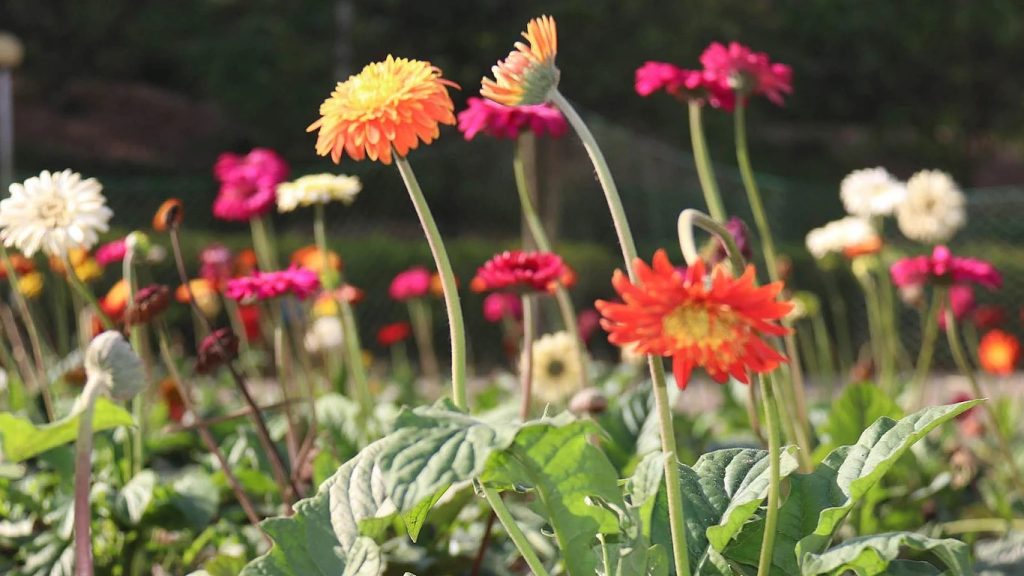
Gerbera is an important commercial flower of the Asteraceae family. It is named after the German environmentalist Traugott Gerber. It is one of the 10 most important cut flowers in the international flower trade, and as a cut flower that stays fresh in a vase for a long time, gerbera has no equal.
The genus Gerbera has about 40 species. Of these, Gerbera jamesonii is the one cultivated, and many varieties of Gerbera jamesonii have been developed through hybridisation. The Bangladesh Agricultural Research Institute (BARI) has developed two gerbera varieties, BARI Gerbera-1 and BARI Gerbera-2.
Climate
Gerbera is a hardy plant and grows more or less in all kinds of climate. In tropical regions it is recommended to grow it in the open or under poly-shade, and in temperate regions in greenhouses.
In Bangladesh, gerbera is grown in open fields in winter and under poly-shade in summer. Although growing it in a controlled environment costs more, it is essential for better flower quality and yield and to protect the plants from diseases and pests. Bright sunlight helps plant growth and the production of quality flowers, but in summer light shade (30%) must be provided for better flowers. The ideal daytime temperature for gerbera is 16-20 degrees Celsius and the night-time temperature 10-12 degrees Celsius. At high temperatures the plants do flower, but the flowers are not of such good quality.
Soil
Well-drained, fertile loam or sandy loam is best for gerbera. Soil pH should be between 5.5 and 7.0. Gerbera land needs plenty of organic matter, so cow dung, leaf compost, coco dust and similar materials should be applied in moderate amounts.
Propagation
- By seed: gerbera can be propagated by seed. Plants produced this way do not keep all the qualities of the mother plant, but the method is easy. Its advantage is that there is less chance of disease and pest attack through seed.
- By division of clumps: the clumps of the mother plant can be divided. Well-established, fully grown plants in the field are cut into small parts with a sharp knife.
The leaves and roots of these suckers are lightly pruned and then planted in new beds.
Source: Staff Correspondent. First published in Bengali on The Agro News.
Comments
(0)