
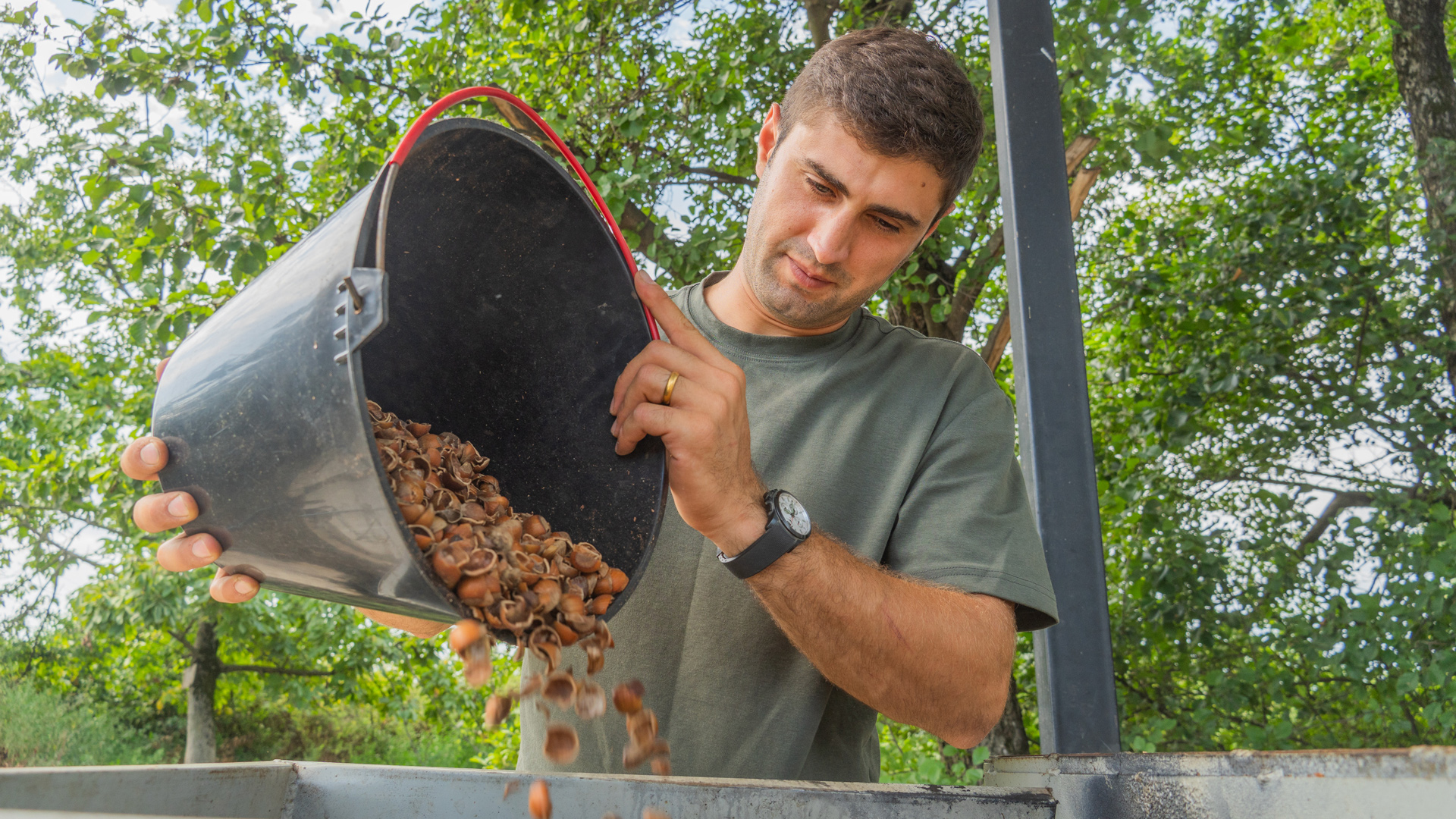
Four years ago a reseller sent Shete Kemoklidze's hazelnuts back: aflatoxin had turned up in the batch. The poisonous chemical develops from fungal infection when nuts sit damp on the ground, in the husk or in storage, and a contaminated batch is no longer fit to eat. "The product has to be thrown away and destroyed. I lost around USD 20 000," he said, blaming incorrect drying.
Kemoklidze, 31, farms 17 hectares in the Kvareli municipality of Georgia's eastern Kakheti region, 13 of them in full production with the local Anakliuri variety. He harvests at least three tonnes of dried nuts a hectare.
Through the European Neighbourhood Programme for Agriculture and Rural Development (ENPARD IV), funded by the European Union and the Government of Sweden and implemented by FAO, he completed food-safety training and received a matching grant to buy a hazelnut dryer and a vertical elevator that feeds it. The furnace burns hazelnut shells, once a waste product. "The waste is now our main drying source," he said. Broken kernels are pressed for oil and the residue milled into flour.
The stakes are high. According to Georgia's National Statistics Office, hazelnuts and other nuts were the country's seventh-largest export commodity in 2025, with more than 18 000 tonnes of hazelnuts exported, worth over USD 165 million. Aflatoxin cannot easily be seen, which is why correct drying matters so much.
Grant recipients now dry nuts for their neighbours too, hundreds of tonnes that once sat in heaps at the mercy of the weather. "Now even farmers with three or five tonnes are asking to dry their hazelnuts," Kemoklidze said. FAO says cutting food loss is a sequence of steps along the value chain, from crop treatment and fast harvesting to drying and proper storage, and that with training and equipment such loss is avoidable.
Photo: ©FAO / Guram Saqvarelidze
Source: FAO Newsroom

Comments
(0)