
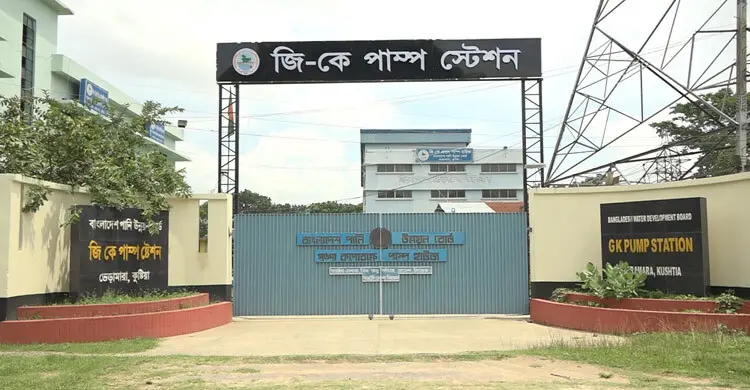
The Ganges-Kobadak (GK) irrigation project is in a poor state with age. The economic life of its main pumps has already run out. With the pumps unrepaired for 10 years, two of the three main pumps are out of action and one is kept running through regular repairs. The subsidiary pumps broke down in 2004–05; they cannot be repaired and have not been replaced, so the required amount of irrigation water cannot be supplied in the dry season.
The Kushtia, Ganges and Alamdanga canals under the project have a total length of 193 km. Unrepaired for years, about 150 km of the main canal has silted up and the canals' dykes are completely damaged, so irrigation cannot be supplied as needed.
Planning Commission inspection
On 5 February, AKM Fazlul Haque, member (secretary) of the Planning Commission's Agriculture, Water Resources and Rural Institutions Division, joint chief Enamul Haque and deputy chief (irrigation) Ratna Sharmin Jhora inspected the project. A copy of their report and recommendations has been sent to the Implementation Monitoring and Evaluation Division (IMED) for appropriate action.
The Planning Commission said a feasibility study through a PDC (project management and design consultant) had recommended installing 10 subsidiary pumps in place of 12 and replacing the three main pumps. In addition, 1,313.51 km of main, secondary and tertiary irrigation canals need re-excavating, and repair and rehabilitation of the infrastructure built under the project is essential. Otherwise the project cannot run properly and its core purpose will collapse.
Restoring the project and its irrigation would expand the irrigated area, it said, making possible gains in crop production, forestry, fish farming, communications, employment, women's empowerment, environmental balance and socio-economic development, and contributing significantly to food security. Considering changes in biodiversity in the project area, the project needs to be re-planned and redesigned to introduce sustainable irrigation using modern technology.
AKM Fazlul Haque told Jagonews: "In the context of our agriculture-based country, the GK irrigation project is extremely important. But at present the project is hardly effective. Most canals have silted up and the pumps are broken. The purpose for which the project was taken up is not being met. So new pumps and canal excavation under the project are urgent, and we have recommended to those concerned that a project be taken up."
How the system works
According to the Planning Commission, the project has two pump houses: the 'main pump house', with three pumps of 1,001 cusecs capacity each, and the 'subsidiary pump house', with 12 pumps of 125 cusecs each. In the irrigation season, two main pumps lift water from an intake channel connected to the Ganges at Bheramara, with one main pump on standby. The main canals are 193 km long, the secondary canals 467 km and the tertiary canals 995 km. In the dry season, when the Ganges falls to 4 metres below sea level, the main pumps do not work and the subsidiary pumps are used.
The project's command area was initially 197,500 hectares, of which 116,000 hectares were irrigable. At the start, irrigation could be provided to 95,616 hectares in the monsoon (Kharif-2) season. The project was planned and designed only to give supplementary irrigation to aman rice in Kharif-2. At that time 311,000 tonnes of paddy and 290,000 tonnes of food grain were produced. After the decision to irrigate in three seasons (rabi, Kharif-1 and Kharif-2), 530,000 tonnes of paddy and 364,000 tonnes of food grain are produced, an increase of 219,000 tonnes. However, targets have never been met in the rabi and Kharif-1 seasons because of low water in the Ganges.
Canals, structures and charges
Secondary canals: The 49 secondary canals total 467 km. The dykes of 29 are partly damaged, reducing their capacity; the dykes of the rest are completely damaged and they cannot carry irrigation water.
Tertiary canals: The 444 tertiary canals total 995 km. Of these, 208 have silted up; the rest, without water for a long time, are overgrown with jungle and weeds, and with their dykes gone they have become level with the fields, so the desired irrigation cannot be supplied.
Water control structures: Most of the structures that control water in the irrigation canals have broken down for lack of repair and rebuilding, making irrigation water hard to control. The drainage canals have also silted up, so heavy monsoon rain causes waterlogging and losses of crops and property. Inspection roads are unusable for lack of repair, and office buildings and other structures built in the 1960s are dilapidated and unusable.
Irrigation charge: The BWDB sets an irrigation charge of Tk 200 an acre a season, but farmers do not pay regularly, and in the current context the charge is inadequate. Farmers, however, say they will pay on time if water is supplied regularly.
Irrigable area: The project's current irrigable area is 95,616 hectares. But because the pumps, canals and structures are not fully working, the area irrigated fell to 51,555 hectares in 2020–21, 40,770 hectares in 2021–22 and only 39,829 hectares in 2022–23. Lifting water from the Ganges and irrigating the project area has changed the biodiversity of the Ganges basin and the region.
Main objectives: The project runs in Kushtia, Chuadanga, Magura and Jhenaidah districts. Its aims are uninterrupted irrigation through rehabilitating the main pumps and building new support pumps, expanding the command area, raising farm incomes and jobs by improving water resources, reducing flood damage, improving communications through roads on the canal dykes, developing fisheries, raising farm output and speeding other economic activity. Improving farmers' socio-economic condition and reducing poverty in the project area are among its main tasks.
Source: Jagonews24. First published in Bengali on The Agro News.
Comments
(0)