
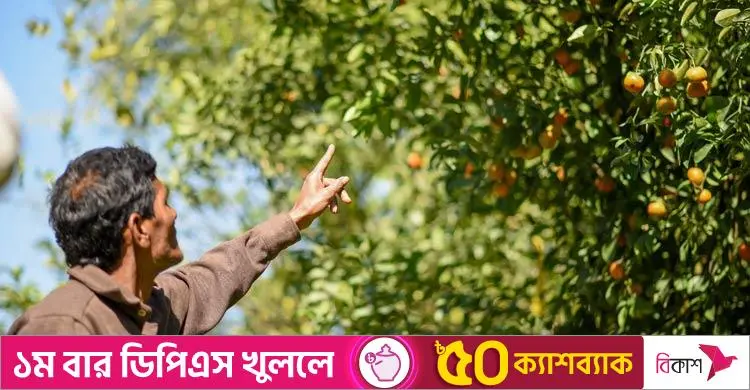
Juicy oranges hang in clusters among dense green leaves; from a distance it looks as if lights are glowing among the branches. A footpath runs between two rows of trees laden with ripe fruit, and the whole orchard seems to smile with colourful "China" oranges. Visitors stroll through, handling the fruit and delighting in the sight.
The "Chinese" orange orchard is in Sundarganj upazila of Gaibandha. The fruit is grown commercially in the orchard of Maloy Kumar Liton in East Chhaparhati of Chhaparhati union, and the yield has been good. The owner picks oranges from the trees by colour and size and hands them to visitors.
From flowers to oranges
The orchard lies one and a half kilometres west of Dharmapur Bazar in Sundarganj. Liton, 45, used to run a business selling music CDs and cassettes and doing recording at the local market. He gave that up and in 2008 started a nursery on his father's 80 decimals (about two and a half bighas) of land to grow roses, marigolds, chrysanthemums, gladioli and tuberoses commercially.
In 2020 Covid hit Gaibandha's flower market. To absorb the blow and get through the slump, Liton began growing oranges in the orchard that year, and with intensive care the trees bore fruit in 2022. Besides oranges, the orchard has Katimon mangoes, jujube, sapodilla and pomelo, and ginger is grown as a companion crop in 2,000 sacks.
According to the Department of Agricultural Extension (DAE) in Gaibandha, oranges are grown on 4 hectares of flat land and malta on 44 hectares across the district's seven upazilas. The 576 large and small orange and malta orchards hold about 40,000 trees, producing about 636 tonnes a season, worth about Tk 13 crore.
Tk 200 a kg, picked from the tree
In Liton's orchard, paths run between rows of orange trees, with clusters of ripe fruit all around. Visitors and buyers walk through buying the sweet, juicy China mandarin oranges, which cost somewhat less than in the market because they are bought directly from the orchard.
"Sales from the orchard started four weeks ago. Oranges picked by hand from the tree are selling at Tk 200 a kg. The orchard has 100 China mandarin orange trees and more than fifty malta saplings, and about 90 per cent of them have fruited. This year I have sold oranges worth about Tk 2.5 lakh, and I have given away the same amount to neighbours and visitors," Liton said.
Cultural activist Manik Bahar came from the district town to buy oranges for his family. "The size and colour of the oranges are very attractive, and they taste much better and are juicier than market oranges. I am delighted to pick chemical-free oranges from the tree myself," he said.
Md Khorshed Alam, deputy director of the DAE in Gaibandha, told Jagonews: "The Chinese oranges have yielded well in Liton's orchard. They are sweeter than local varieties, so many people like them. The agriculture department is supplying the district's orange and malta farmers with seed, seedlings and fertiliser and giving various advice. This variety has huge potential if grown in a planned way."
Source: Jagonews24. First published in Bengali on The Agro News.

Comments
(0)