
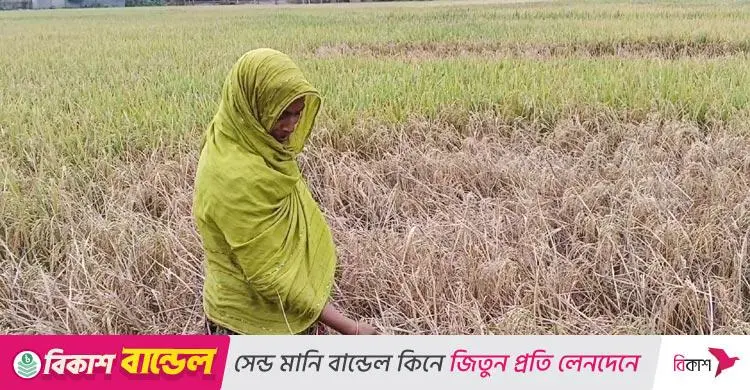
Farmers in Gaibandha cannot protect their Boro crop from blast disease, known locally as 'current poka'. Before their eyes, the panicles of the rice they worked hard to grow are turning chaffy and dying. Pesticides and other remedies bought from local shops have brought no relief.
According to the district office of the Department of Agricultural Extension (DAE), IRRI-Boro rice has been planted on 1,29,020 hectares across Gaibandha's seven upazilas this season.
Boro panicles are now swaying in the wind in field after field, and with them the farmers' hopes. Neck blast is threatening those hopes. As the rice ripens, the disease is turning the grain chaffy. From a distance the fields look ripe, but they are not: the leaves turn grey and the half-ripe panicles turn white. New Boro fields are being hit every day, leaving farmers at a loss.
Farmers watch their crop die
Meja Mia, a marginal farmer from Chapadah village in Gaibandha Sadar upazila, borrowed money to grow IRRI-Boro rice on 5 bighas of his own and sharecropped land. The crop grew well and his land filled with clusters of panicles, which had started to ripen. But blast is killing the panicles before the grain matures. Watching his crop go to waste, Meja Mia can do nothing but come to the field and weep.
Fuad Mia, a farmer from the same village, is in the same position. He has sprayed again and again on the advice of local pesticide sellers but cannot save his land.
Bablu Mia, a farmer from Puranadah village in Gobindaganj, said the hybrid rice had been struck by a rot disease ('pochari') that was slowly spreading across the whole beel.
Another farmer, Helal Mia, said most of the rice in the fields was on the point of ripening, but the panicles were turning white and all the grain was becoming chaffy.
DAE cancels officers' leave
Md Khorshed Alam, deputy director of the DAE in Gaibandha, said the highest level of caution was being taken over rice diseases. Rice should be harvested as soon as 80 per cent of the grain in a field is ripe, he said. All agriculture officers' leave has been cancelled so that they can make farmers aware, and action will be taken if any complaint is still received.
Source: Jagonews24. First published in Bengali on The Agro News.

Comments
(0)