
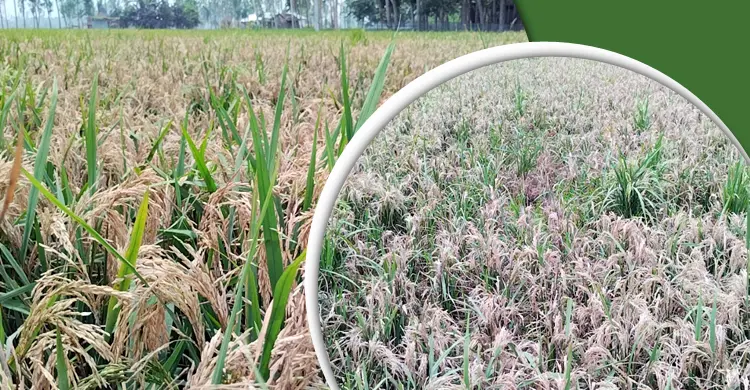
Gaibandha is known as the granary of the north, and every kind of crop is grown in its seven upazilas. This Boro season, blast and fungal disease have struck half-ripe Boro paddy in various parts of the district. The grains are drying into chaff, leaving farmers desperate as their golden dreams are ruined in the field.
Farmers say the damage happened because they did not get advice from the agriculture department in time. The department says farmers were discouraged from growing BRRI dhan28 and 29 but did not listen, and that led to the blast outbreak.
According to the district Department of Agricultural Extension (DAE), the target this season was to plant Iri-Boro paddy on 128,950 hectares in the district, but 128,205 hectares were planted, 745 hectares short of the target. Of this, Sundarganj upazila has 25,675 hectares, Sadar 21,069, Palashbari 12,617, Sadullapur 16,580, Gobindaganj 31,124, Saghata 14,912 and Fulchhari 6,228 hectares. The department has set a production target of 562,819 tonnes of paddy this year.
Heads turn white within days
The land has been planted with high-yielding hybrid Boro, and because the rice is fine and tasty, several high-yielding varieties including BRRI dhan28, BRRI dhan50, BRRI dhan81 and Surovi have also been grown. Where BRRI dhan28, 29 and 81 were planted, the panicles burnt into chaff as soon as they emerged, causing heavy losses.
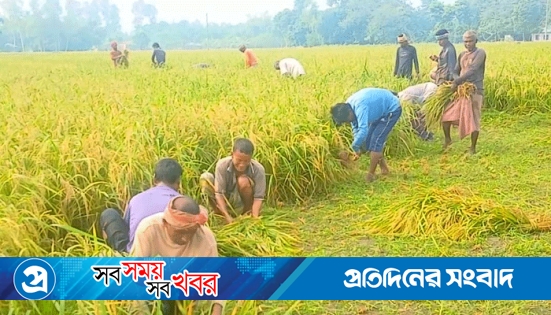
Farmers grew the crop despite a lack of irrigation water due to power shortages and a lack of rain. The harvest was due across the district within a week or two, but blast struck first. Affected panicles are ruined within three or four days, new fields are infected every day, and thousands of farmers fear losses.
In the fields, the panicles are brown with black spots at the neck. From a distance the paddy looks ripe, but it is actually rotting. In some fields about 80 per cent of panicles are ruined, and in many areas blast has spread down to the base of the plants. White heads have appeared even in high-yielding varieties. Repeated pesticide sprays have not brought the disease under control, and farmers are struggling to protect neighbouring fields. The district agriculture department has estimated the affected area, but it is several times lower than the area actually affected in the field.
Farmers say thousands face losses because of a lack of timely advice and proper pesticide management. Many grew the crop with loans and can do nothing as it is ruined before their eyes.
Farmers count their losses
Abdul Majid, a farmer from Bazarpara village in Ramjiban union of Sundarganj upazila, said: "Of my four bighas, I grew BRRI dhan81 on one bigha. Before it ripened, blast ruined the paddy on the whole plot. All the heads have turned white. I won't even recover the cost of production."
Manju Sarkar of Dhumaitari village in Dahbanda union of the same upazila said: "I grew it on borrowed money. Suddenly blast finished everything. I applied several pesticides but they didn't work. Black spots form at the base of the panicle and the head droops. If I had got advice in time, some paddy could have been saved."
Abdul Malek of Badiakhali village in Sadar upazila said: "The paddy on a bigha and a half is almost all ruined. I won't get even 10 kg in all. I've lost everything. I took a loan from an NGO to grow it. How will I repay it now?"
Nazrul Islam of West Kumargari village in Palashbari upazila said: "I grew BRRI dhan81 and hoped for about 29 maunds of paddy. Blast has ruined 90 per cent of that field. Even pesticide couldn't save it."
Sundarganj upazila agriculture officer Md Rashidul Kabir, an agriculturist, said: "We are going to the field and advising farmers on preventing blast and other diseases. Blast is a fungal disease, so fields must be sprayed regularly every month. Then the crop will not be damaged."
Md Khorshed Alam, deputy director of the Gaibandha district DAE, said: "This season BRRI dhan28 has been grown on 119,600 hectares in the district, of which 22 hectares have been attacked by blast. The agriculture department is giving regular advice, and awareness leaflets are being distributed to protect the crop."
Source: Jagonews24. First published in Bengali on The Agro News.
Comments
(0)