
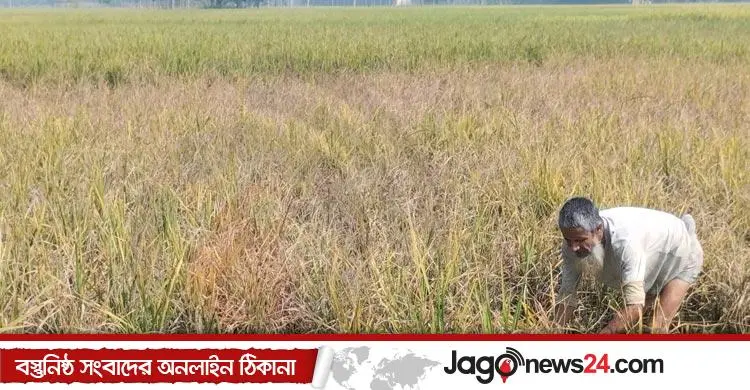
An unknown disease has broken out in aman paddy fields across all seven upazilas of Gaibandha. The leaves of affected plants dry out and turn brown within two weeks, and plants are dying before the panicles form. Farmers say pesticides sold in the market have not saved their crops, and they are at a loss. If the disease is not brought under control, output could be badly hit and farmers could face serious losses.
Farmers say they spent Tk 8,000 to 10,000 per bigha, but do not expect even one maund of paddy per bigha. The agriculture department, on the other hand, says this is not a major disease: leaves are turning reddish because of a lack of needed rain and plant nutrients, and because of farmers' faulty care it will take a little time for them to turn green again.
According to the district Department of Agricultural Extension (DAE), aman has been planted on 1,33,125 hectares in the district's seven upazilas this season, with a production target of 6,42,994 tonnes.
Farmers say pesticides have failed
Farmers say the disease appeared about two months after transplanting. They say no one from the agriculture office came to advise them or check on them, so they bought pesticides from shops and applied them on their own, without effect. There is no grain on the plants and they do not know why. They planted aman on borrowed money and had hoped to repay their debts by selling the harvest.
Komol of Rifaitpur in Gaibandha Sadar upazila said: "I planted paddy on borrowed money. Some unknown disease has struck the paddy and nobody can identify it. We will face a big loss on paddy this time."
Chhamchhuljaman Marju of Purba Kumargari in Palashbari upazila said: "I planted aman on about 5 bighas this year and spent about Tk 50,000 to plant it. The paddy on all of it is ruined. I don't expect a single chhatak of paddy from the 5 bighas. I applied a lot of pesticide, but it didn't work. Even cows won't eat the affected plants. The fields are dying before my eyes."
Abdul Aziz of Halimnagar said: "On my 65 decimals, brown spots first appeared on the leaves, and then the whole leaf dried up. I don't understand what the disease is. I informed the agriculture office; they came and looked, but no effective measure has come yet. There are about 300 bighas in the Tulam beel, and the paddy on all of it is in the same state. We want people from the agriculture office to come and find out why this happened. We want compensation from the government."
Khushi Mia of Bharatkhari village in Saghata upazila said: "I have no land of my own. I grew paddy on about 1 bigha 17 decimals of sharecropped land. About 20 days ago the disease suddenly appeared. I used pesticide, but I still cannot save the plants."
Ujjal Mia, a farmer of Kochasahar village in Gobindaganj, said: "We work hard all year to farm, but if the paddy is ruined by a disease like this, it will be hard to run our households. The government should act quickly."
What officials say
According to experts, weather irregularities caused by climate change, excessive rain and swings in temperature are among the main reasons new paddy diseases spread. Without quick diagnosis and remedial action, aman production could be badly affected not only in Gaibandha but in neighbouring districts too.
Md Rostom Ali, additional deputy director of the DAE's Gaibandha office, said: "Field-level officers have collected samples of affected paddy from different areas. The preliminary assumption is that the plants are infected with bacterial leaf blight."
He said: "The fields are waterlogged and unsuitable for paddy cultivation. Because nutrients were not applied to the transplanted aman seedlings, their growth is being hampered, and as a result the panicles or leaves are becoming diseased. Our field workers are keeping in regular contact with farmers about the disease."
Source: Jagonews24. First published in Bengali on The Agro News.


Comments
(0)