
By Umme Salma
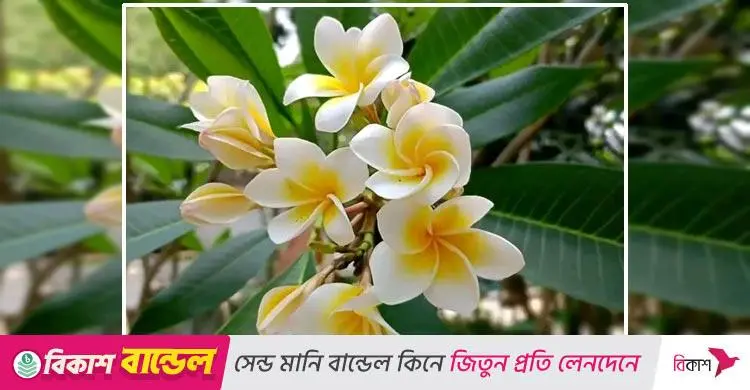
Kathgolap (frangipani) is a much-talked-about flower. The name, which means "wooden rose", makes you think of a rose made of wood, and the word rose brings to mind clusters of red petals on a thorny bush. But a "rose" also grows on tall trees without red petals or thorns, and that is the kathgolap. The flower has no connection with the rose, yet everyone knows it by that name.
The tree stays leafless through the year, and the touch of the monsoon seems to bring it back to life. Green leaves and flowers of red on white double its beauty. The flowers come in many colours: some pure white, some white with yellow markings, others reddish pink. Near or far, these colourful blooms easily catch the eye, and people are often seen holding photo sessions among them.
Origins and species
Kathgolap is originally a flower of the tropical Pacific region. Its English name is frangipani; it belongs to the family Apocynaceae and the genus Plumeria. It came to this country by way of Mexico, South America, the Caribbean, Venezuela and southern India. The plant has many species, and depending on the species the tree can grow 8-10 feet tall. Leaf shapes vary too: Plumeria rubra has pointed leaf edges, Plumeria obtusa rounded leaves and Plumeria pudica spoon-shaped leaves.
The tree flowers throughout the year, but in summer, the monsoon and autumn it is covered in blossom. Depending on the region, the flower is also known as kathchanpa, gulachichanpa, golokchanpa, chaltagolap, garurchanpa, gulach and golaich. The tree has some medicinal properties.
How to grow it
The tree is propagated from cuttings, by vegetative propagation and from seed. March-April is the best time to plant it. A raised spot should be chosen, and it needs enough light, air and water. It can be planted at homes, in the gardens of institutions and in tubs on rooftops.
You can buy one from a nearby nursery and plant it in a tub, or grow a new tree from seed or a stem cutting. In summer and the monsoon the kathgolap spreads its charm, a unique form of beauty.
The writer is a student at Chittagong College.
Source: Jagonews24. First published in Bengali on The Agro News.

Comments
(0)