
Bangladesh is a land of rivers, with more than 45 lakh hectares of water area. In the monsoon, large parts of Gopalganj, Jhalakathi, Barishal, Pirojpur, Satkhira, Chandpur, Cumilla, Brahmanbaria, Netrokona, Kishoreganj, Sunamganj, Habiganj and many other districts are waterlogged, staying under water for about six months a year. During that time there is no farm work and no crop, and people live without work. The water is covered with water hyacinth and other aquatic weeds.
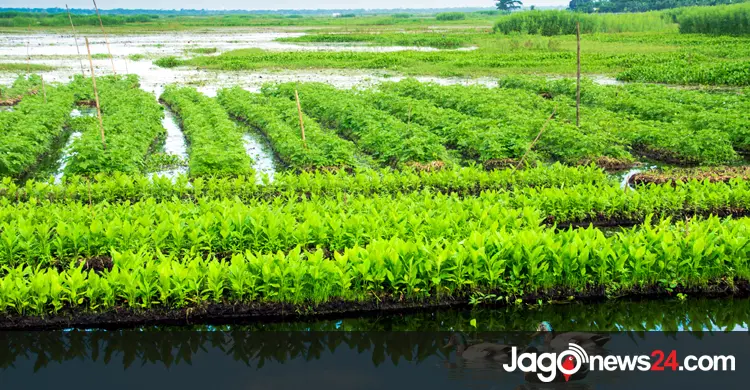
Farmers in the south devised floating agriculture themselves to meet their own needs. The waterlogged areas of these districts, especially beels, haors, canals, ditches and derelict ponds, are choked with water hyacinth and other aquatic weeds. Farmers now pile these up scientifically into raft-like beds of the required size and easily grow different vegetables and spices on them all year round. As a climate change adaptation strategy in flood-prone and waterlogged areas, floating vegetable and spice production, and in some cases raising Aman rice seedlings in emergencies, has opened a new era and new doors to agricultural prosperity. The practice is gradually spreading across waterlogged areas.
Aman seedbeds on floating beds
This year, on instructions from the top level of the Ministry of Agriculture, Aman rice seedbeds were made on floating beds in flood-hit areas. So far at least 800 floating beds have been used as Aman seedbeds. With floating seedbeds, 20- to 25-day-old Aman seedlings can be planted in the main field without delay as soon as the water recedes or submerged land re-emerges. No time is lost, Aman can be grown in step with the season, and the Aman yield is hardly affected. Even where rain and floods make it impossible to raise Aman seedbeds, farmers can plant Aman on time with seedlings raised on floating beds once the water recedes. This saves time and brings many benefits. The technology has already become quite popular and is benefiting agriculture and farmers in many ways.
Materials
The main material for a floating bed is water hyacinth. Duckweed, algae, various aquatic weeds, dulali creeper, rice straw or crop residues, sugarcane bagasse and sawdust can also be used. Beds made with mature, dark green, large and long water hyacinth last longer. Where dulali creeper is not available, jute rope is used instead to make balls of growing medium. Coconut coir dust is also used for raising seedlings.
Seed rate and care
As with ordinary seedbeds, the seed rate for a floating seedbed is 80 to 100 grams per square metre. Seedlings from 35 square metres, or about one decimal, of floating seedbed can plant one bigha. When the seedlings are 20 to 25 days old they can be lifted and planted in the field. This means the main field is no longer needed to raise rice seedlings, saving land, and farmers profit more by quickly growing the crop they want on newly exposed land. The seedlings are transplanted, cared for and managed like ordinary seedlings and give the same yield. Because the bed floats on water, irrigation is usually not needed, though water can be sprinkled occasionally if necessary.
In flood-hit areas there is usually no space for seedbeds in the monsoon, and after the floodwater recedes there is not enough time to raise seedlings. Beds made of water hyacinth and aquatic weeds allow sprouted Aman seed to be sown easily to raise seedlings in an emergency. Before sowing, however, the bed should be coated with a thin 2 to 3 cm layer of pond-bottom mud or soil slurry to make a wet seedbed. To keep the bed from being swept away by floodwater, it must be tied to a stake with rope. After sowing, care must be taken that birds or anything else do not destroy the seeds.
Higher yields and organic matter
Because floating beds are rich in the nutrients plants need, seeds can be sown or seedlings planted more densely than on level ground. The high organic content also makes crops grow faster than in conventional fields, and in many cases yields are about three to five times higher. When the water level falls at the end of the flood and the beds settle on the ground, they can be broken up and spread on the land or mixed into the soil to grow different crops successfully. At the end of the season, rotted water hyacinth can also be used as fertiliser at the base of fruit trees to raise fruit production.
Cultivated land in Bangladesh does not receive the organic fertiliser it needs. In this situation, using water hyacinth from waterlogged low-lying areas to grow vegetables and spices would supply nutrition through safe vegetables and spices, as well as monsoon Aman seedlings. Using rotted water hyacinth as organic fertiliser would raise soil fertility and productivity, increase output and contribute to organic, environment-friendly farming. It saves land and gives a chance to use fallow land.
By following this method, farmers can make up their losses, do many kinds of work, get the yields they want and profit more. Farming on floating beds will save time, let cropland be used earlier, cut costs, raise profits and further expand environment-friendly agricultural production.
Source: Jagonews24. First published in Bengali on The Agro News.

Comments
(0)